
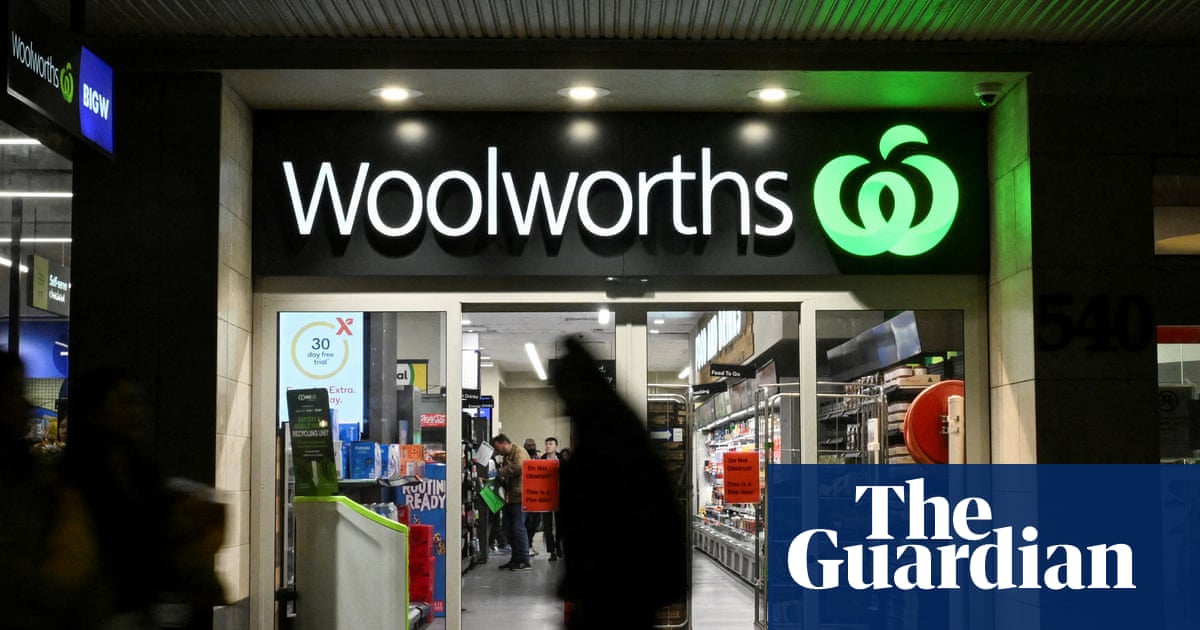
A senior Woolworths executive has defended relaxing rules designed to protect shoppers from misleading discounts by preventing the supermarket or suppliers from “gaming” the “Prices Dropped” promotional program.
Woolworths’ chief commercial officer, Paul Harker, gave evidence on the second day of a landmark trial between the Australian Competition and Consumer Commission and Woolworths in the federal court on Wednesday.
The ACCC has accused Woolworths of using the promotional scheme to disguise planned price increases with outsized, short-term spikes before reducing products to a supposedly discounted price that was actually higher than the original shelf price.
Under cross-examination, Harker, who has worked in the Woolworths head office since 2000 after starting as an in-store staff member in 1993, acknowledged that he had ultimate responsibility for the “Prices Dropped” program.
The ACCC alleges that, between September 2021 and May 2023, Woolworths temporarily increased the prices of at least 266 products before placing them on “Prices Dropped” promotions to make shoppers think they were getting a discount.
Additionally, the ACCC alleges Woolworths “contravened” its own internal policies, known as “guardrails”, which determined how long a a product had to stay at a certain price before it could be placed on promotion.
The consumer regulator says Woolworths relaxed the guardrails that had meant products had to be sold at one price for at least nine months before they could go on sale, reducing the required timeframe to six months and then eight to 12 weeks.
Ultimately, the ACCC alleges Woolworths changed its policy so that products could be placed on promotion – including as part of “Prices Dropped” – after just three to six weeks at one price.
Harker on Wednesday conceded the rules had been changed, but said they had been introduced in a low-inflation environment.
“As inflation continued to grow and grow and grow we revised these policies as we moved away from a set of policies that were about managing team and supplier dynamics to what does it actually mean at the shelf for a customer,” he said.
“And that’s how we arrived at our final ‘price trust policy’ of three to six weeks.”
He told the court the longer price establishment period had been designed to encourage a long-term commitment to the program by discouraging suppliers from cycling products on and off it.
“It was a disincentive for people to try to move things on and off the program without a legitimate commercial justification,” he said. “If you were, you couldn’t game the system.”
The guidelines were intended to protect consumers from misleading discounting by ensuring products were sold at a stable price for a reasonably long period of time before they were put on sale.
How long Woolworths took products on and off the “Prices Dropped” program is central to the case, because the ACCC is alleging the supermarket deliberately used a short window to make products appear cheaper once they were put back on sale.
The 266 products identified by the ACCC were sold at one price for 180 days or longer, before their prices were increased by at least 15% – but only for a period of 45 days or less.
Woolworths then placed the items on the “Prices Dropped” promotion at a price higher or equal to the first long-term price, and in many cases had negotiated the different pricing phases with suppliers well in advance.
Disclaimer : This story is auto aggregated by a computer programme and has not been created or edited by DOWNTHENEWS. Publisher: theguardian.com



