Updated ,first published
OpenAI will apologise to Australians for its AI models accessing government websites they were never directed to, and concede it “should have handled our response better”.
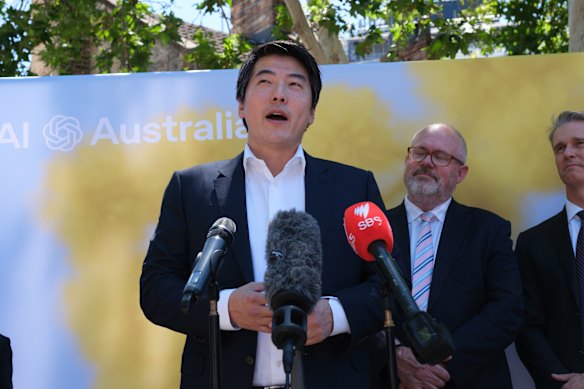
Chief strategy officer Jason Kwon will tell the parliament’s Joint Select Committee on Artificial Intelligence, sitting in Sydney on Tuesday, that the company is sorry and has “work to do to rebuild trust with the Australian people”, according to opening remarks seen by this masthead.
Kwon, who appears at 2pm, will say OpenAI has paused training on some frontier models while it strengthens its infrastructure, monitoring and approach to alignment. He will be joined by Adam Cohen, OpenAI’s head of economic policy, and Peter Anstee, its national security lead for the Asia-Pacific.
He will commit resources to affected agencies through OpenAI’s $1 billion Daybreak cyber defence fund, and announce a local taskforce of independent Australian experts that will report by the end of the year.
His statement does not mention Medicare by name. Prime Minister Anthony Albanese revealed last month that an OpenAI agent accessed public and non-public files on the Medicare Statistics Reporting Service portal in June. Rival Anthropic fronts the committee at 12.10pm.
Before the AI companies appeared, the music rights body APRA AMCOS warned the federal government against “caving to pressure” from US tech giants, as creative groups told the hearing that AI companies must pay to train on Australian work.
Jonathan Carter, the chief operating officer of APRA AMCOS, said international music publishers were alarmed by reports the government was considering changing the Copyright Act. He said the change would let AI firms train on the world’s music in Australia with fewer obligations than in the US.
“Foreign investment by AI companies here should be on Australian terms,” he said.
Australian Copyright Council chief executive Eileen Camilleri said letting developers use creative work without permission or payment posed “an existential threat” to the sector. She welcomed the government ruling out a text and data mining exception.
Arts Law chief executive Louise Buckingham described the use of artists’ work by tech companies as an “unparalleled” trampling of their rights.
Earlier, the ABC told the hearing it has no plans to replace any of its on-screen newsreaders or journalists with artificial intelligence, and asked for help getting tech companies to pay for its content.
“To be very clear, the guidance that we give to our editorial staff makes very, very clear that they are not to create replicas of people or their voices without very careful consideration,” said David Sutton, the ABC’s senior executive for policy and regulatory affairs.
“I can envisage particular contexts in program-making where that might be necessary. But fundamentally there’s no plan to recreate our newsreaders or anything like that.”
The ABC’s head of legal for content, Kate Gilchrist, said there was a “lot at stake” for media companies. That includes making sure audiences understand what content is produced by the ABC, and that there is a “financial return” on content created with public money.
The ABC has no control over how its content is being used by AI “to control the integrity, accuracy, impartiality of the content, and the independence of the ABC”, Gilchrist said.
The executives pointed to the Epstein files as an example of how AI can help journalists, with the technology able to sift very large collections of documents and surface material for reporters to examine more closely, Sutton said.
“Enormous troves of documents, and I think half the world turned around and threw AI engines at that [the Epstein files] much in the same way that I think they wish they could have done with the Panama Papers,” Sutton said.
The ABC has sought to negotiate arrangements with major tech companies to be paid for its content but those talks have had little success so far, Sutton said.
“Some assistance in making that happen would be wonderful,” he said.
More to come
The Business Briefing newsletter delivers major stories, exclusive coverage and expert opinion. Sign up to get it every weekday morning.
 David Swan is the technology editor for The Age and The Sydney Morning Herald. He was previously technology editor for The Australian newspaper.Connect via X or email.
 Calum Jaspan is a media writer for The Sydney Morning Herald and The Age, based in Melbourne. Reach him securely on Signal @calumjaspan.10Connect via X or email.
From our partners
Disclaimer : This story is auto aggregated by a computer programme and has not been created or edited by DOWNTHENEWS. Publisher: www.smh.com.au