
The 2026 World Cup was everything the expanded format promised and several things nobody quite expected.
Spain arrived as European champions and left New Jersey as world champions, beating Argentina 1-0 in a scrappy final.
England reached their best World Cup finish since 1966, beating France 6-4 in a breathless third-place match in Miami.
Norway, at their first World Cup since 1998, reached the quarter-finals and knocked out Brazil in the process. Erling Haaland turned the tournament into his own private record book.
The United States, playing on home soil, went out to Belgium 4-1 with politics overshadowing the football, and Mauricio Pochettino’s tenure ended without the historic run the host nation had dreamed of.
Portugal were beaten by Spain in the last-16, and Germany were stunned by Paraguay. The chaos of a 48-team competition delivered exactly the kind of upsets and surprises its architects had promised.
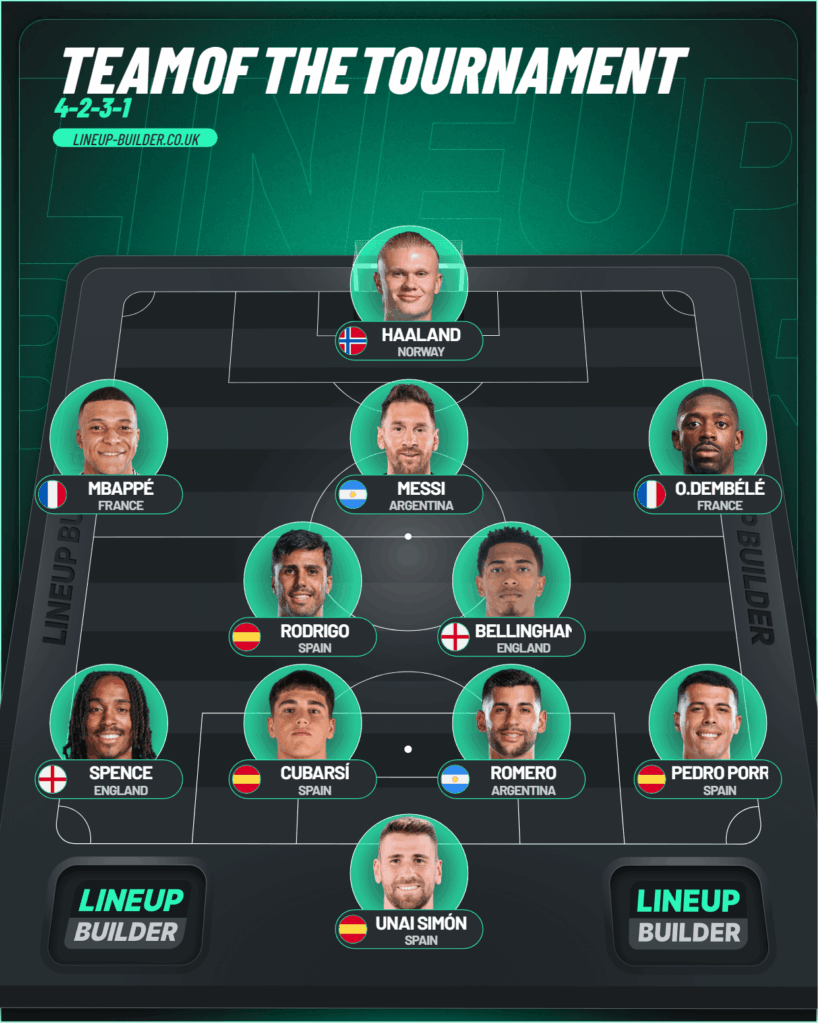
Here is our team of the tournament, in a 4-2-3-1 formation.
Table of Contents
GK: Unai Simon (Spain)
The easy read on Spain’s tournament is that their goalkeeper had little to do.
In truth, Unai Simon was authoritative throughout, commanding his area with the quiet assurance of a goalkeeper completely at home on the biggest stage.
Spain conceded just one goal across the entire knockout phase, and the defensive organisation in front of Simon was as much a product of his direction from the back as it was of Cubarsi and Laporte’s excellence ahead of him.
In the final, when Emiliano Martinez was making saves that drew gasps, Simon barely had his gloves tested, but he still walked away with the Golden Glove.
RB: Pedro Porro (Spain)
Porro announced himself to a global audience at this tournament and left it as one of the best attacking right-backs in the world.
His goal in the 58th minute of the semi-final against France settled the tie and sent Spain to the final. He was equally impressive throughout the group stage and into the knockout rounds.
He ranked third in Spain’s internal FIFA Power Rankings for the tournament, behind only Rodri and Cubarsi, which tells you everything about his quality this summer.
CB: Pau Cubarsi (Spain)
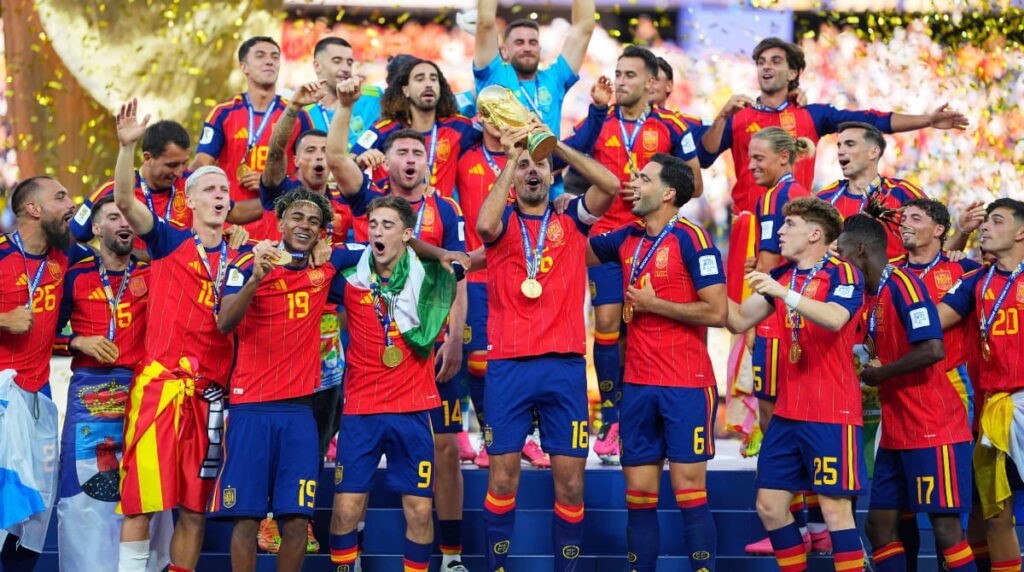
Nineteen years old. Every minute of every game. Six clean sheets in seven matches. Those three facts alone would justify the inclusion, but the Cubarsi story at this tournament was about considerably more than the headline numbers.
He played 566 passes across Spain’s campaign, more than any other outfield player, completed more through balls than any other player at the tournament and was, according to Opta’s group-stage team of the tournament, the only player under 20 in their best XI alongside Messi, Mbappe, Haaland and Vinicius.
Against France in the semi-final, he held Mbappe scoreless. In the final, he was on the receiving end of the Enzo Fernandez challenge that produced Argentina’s red card and changed the match.
Cubarsi broke Sergio Ramos’s record as Spain’s youngest-ever defender, won an Olympic gold medal at 17, and has a €500 million release clause at Barcelona. He is 19. The sport has not produced a centre-back quite like him in a generation.
CB: Cristian Romero (Argentina)
The man who almost opted to skip Spurs’ relegation decider in May somehow became the defensive heartbeat of a run to the World Cup final two months later.
Romero arrived in North America carrying the baggage of a difficult club season, a torn MCL injury in April and questions about his commitment.
Against England in the semi-final, he was extraordinary. He could not prevent Torres’ winner in the final after leaving the pitch with a knock, but he gave everything in a campaign that reminded the sport of exactly how good he is at his best.
LB: Djed Spence (England)
Nobody on this list attracted more scepticism before the first ball was kicked. Spence’s inclusion in the England squad over Trent Alexander-Arnold was one of the most criticised selections of the summer, and the Spurs full-back arrived in North America carrying the full weight of that noise.
What followed was one of the great individual tournament redemption stories. He was used across both flanks by Thomas Tuchel, defensively elite whenever called upon, and produced the defining moment of England’s semi-final campaign against Argentina in a last-ditch tackle on Giuliano Simeone at a point when the tie was hanging by a thread.
His performances against Norway in the quarter-final and Mexico in the last-16 were crucial to England reaching the last four.
CM: Rodri (Spain)
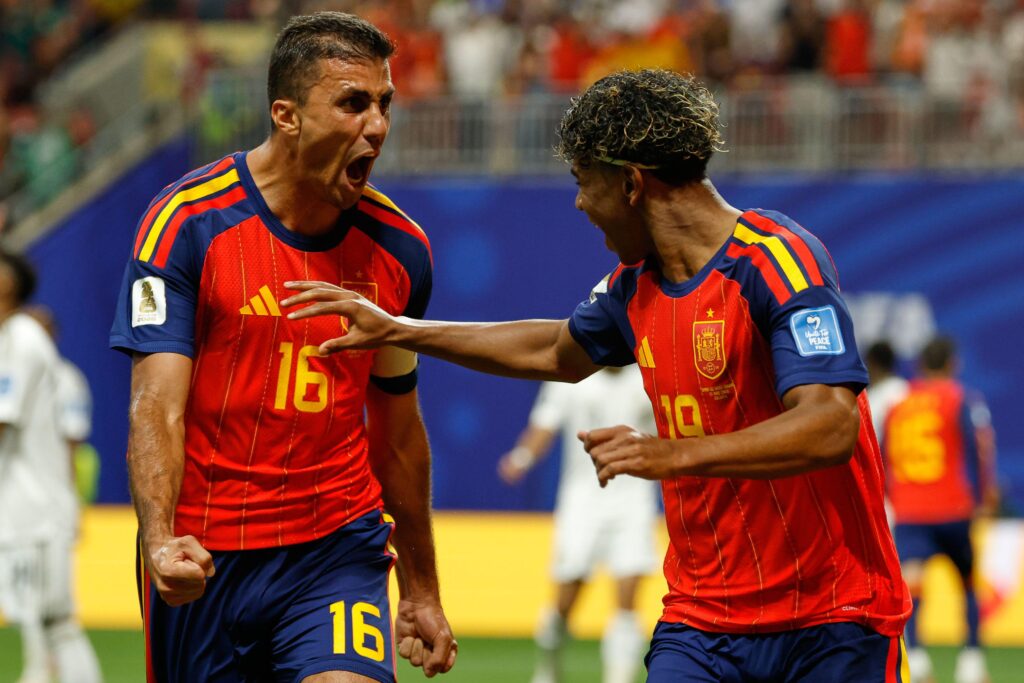
Rodri was the quiet engine beneath everything Spain did at this tournament. In a squad full of technically gifted, eye-catching players, he was the one who controlled the pace, the tempo and the structure of every match Spain played.
His passing accuracy never dropped below 93% across seven games. He pressed without losing position, covered the ground behind Spain’s more adventurous midfielders and dictated when the team sped up and when they slowed down.
Against Argentina in the final, when Scaloni’s side tried to press high early in an attempt to disrupt Spain’s rhythm, Rodri simply bypassed the press and recycled the ball until the space opened.
He ranked first in Spain’s FIFA Power Rankings for the tournament. There is not a better defensive midfielder at a World Cup in recent memory.
CM: Jude Bellingham (England)
No midfielder has ever scored more goals at a single World Cup. Six goals across six matches, with an another goal in the third-place match against France to add to the tally, took Bellingham to seven direct contributions at a tournament where only three forwards, Messi, Mbappe and Haaland, scored more often.
He opened England’s tournament with the winner against Croatia, scored twice in 98 first-half seconds against Mexico in the last-16 to become the first player to score two goals in a match at Mexico City Stadium in a World Cup since Diego Maradona in 1986, then scored twice again against Norway in the quarter-final.
He won four Man of the Match awards. He became the youngest player in history to reach ten World Cup appearances, aged 23 years and six days.
CAM: Lionel Messi (Argentina)
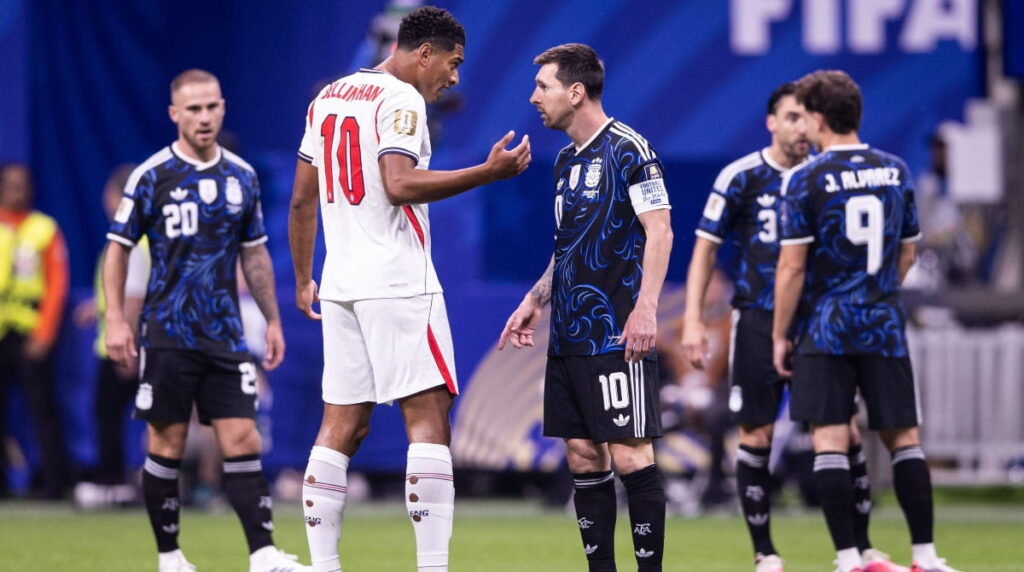
Eight goals. Four assists. Twelve goal contributions, more than any other player at the tournament. His first World Cup hat-trick, scored against Algeria in the group stage opener after 31 appearances across five previous tournaments without one.
He broke Miroslav Klose’s all-time World Cup goals record against Austria to take his tally to 21. He scored or assisted in 11 consecutive World Cup matches. He has 10 knockout stage assists, six more than any other player in the recorded history of the competition.
Against England in the semi-final, with five minutes remaining and Argentina losing, he rolled the ball back for Fernandez’s equaliser and then crossed for Martinez to head home in stoppage time.
At 39 years old, in what was almost certainly his final match in a World Cup, against Spain in the final, he was held without a shot on target for the first time in the tournament. It did not diminish a single thing he did before it. He is the best player in the history of this competition.
RW: Ousmane Dembele (France)
Dembele arrived in North America as the reigning Ballon d’Or winner and had, across 19 consecutive major international tournament appearances before this summer, scored precisely zero goals.
He scored a hat-trick against Norway in the first 32 minutes of France’s final group game, the second-fastest hat-trick in World Cup history after Austria’s Erich Probst in 1954, the first by a Ballon d’Or winner since Cristiano Ronaldo against Spain in 2018 and the first first-half hat-trick at a men’s World Cup since Oleg Salenko in 1994.
He finished the tournament with seven goal contributions, adding further goals against Iraq and in the knockout stages.
LW: Kylian Mbappe (France)
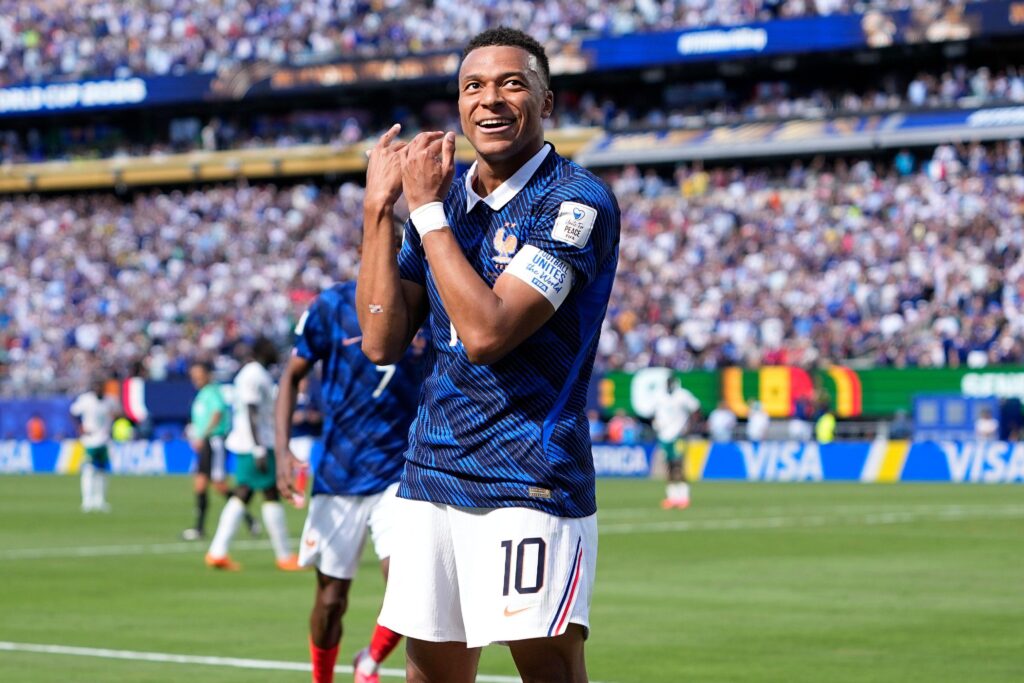
France’s captain finished with 11 direct goal contributions, second only to Messi in the entire tournament, and was the central figure in the most explosive attacking team at the competition.
His assists for Dembele’s hat-trick against Norway were as impressive as any of the goals he scored himself.
He was electric against Senegal in the group stage, decisive against Morocco in the quarter-final and was the player Spain most feared going into the semi-final.
ST: Erling Haaland (Norway)
Seven goals in five matches. A conversion rate of 39 per cent from 18 shots. The best debut World Cup return since Grzegorz Lato’s seven goals for Poland in 1974.
He scored twice against Iraq on his first-ever World Cup appearance, once in the Round of 32 against Ivory Coast, twice in the dying minutes to knock five-time champions Brazil out of the tournament in the last-16.
Norway had scored five knockout stage goals in their entire World Cup history before this tournament.
He was the most physically intimidating forward at the competition, the most clinical in front of goal, and the single biggest reason a nation at the World Cup for the first time in 28 years reached the quarter-finals and had 80,000 people believing, right to the final whistle, that they could go further.
2026 World Cup Team Of The Tournament
Disclaimer : This story is auto aggregated by a computer programme and has not been created or edited by DOWNTHENEWS. Publisher: 101greatgoals.com




