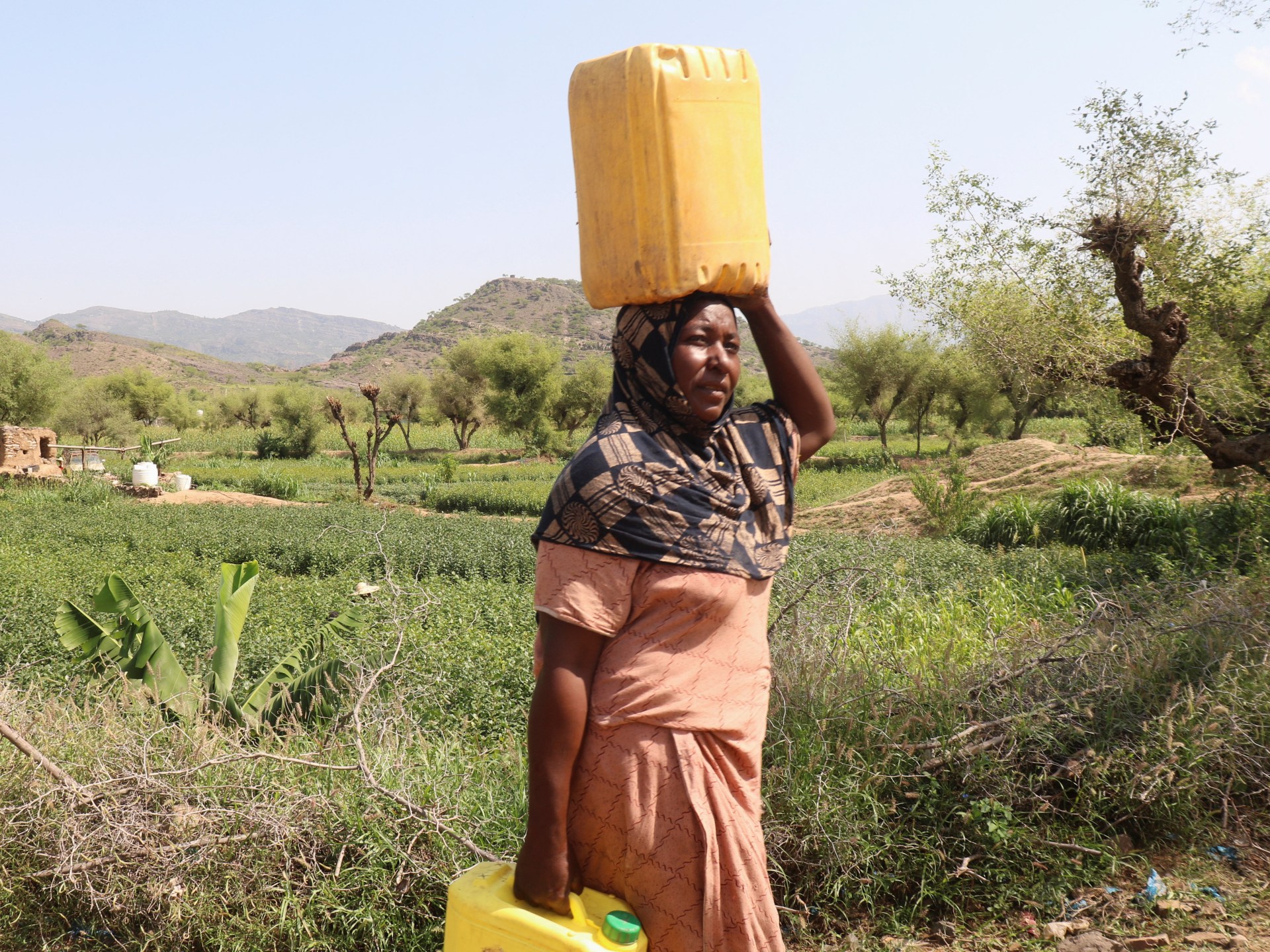
Taiz, Yemen – In mid-September, Mohammed started hearing the sound of shelling and gunfire in the distance from his village in the Jabal Habashi district of Taiz. By the following day, the fighting had intensified, and the sounds were drawing closer.
After four years of calm, Yemen’s return to violence had arrived at Jabal Habashi, where the Houthi rebels are attempting to advance in government-held areas. The fighting has left civilians, like the 39-year-old Mohammed, afraid of moving around their homes and farms.
Recommended Stories
list of 3 itemsend of list
Mohammed soon fled his village with his wife and child, heading to the city of Taiz. But Taiz, one of Yemen’s largest cities, is itself under threat from the Houthis, having sat on the front lines between the Yemeni government and the Houthis for the majority of the country’s 12-year war.
Mohammed has at least found shelter with one of his relatives, but thousands of others arriving in Taiz from the countryside are now staying in displacement camps.
“I am lucky to have a relative who can accommodate me even temporarily. I cannot stand life in crowded camps lacking access to food, healthcare and sanitation,” Mohammed told Al Jazeera.
Mohammed is part of a wave of displacement in Taiz and other conflict-affected parts of Yemen, increasing pressure on already overstretched humanitarian services.
The wave began when the Houthis made a rapid advance in September, taking over the entire Red Sea coast of Yemen and tightening their grip on the Bab al-Mandeb strait, a vital international shipping route.
Advertisement
With roads and port operations affected by war, providing aid for the thousands of Yemenis living in the makeshift displacement camps has now become a pressing concern for the government and humanitarian groups.
‘Agony and death’
Internal displacement from the most recent bout of fighting could swell to more than 230,000, the United Nations said on September 22, on top of the more than 5.2 million people who were already internally displaced in Yemen.
Mohammed Radman, a displacement coordinator with the Executive Unit for IDP Camp Management in Jabal Habashi district, has visited several of the displacement camps over the past few days.
“Road closures have caused indescribable human suffering in Taiz and elsewhere where fighting has erupted,” Radman told Al Jazeera. “Closed roads … sometimes mean death for civilians.”
Before the escalation in fighting, aid and essential supplies were able to reach Taiz with ease, he recalled.
“Now, travel is risky; travellers must navigate arduous, mountainous alternative roads,” Radman added. “Consequently, the volume of humanitarian aid reaching those in need has declined, and this has heightened the suffering of people, particularly the displaced.”
Abdulrahman, 34, was displaced from Taiz governorate’s al-Waziiya district two weeks ago. Today, he is in Taiz city, but he wants to go back to his home to get the possessions he left behind.
“If the roads were open as they were before the war, I would have gone to my house in al-Waziiya to bring my mattresses and cooking gas cylinders. Now, I am not sure I would be able to return safely. This reality makes it difficult for us to return to our areas,” Abdulrahman told Al Jazeera.
UNHCR in Yemen said last week that humanitarian operations in the country face severe constraints. The United Nations body cited several factors that limit and slow the delivery of life-saving aid, including active front lines, movement restrictions, telecommunications disruptions, and damaged roads and infrastructure.
Aid roadblocks
Ali Othman, a humanitarian activist in Taiz who has visited camps in recent days, said displacement was causing “real misery”.
“Most of these families fled with nothing but the clothes they wore; they escaped death,” Othman told Al Jazeera. “Many are living together, sharing tents.”
Othman listed other difficulties, including the burden on families hosting displaced relatives, and restrictions on movement because of the fighting.
“Roads are blocked or unsafe, and so displacement camps become isolated,” Othman said. “Humanitarian organisations fail to reach camps, and so aid may not reach the displaced at all; people in the camps suffer unseen and uncared for amid the chaos of the war.”
Advertisement
The cost of transporting food, medical supplies, and shelter materials rises as roads become closed or unsafe.
“Delivering humanitarian aid becomes increasingly challenging – or may fail to reach the intended recipients altogether,” Othman added.
The International Organization for Migration estimates that more than 22 million Yemenis, approximately half the population, are in urgent need of humanitarian aid.
Before the fighting and the Houthi takeover of Mocha city and port, a truck would take about three hours to travel from Mocha to Taiz city, according to Radman.
“Now the Mocha-Taiz road is closed. And a journey from Taiz to Aden requires six hours or more. Before the ongoing conflict, the same journey would have taken about two hours,” he said.
Declining imports
The renewed conflict is also affecting the flow of commercial goods into Yemen, increasing concerns about food availability and prices.
Wafiq Saleh, an economic researcher and executive director of the Taiz Centre for Yemeni-Gulf Studies, told Al Jazeera that the recent Houthi takeover of Mocha and the rebel group’s sporadic attacks on ships on the Red Sea led to a decline in the number of vessels arriving in Yemeni ports.
“The country depends on imports for nearly 90 percent of its food commodities,” Saleh said. “So, the shrinking quantity of imports and aid will worsen the humanitarian situation in the country. This will not hurt the recently displaced people alone. Its impact will reach other communities.”
A UN report indicated that wheat and flour imports fell sharply in August – before the most recent fighting on the Red Sea – down 48 percent month-on-month and 32 percent below three-year averages. Meanwhile, fuel imports, the report showed, collapsed even further – dropping 67 percent from July and 89 percent below historical averages, with no petrol or diesel reaching northern ports.
Mocha port was an important source of government revenue, and it was a critical supply line for food and aid.
“As [Mocha port] continues to be out of operation, the consequences on the humanitarian situation are crystal-clear, especially in areas that used to depend on it,” Saleh said.
On September 23, international humanitarian, development, and civil society organisations warned that the humanitarian crisis in Yemen was worsening, and called on world leaders attending the UN General Assembly to take urgent action to protect humanitarian aid and ensure its delivery, maintain essential services, and support a comprehensive, Yemeni-led peace process.
But on the ground in Yemen, the conflict shows no signs of abating, and instead has the potential to escalate further if the Houthis press ahead with their campaign to take more territory in Taiz, or if the government moves forward with its counterattack.
The displacement crisis will therefore likely worsen, even as humanitarian groups struggle to meet the growing needs.
Mohammed, having fled Jabal Habashi, said he was registered as a displaced person a week ago in Taiz city. But he is struggling.
Advertisement
“I have not received any aid, and I do not know whether I will receive any,” he said. “There is a sea of displaced people.”
Disclaimer : This story is auto aggregated by a computer programme and has not been created or edited by DOWNTHENEWS. Publisher: aljazeera.com