This story is part of “Parenting: What Google Won’t Tell You” — The Better India’s people-led parenting series that goes beyond conventional advice to document how real families are actually raising their children. Through real parents, parenting coaches, influencers and experts, the series brings honest, diverse and relatable perspectives on the questions, choices, challenges and solutions that shape everyday parenting — the things Google can’t always answer.
There is something special about the way children settle into a grandparent’s home. Breakfast somehow becomes a little longer, familiar faces multiply around the table, and everyday things — a cup of tea, a walk to the garden, a shared snack- turn into memories.
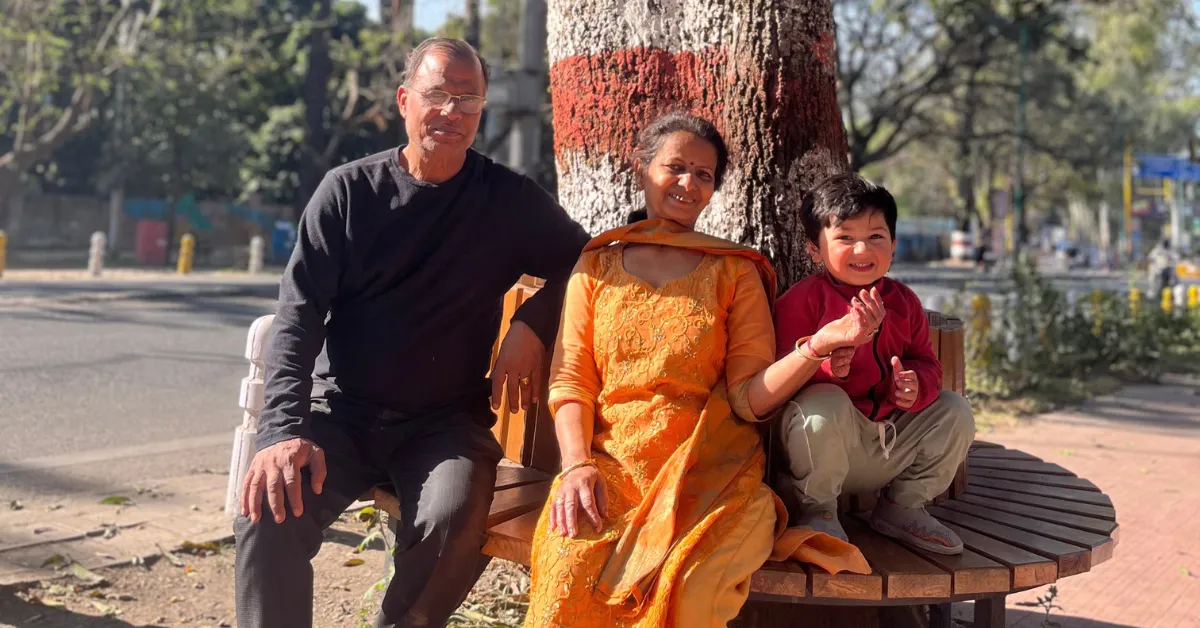
For four-year-old Udyan, a three-week stay with his Nanu-Nani (grandfather and grandmother) in Haridwar this July became just that. But what he brought back from their home was not a new chore or a particular habit. It was a deeper understanding of what it means to belong to many people at once.
“Udyan’s grandparents live in a beautiful haveli-like joint-family setup, with several families under one big roof,” says his mother, Khushboo Goel. “But what stands out is the bond that the families have built over the years and have stood by one another for decades.”
Udyan, who is about to turn four this month, is used to being involved in everyday life. Born in Dehradun, he lives with his parents at the beginning of Mussoorie, where long walks and household chores have been part of his childhood.
His parents, both of whom work from home, involve him in simple tasks — washing clothes, drying them in the sun, watering plants, helping with cooking, making tea and serving snacks to guests.
So, the grandparents’ homes did not necessarily introduce him to completely new activities. Instead, they showed him what those everyday acts can look like when an entire community practises them together.
A home where everyone belongs
At Nanu-Nani’s home in Haridwar, the idea of “my home” and “your home” almost disappears.
Udyan might have breakfast in one house and lunch in another. He may clean coriander at someone’s home, ask another family what they have cooked, or join a small gathering where someone has organised a samosa or tea party.
/filters:format(webp)/english-betterindia/media/media_files/2026/09/29/summer-vacations-2026-09-29-10-59-35.png)
“There is no keeping score of who did what for whom,” says Khushboo. “Someone might organise a samosa party, another a tea party, or simply make something Udyan asks for. They do these little things for one another naturally.”
For a child, there is no formal lesson here. He simply watches people make space for one another, help without being asked, and show up for each other.
“I think observation is one of the best teachers for children,” Khushboo says. “Nobody needs to sit Udyan down and explain love, compassion, sharing or caring when he is at Nanu-Nani’s.”
At Dadu-Dadi’s, the garden teaches too
Udyan’s other grandparents live in Dehradun, and his time with them brings a different kind of learning.
His Dadi loves growing vegetables in her kitchen garden, from ladyfinger and bottle gourd to mint, corn and leafy greens. Udyan gets to see the work that goes into growing something before it reaches the dining table.
/filters:format(webp)/english-betterindia/media/media_files/2026/09/29/summer-vacations-2026-09-29-11-00-12.png)
“We often talk about natural food and growing our own vegetables, but seeing his grandmother do it makes those ideas much more real,” says Khushboo.
It is another lesson without a classroom — watching, helping and understanding that food involves time, effort and care.
What he carries home
The biggest change Khushboo notices after these visits is not a new routine. It is how much Udyan misses the people he has spent time with.
And perhaps that is the most meaningful thing he has learnt.
/filters:format(webp)/english-betterindia/media/media_files/2026/09/29/summer-vacations-2026-09-29-11-01-50.png)
“My parents always told me, ‘You are not just my child; you are a child of everyone in the household,’” says Khushboo. “I grew up hearing this for the first 17 years of my life.”
Now, she sees a version of that idea unfolding in her own son.
At his grandparents’ homes, Udyan sees people giving without keeping score, finding happiness in small gatherings, growing food with their own hands and sharing what they have.
“He sees that doing things for others can itself bring happiness,” says Khushboo.
For Udyan, these may simply feel like long days at Nanu-Nani’s, time in Dadi’s garden and meals shared with people he loves.
/filters:format(webp)/english-betterindia/media/media_files/2026/09/29/summer-vacations-2026-09-29-11-05-29.png)
But for his mother, they are experiences that could quietly shape the way he understands relationships for years to come.
“Udyan gets to experience it without anyone having to explain it to him,” she says. “I believe it will shape how he sees life and builds relationships.”
All images courtesy of Khushboo Goel
Disclaimer : This story is auto aggregated by a computer programme and has not been created or edited by DOWNTHENEWS. Publisher: thebetterindia.com