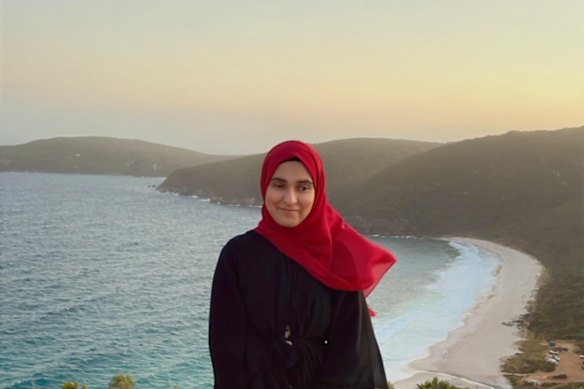

Sara Qalandari took on the role of a carer for her family when she was just 10 years old after they migrated to Western Australia as refugees.
The now 25-year-old learned English at school but no other family members spoke the language.
Her mother had several health conditions that required plenty of doctors visits, and her siblings needed help at school.
But mostly, Qalandari has looked after her brother, now 18, who lives with a congenital visual impairment.
“I go to all the appointments – NDIS, Centrelink, schools, doctors, I basically take care of all of that,” she said.
“I’ve actually done a degree in biomedical sciences. I’ve completed that in 2022, and I’m currently doing a Bachelor of Psychology part-time for now, but my main goal has always been to become a doctor.
“I’m trying to get into medical school, and that’s a big issue for me because it’s quite hard to compete on the same level as other applicants when you have so many responsibilities.
“The issues that you have, other people don’t have, and you’re competing in the same level – it has been very difficult for me to pursue my education.”
Qalandari, who is one of an estimated 40,000 young carers in WA, said she was advocating for a pathway for carers and for people with disability at university studying to become a doctor, so they had an equal platform to compete with other applicants. She has also advocated with politicians with little success.
“I’m really devastated about that because it’s very unfair that we have to choose between our career and care responsibilities, it shouldn’t be that way. We should be able to be caring for our loved ones as well as trying to pursue our dreams,” she said.
It’s not only education that has been more challenging for Qalandari, who initially struggled to reconcile the life of others her age with her own.
“Especially when I was younger, I was really looking at other young people my age and seeing them hanging out with their friends or travelling or socialising, and I couldn’t explain to them that I do want to join you guys, but I have responsibilities that I have to go home to,” she said.
“That was difficult because you can’t explain to people that you’re a carer, especially school-age kids. They don’t understand if they haven’t done caring.
“But there’s the other side of it that you’re building skills such as advocacy, empathy, communication, and so many other skills that come with it.”
She had also been able to meet other young carers through Care WA and the Youth Advisory Council.
“In 2024, I found out that I had been a young carer which is quite late to figure that out. I met other young carers, and I was like, wow, there are other people like me, and who have gone through the same difficulties and struggles and responsibilities that I have, it just gives you a sense of belonging,” she said.
“We need more awareness and recognition of young carers in the education system and in the healthcare system very early on – that’s how they can get the support they need and be connected with other young carers from the start.”
Carers Australia released its national Carers Wellbeing Survey on Monday which showed an increase in the number of young carers, aged 12 to 25, who felt they’d lost their childhood – up to 65 per cent from 54 per cent last year.
Fewer young carers felt included in planning and decisions about the person they care for, and less than half reported they were treated with respect or that their concerns were heard and acknowledged.
And more than 50 per cent said they found navigating government systems challenging.
Access to peer supports is also declining, with only 17.9 per cent reporting being able to connect with other young carers.
Carers Australia chief executive Joanna Cave said the findings demonstrated why carers needed greater recognition and support.
“There’s a direct correlation between someone providing unpaid care and how their wellbeing is compared with someone in the population that isn’t performing that role – their financial stability, their physical health, tracks at lower levels which is a major concern,” she said.
“It’s not a question of them being unwilling to do it, but the choice they make to become a carer is what we call a constrained choice.
“It often arises suddenly if someone has an accident or a serious health diagnosis, and they very quickly have this new job they had no qualifications for.
“They’re often unsupported in that role, and because they’re unsupported they’re often invisible within our society.”
She said there was particular concern for young carers because “they miss out on time with friends and all the social and sporting activities that regular kids do, if they spend a lot of time providing care”.
“Young carers start that role as young as seven and often keep doing it right through to their early 20s, depending on their particular circumstances,” Cave said.
Young carers can access financial supports like the Government funded Young Carer Bursary and access support and information through the Young Carer Network.
There are also some supports available through Carer Gateway like counselling, coaching, peer support and referral to respite.
“These are both helpful initiatives, but we would like to see more,” Cave said.
“The kind of support that carers really ask for overwhelmingly is recognition that they exist. It can be incredibly frustrating to have to re-prosecute your role through all these systems.
“Your GP might recognise your role, but the school might not, so having that clarified and formalised would be fantastic.
“The other thing that carers are really crying out for is more flexible respite services – carers are often desperate for short breaks, but they’re not readily available.
“The absence of respite is something that we know really grinds carers down.”
 Holly Thompson is a journalist with WAtoday, specialising in education and the environment.Connect via X or email.
From our partners
Disclaimer : This story is auto aggregated by a computer programme and has not been created or edited by DOWNTHENEWS. Publisher: www.smh.com.au