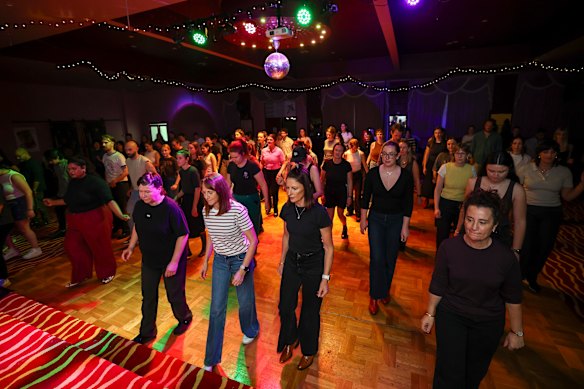

Standing in Brunswick’s Quadraphonic Club, it feels as if the energy in the room would be enough to fuel every data centre in the southern hemisphere.
It’s 8pm on a Thursday and an eclectic group of young and old Melburnians have congregated, some dressed in denim cutoffs and flannel shirts, others in silk shorts that catch the kaleidoscopic disco lights. Their cowboy boots and Doc Marten stompers move in synchronicity to Banoffee’s electro-pop track Muscles.
They step, stomp, tap and turn in unison, each beat of the song propelling them through the dance as their instructors yell from the stage in front, guiding them along the way. Occasionally, they’ll whoop or clap or cheer each other on.
“It’s just so happy and fun and welcoming,” Annabel Hickmott, 24, says of the Country Struts line dancing class she attends every week. Run by Alice Glenn and Abigail Varney, it’s one of the most popular line dancing collectives, drawing hundreds of attendees each week.
“And it’s still growing,” says Glenn.
Hickmott and her friends are enthusiastic, regular attendees at Country Struts, and part of the growing number of young people all over the world who are flocking to line dancing.
Whether it’s at a local town hall on a weeknight, at the club on a weekend or on social media feeds, young people can be found moving in sync to pop bops or classic electro tunes.
According to Eventbrite, line dance listings are up 165 per cent. The popularity is driven in part by social media and the return of the cowboy aesthetic, sent mainstream by Beyoncé’s Cowboy Carter and artists like Orvill Peck. But it’s also a continuation of the ongoing discussion among young people regarding their search for community and connection in the real world beyond their phones.
Unlike the line dancing communities of yore, these groups aren’t reserved for senior citizens: they are increasingly diverse and usually dancing to contemporary pop bops and bangers, modernising the tradition for the 21st century.
The history and exact origins of line dancing are hard to pinpoint. It can be traced it to the 90s country western tradition, all Achy Breaky Heart and Boot Scootin’ Boogie, or possibly the history of soul line dancing within the African American community who popularised the Electric Slide and the Cupid Shuffle. Australians have their own small affection for the dance, lest we forget the moves implanted in the memory of anyone who moved to the Nutbush at a school disco.
There’s also the rich lineage of queer line dancing, spanning dancers at the Imperial in 1980s Sydney to those in Los Angeles – the latter of which forms the subject of the 2024 documentary Stud Country.
Inspired by a Los Angeles Times article by Lina Abascal, Alexandra Kern’s short film introduces the queer line dancing community of LA, where a young generation took it upon themselves to revive the movement to preserve the places that enable fierce social bonds.
“We were drawn to the fact that this space was a place where there’s this physical way of connecting and feeling at peace for a moment, or feeling like there’s symbiosis with another next to you,” Kern says. “We were really interested in connecting the spaces where multiple generations could exist, and the ways tradition can persist, evolve and create belonging.”
It was Stud Country that inspired 37-year-old Marzy, who is not sharing her surname for privacy reasons, to start her own iteration in Sydney’s inner west, having grown up line dancing with her mother and grandmother.
“I remember thinking, ‘Oh my God, it’s amazing. I haven’t done this since I was young’,” says Marzy, who started Saddle Club with Charis in 2024, known for its love of pop hits from the likes of Chappell Roan and Robbie Williams. “It’s so cool seeing people get into this, but in particular, the queer community.”
Like Stud Country, Saddle Club is queer-led, but inclusive. “We’ve always been very intentional about saying that we’re a queer line dancing collective, but everyone is welcome and allies are more than welcome,” Marzy says.
“The other beautiful thing about it is it’s a queer space where it’s not necessarily a party or a bar. We love those things, but we also love trying to stay well.”
Studies have shown structured dancing, and line dancing specifically, is an ideal form of exercise. A 2017 systemic review published in Sports Medicine reported that dance interventions significantly improved body composition, blood biomarkers and musculoskeletal function and a 2024 study expanded on that research to find that dancing may be better than other forms of exercise for improving mental health.
Line dancing is certainly an excellent form of the moderate-vigorous physical activity health experts encourage everyone to do for 150 minutes each week, says Dr Alycia Fong Yan, the lead researcher on both studies and senior lecturer at the University of Sydney’s Faculty of Medicine and Health.
“Dance classes that are a bit more upbeat and higher intensity than just a gentle walk, so it’s going to be a way to get the heart rate up, to get a little bit breathless, to get sweaty,” says Fong Yan, who has been researching how people use dance as exercise in disguise for the past 10 years.
“That’s going to have all manner of different health benefits. If it’s line dancing where you’re a little bit more bouncy, you’ll get some bone health benefits too and if you’re in a group, you get the social benefits.”
There’s also no arguing with the unanimous enthusiasm of devotees who won’t hesitate telling you about the unadulterated joy that defines a line dancing event. “It’s really hard to be sad when you’re line dancing,” says Marion McGettigan, 29, who discovered first-hand the benefits after getting roped into an event by her friend a year ago.
“I actually resisted it for a long time because I had a lot of other extracurricular activities. But I went along to the Rising Festival event that Country Struts had last year, and I was like, ‘Oh my gosh, this is so much fun’,” says McGettigan, a teacher from North Melbourne.
She’s attended a class every week since, never missing a chance to line dance with her friends. “There’s almost like a moment of silence in the group chat when somebody can’t come because it’s like, ‘Oh, I’m so sorry, is there any way that you can move things around?’.”
The structure of line dancing – the steps are fairly straightforward, repetitive and not complicated – makes it particularly accessible for all. Twenty-seven-year-old PhD student Alix Crowe from Glebe, says this crucial element has even her most unco-ordinated friends, the ones who struggle to tell their left from right, attending a class.
“It’s so nice because you just do it, no one’s like looking at you, you’re just following the instructors and no one’s paying attention to the things that you’re doing wrong,” she says, noting a particular highlight is feeling all remnants of self-consciousness swept from the room as people attempt body rolls and kicks with earnest gusto.
“It’s just so endearing, and it’s so nice seeing that nobody makes fun of it, they’re just giving it a go.”
Marzy echoes similar sentiments. “It’s when you’ve accidentally turned the wrong way, so you’re facing someone, you have these incidental moments of connection and silliness. That’s pretty approachable for people.”
Above all else, connection is the recurring theme among line dancing acolytes.
One of Rufus Lowe’s favourite memories took place after a Saddle Club lesson in Marrickville. “I was sitting at the bar and everyone came over after packing up and wanted to learn more about me, so they invited me to have a drink with them,” says the 25-year-old bartender from Chippendale. “It was the community of this small world; laughing over being so in your head that you forget left to right and discussing what songs we like.”
In a world increasingly mediated by technology, where discussions are increasingly hostile, and every second person seems to be battling a different kind of digital addiction, line dancing offers a glimmer of the best parts of our humanity and the possibilities we unlock when we come together, united by the same dance moves across continents.
“We discover the best version of ourselves and become stronger together through having these third spaces where we connect and share in this collective joy,” Kern says.
Hickmott was recently reminded of just how profound the impact has been when she recently finished a journal.
Looking back through her first entries, Hickmott found a letter she’d written to herself a year ago. “One of the things I wrote was, ‘Are you still doing line dancing? If not, go to a class right now’,” she says. “I’m still doing it, and loving it even more.
“It’s really life-changing.”
Find out the next TV, streaming series and movies to add to your must-sees. Get The Watchlist delivered every Thursday.
From our partners
Disclaimer : This story is auto aggregated by a computer programme and has not been created or edited by DOWNTHENEWS. Publisher: www.smh.com.au