Updated ,first published
Victoria’s strained health system is under unprecedented pressure from a growing population that is sicker than ever before, causing ambulances to miss key response targets and hospitals failing to provide timely emergency care.
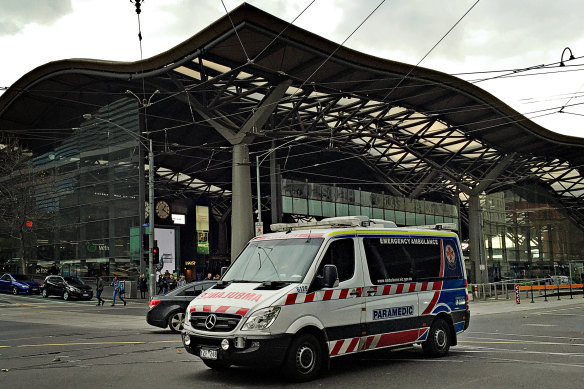
As the state government unveiled a new standard for the handling of Triple Zero emergency calls, Tuesday’s budget painted a grim picture of emergency care: with just 65 per cent of code one “lights and sirens” ambulance call-outs expected to be responded to within 15 minutes this financial year, compared with a statewide target of 85 per cent.
The budget allocates $32.3 billion into Victoria’s health system, with $1.6 billion of additional funding for hospitals and more than $50 million to allow paramedics to deliver faster care.
There is $284 million to open and expand health services such as a new emergency department at Werribee Mercy Hospital and additional services at community hospitals in Cranbourne and Craigieburn.
After years of lengthy, stressful delays to access colonoscopies in the public system, the budget includes $27 million to fund new equipment and endoscopy access teams to speed up detection and treatment.
More than $109 million will be spent over four years to improve access to planned surgery and specialist care for sick children.
Firefighter Brian Brewer welcomed a $65 million boost for regional hospitals to improve treatment and medical imaging, but said much more still needed to be done.
Brewer was rushed to the West Gippsland Hospital last week with pains in his chest and was shocked to be told that all beds were full.
“It was so busy in the emergency department they just said, ‘Sorry, there are no beds tonight.’”
The 59-year-old spent about 12 hours in the emergency department, and was ultimately put in a bed in the paediatric unit for monitoring after his heart rate dipped below 30 beats per minute.
“I just couldn’t believe how overrun it was in there,” he said. “It is such a fast-growing population out here, we desperately need more resources.”
Brewer, who was later diagnosed with a blood clot in his left lung, said he was deeply shocked by the experience.
“The entire hospital just needs replacing, and we’ve got bipartisan support but no one’s putting their money where their mouth is,” he said.
Meanwhile, people calling Triple Zero for patients showing “no sign of life” should have their call answered and an ambulance dispatched within 145 seconds, in a long-awaited overhaul of Triple Zero Victoria’s performance standards.
The new standard was unveiled in response to the pandemic-era collapse of Victoria’s emergency ambulance call taking system, linked to the death of 33 people. After the disaster, the service’s performance standards were declared unfit-for-purpose.
While there is no change to the agency’s strict call-answering benchmarks, including the requirement for 90 per cent of ambulance calls to be answered within five seconds, new rules will govern how long operators spend processing emergency calls and dispatching assistance.
For example, priority-one police calls reporting aggravated burglaries, violent offenders and life-threatening road crashes will have to be answered within five seconds, processed within 140 seconds and dispatched within 160 seconds in at least 80 per cent of cases.
A number of new quality-based standards will also be introduced. In 98 per cent of calls, operators will have to accurately pass on critical scene safety information for first responders.
“So, is it a petrol tanker? Is it a milk tanker? [That] makes a big difference to the responding fire crew. Or for ambulance, is it a hostile situation or non-hostile situation?” Victoria’s Emergency Management Commissioner Tim Wiebusch said in an exclusive interview with The Age.
Dispatchers will also have to pass on updates in a timely manner. For example, informing responders that a car involved in a crash has caught fire.
The changes to Triple Zero Victoria’s response standards respond to a 2022 review by former police chief commissioner Graham Ashton, which concluded the standards were “not fit for purpose” as they did not adequately measure patient outcomes. Ashton recommended new outcome-based performance standards be developed.
Wiebusch, who has taken a hands-on role developing the new standards since being appointed commissioner in June, said it was an exercise of balancing speed with quality.
“You can push the call takers to take calls in a very short time, but if the quality is not there, you just still end up with a poor response,” he said. “And similarly, if it’s less [emphasis] on the time and more on the quality, then it’s not happening quick enough.”
Under the new requirements for ambulance calls, the most urgent “priority 0” ambulance calls such as a cardiac arrest will have to be answered within five seconds, processed within 120 seconds and dispatched within just 20 seconds in at least 80 per cent of cases.
For the second most-serious category of ambulance calls, such as patients with chest pain and breathing difficulties, call takers will be given an extra 25 seconds to process and dispatch.
Previously these two categories were lumped together.
Triple Zero Victoria has been meeting its current call-answering benchmarks since August 2022, requiring 90 per cent of ambulance calls to be answered within five seconds. The most recent publicly released data shows that in June 2025, 92 per cent of ambulance calls were answered within five seconds.
However, data obtained by this masthead last year through freedom of information laws showed that among the remaining 10 per cent of calls that did not have to be answered within five seconds, there were thousands of ambulance calls still waiting more than a minute to be picked up.
This data echoed the Ashton review, which found that, even before the pandemic call-taking crisis, there were peak periods where calls were not being answered on time. The emergency service was still able to meet the overall standards by rostering extra call takers on at the end of each month to mask periods of “poor compliance”.
Asked if he had considered a change to address these outlier calls, Wiebusch said this 90 per cent benchmark should always be considered a minimum, and Triple Zero Victoria should be aiming to exceed it.
It had been decades since Victoria’s Triple Zero performance standards were meaningfully reformed, Wiebusch said. When they were initially developed, most people called the service using a landline, which was automatically attached to an address. Now, Wiebusch said 20 to 30 per cent of callers were unsure where they were.
Triple Zero Victoria’s new performance standards, which will largely come into force from July, will now be reviewed at a minimum of every five years. Come mid-2027, the agency’s performance standard results will also be published quarterly.
Danny Hill, secretary of the Victorian Ambulance Union, welcomed the new standards and said he hoped to never see another deadly collapse of the state’s emergency ambulance call taking system.
He also applauded a $9.7 million investment over two years to improve the way Triple Zero Victoria triages, reviews and classifies emergency calls.
Hill said paramedics were frequently being sent to non-emergency situations due to the risk-averse way in which calls were triaged.
He said some patients with sunburn and toothaches had been classified as the most urgent category 1 patients due to issues with the call-takers’ scripts.
“The system searches for the worst-case scenarios, not the most likely outcome,” he said. “This will ensure that crews are freed up on less urgent cases so they can get to the patients who need it most.”
Tuesday’s budget also included $10 million to continue a pilot to improve ambulance transfer times during busy periods in emergency departments.
More Victoria budget coverage:
 Aisha Dow is an investigative journalist with The Age. A Walkley award winner, she previously worked as health editor and co-authored a book about the COVID-19 pandemic in Australia.Connect via X or email.
 Henrietta Cook is a senior reporter covering health for The Age. Henrietta joined The Age in 2012 and has previously covered state politics, education and consumer affairs.Connect via X, Facebook or email.
From our partners
Disclaimer : This story is auto aggregated by a computer programme and has not been created or edited by DOWNTHENEWS. Publisher: www.smh.com.au