
There’s a cat-shaped kettle that’s been in my family for generations. It’s played the role of a timekeeper. Shaped like a Persian feline — the elongated bone china tail making for the perfect spout — ‘kitty’ has been guarded fiercely by each generation. As children, we weren’t allowed to play within proximity of the cabinet in which she lived, for fear that the ball would smash the glass, and she’d suffer a tragic death.
At every family function, stories would be exchanged around ‘kitty’. Everyone had something to contribute.
That’s the thing about heirlooms; they outlive certainty but hold on to memory. They gather meaning not from where they were born, but from the lives they witness along the way. And, in 2017, two friends, Aanchal Malhotra, an oral historian, and Navdha Malhotra, a social impact and development consultant, started a digital repository to give such heirlooms a space to speak. That brings us to the Museum of Material Memory.
Tracing family histories across collectibles
Does your family have a piece of history lurking in a cabinet, perhaps, or hanging on the wall of the living room, or stashed within a photo album?
That story can now have a stage. And the best part is that you can tell it yourself.
Aanchal explains, “The museum aims to allow people to tell their own stories. It is a collective endeavour, an attempt to create an organic archive of material culture, not shaped by any single individual, but built through a crowdsourced community.” The crowdsourcing isn’t just by way of the team identifying and responding to submissions, but also through a process of extraction of memories and stories that the contributors do along with their family members to put the piece together.
Aanchal continues, “Every story we encounter reinforces why such a collective is important. Each one carries a nuanced idea or a resurfaced memory that makes it unique and deeply relevant. The very act of writing these stories to preserve them for posterity gives them a fleeting quality, because if they aren’t told now, they may be lost forever.”
Today, the ‘museum’ boasts over 187 stories. And, the driving force behind accumulating more, Navdha shares, has always been a sense of curiosity.
“Everything that can seem so ordinary is extraordinary in certain ways,” she smiles, crediting their “time-intensive” documentation process for unearthing unusual narratives. “I really like hearing our writers say, ‘Oh, this is something that surprised me and stayed with me,’ because very often that’s not their starting point,” Navdha elaborates.
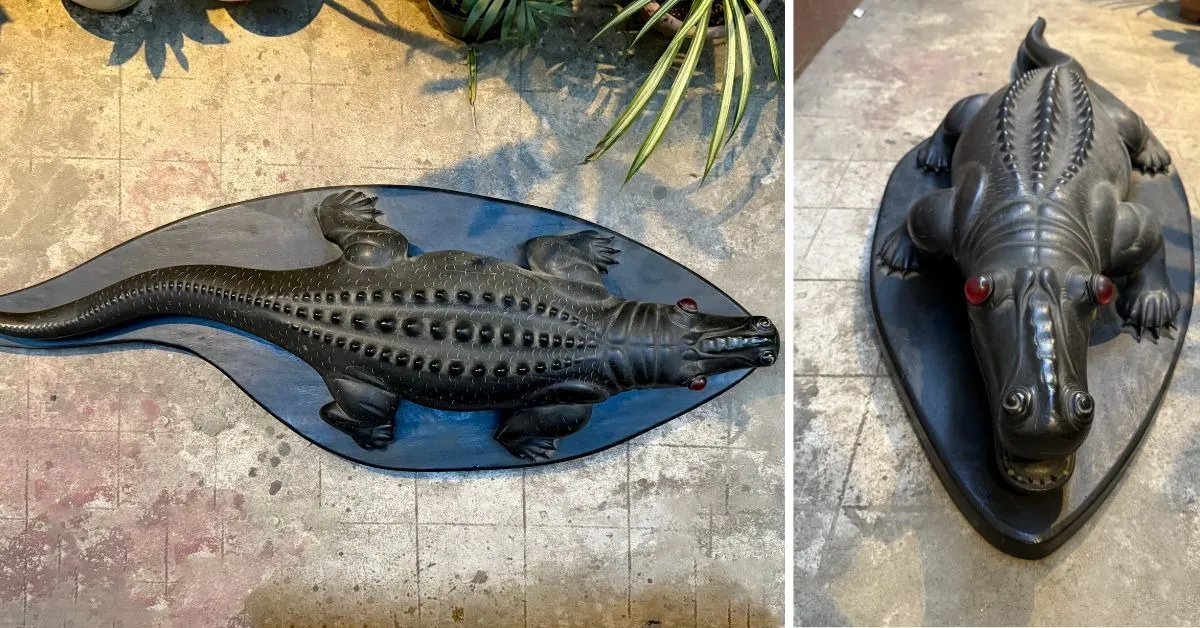
Aanchal underscores this with the example of the story of the Burmese crocodile.
“It was a teakwood sculpture brought to India in the early 20th century. The writer Rajita Banerjee and I spent nearly five months working on it, drawn in by the object’s sheer peculiarity, a five-foot-long carved crocodile, and the question of why someone would go to the trouble of transporting it across seas.”
The research process led the duo down a rich trail of research, from crocodile iconography in Burma to migration patterns between Bengal and Burma, and even to wartime lore about Japanese soldiers in crocodile-infested swamps.
Part of the reason why bringing these stories out takes so long, she explains, is that they want to ensure they do justice to the object, the time period, and the family, while being as factually accurate as possible.
Building the Museum of Material Memory wasn’t an easy task.
It’s logistically demanding. But it’s worth it, watching different generations of a family bond over telling the story of the heirloom.
“Often, a younger person initiates the process, only to turn to older family members: grandparents, aunts, or extended relatives, to piece together the history of an object,” Navdha shares, saying that what follows is an almost investigative process of conversations and recollection. This especially happens in cases where memories have faded, or the concerned generation is no longer around, contributors reach out across the family to reconstruct fragments of the past and give the object a fuller narrative.
She underscores this with an example.
The Bahl family tree
Raunaq Bahl and his grandfather — ‘Daddyji’ as Raunaq fondly called him — bonded over their Urdu learning sessions. In fact, Daddyji had bought Raunaq a Qaida, a primer used to teach children the Urdu alphabet, and Raunaq would pore over it, trying to perfect his understanding.
/filters:format(webp)/english-betterindia/media/media_files/2026/04/14/museum-of-material-memory-3-2026-04-14-18-29-52.jpg)
So, one afternoon, during a spring cleaning session at home, when his mother found a frail piece of paper that appeared to be a photocopied family tree in Urdu — its original handwritten version long lost — Raunaq saw it as an opportunity for him and Daddyji to revise their Urdu, and decipher the lineage together.
But, as they traced its branches, Raunaq noticed an omission; no women were recorded on the tree. Whole lives existed around these names but were left unrecorded. This observation stayed with Raunaq; when he and Daddyji were done, they folded the sheet gently, almost as if putting a piece of memory back to sleep.
While Raunaq’s story points to a larger debate around women’s roles in family history, and how they’re often disregarded, Aanchal says, there’s also another side to this story: “I think with every story of ours, where someone is sitting with a parent, grandparent, aunt, uncle, or another elder from their family to understand how life used to be lived when this object was in use or when it was purchased, whatever the object may be, those interactions really come through in the way the stories are written.”
The foreman sahib’s whisky glasses
Karan Singh Matharoo’s uncle once told him that the family still owned a set of glasses his grandfather had bought in the 1970s for Karan’s great-grandfather. The delicate, round-bottomed pieces meant for brandy were now worn with time but rich in memory.
/filters:format(webp)/english-betterindia/media/media_files/2026/04/14/museum-of-material-memory-4-2026-04-14-18-31-41.jpg)
When Karan finally held them, he saw them for what they were: symbols of inheritance, ritual, and remembrance. He felt a connection to a man he had only known through stories. As Aanchal explains, “We had never really done a story on alcohol glasses before, and the family didn’t have much information about them, where they came from, or anything like that. So what we ended up focusing on was the introduction of glass into India’s drinking culture, and how it made its way into families. We also looked at the patterns on the glasses and what was popular in the ’70s and ’80s. I thought that was a really interesting departure to take from something as simple as drinking glasses.”
Every story is special. And unique.
Take, for instance, the tablecloth that’s been in Debosmita Samanta’s family.
What would seem an ordinary tablecloth at first glance, it was embroidered with the words ‘Sweet Dreams’.
/filters:format(webp)/english-betterindia/media/media_files/2026/04/14/museum-of-material-memory-5-2026-04-14-18-35-09.jpg)
Through it, Debosmita wanted to tell the story of an aunt she never knew, someone who had endured a difficult marriage. It was heart-wrenching to read, especially alongside the irony of those words. While writing, Debosmita wondered if ‘Sweet Dreams’ reflected a life her aunt had hoped for but never had. As Aanchal and Navdha reason, giving space to objects that are ordinary too is precisely the point of this crowdsourced, alternative digital museum: to focus on everyday things that make up people’s lives.
However, they acknowledge that the challenge with creating such a collective is the emotional weight. “You grow deeply attached to each story, because you’re not just documenting an object, you’re engaging with the legacy of a family,” Aanchal says.
A repository of emotional memorabilia
There’s a thekuamould (a traditional wooden carving tool used to create intricate, decorative patterns on thekua, a popular deep-fried, sweet whole wheat cookie) that’s been in Harsha Singh’s family for decades now. It resurfaces each year during Chhath puja(a four-day Hindu festival celebrated around October-November). Carved from mango wood, the mould once stamped festive sweets in a bustling ancestral home, marking occasions of joy and gathering.
/filters:format(webp)/english-betterindia/media/media_files/2026/04/14/museum-of-material-memory-6-2026-04-14-18-37-01.jpg)
But, over time, it came to hold more than memory. It absorbed grief — surviving Harsha’s grandmother’s tragic death and years of silence before returning to ritual use. As it travelled across generations, it bore witness to both rupture and resilience. Today, Harsha sees it as a reminder of love and loss.
That’s the thing about heirlooms; they remind people of different things. Through the Museum of Material Memory, Navdha and Aanchal want to revive the past in a way that will allow families to sit with their histories and finally, attempt to give them a listening ear.
Sources
‘Shajara-e-Nasab: The Bahl Family Tree’: by Raunaq Bahl, Published on 25 January 2026.
‘Sarat Chandra Chatterjee’s Burmese Crocodile’: by Rajita Banerjee, Published on 12 January 2026.
‘The Foreman Sahib’s Whisky Glasses’: by Karan Singh Matharoo, Published on 28 August 2022.
‘Sweet Dreams’: The short story of a tablecloth’: by Debosmita Samanta, Published on 6 July 2025.
‘The Ridges of a Thekua Mould’: by Harsha Singh, Published on 7 May 2023.
Disclaimer : This story is auto aggregated by a computer programme and has not been created or edited by DOWNTHENEWS. Publisher: thebetterindia.com



