“Blue Lights,” now entering its fourth season, may have been conceived as a Belfast-set version of “The Wire,” but it also joins the often exalted ranks of art attempting to explain the complicated history and reality of the Emerald Isle.
The fourth season of the police drama “Blue Lights” begins with a scene that could be taken from American, British or European news coverage: An open house at an immigration center draws a group of angry protesters demanding that the nonnatives go back where they came from. A young woman wields her phone like a weapon, filming the demonstration as she characterizes the small protective police presence as yet another example of the government favoring the immigrants’ rights over those of the locals.
But this is Belfast, and when a group carrying Irish flags is seen heading toward the protest, police concerns hit DEFCON 1. The center is in a Loyalist portion of the city, where residents support Northern Ireland remaining part of the United Kingdom, while the flag carriers are identified as Dublin Republicans, or Nationalists, who want a united Ireland.
As Chief Inspector Helen McNally (Joanne Crawford) says, “If they walk into a Loyalist area carrying those flags, there’s going to be a riot.”
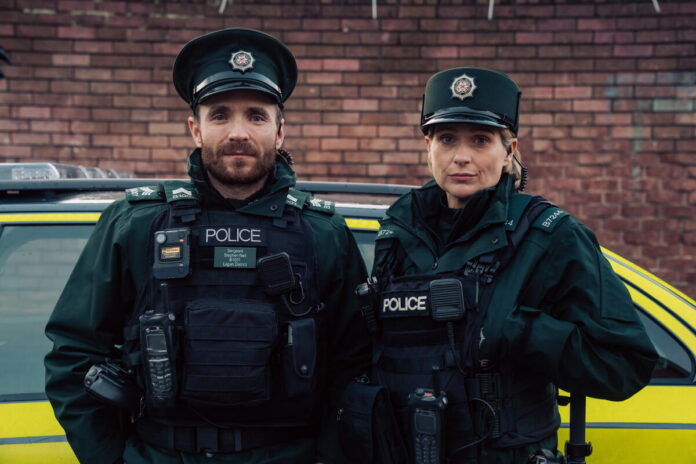
Over three seasons, fans have watched Grace Ellis (Siân Brooke), a highly effective former social worker, fall in love with Blackthorn veteran Stevie Neil (Martin McCann).
(Peter Marley / BBC / Two Cities Television / BritBox)
That isn’t what happens, exactly, but it serves as an instant reminder that in addition to being an outstanding cop show, “Blue Lights” is also a wildly ambitious one. As it enters its fourth, and possibly final, season — creators Declan Lawn and Adam Patterson recently announced they are stepping away from the show — it remains a singular character-driven police drama, rooted in contemporary urban issues — drugs, unemployment, poverty, organized crime, broken social services — that also dares to explore the ongoing impact of Northern Ireland’s 30 years of sectarian violence known as the Troubles.
As the September protest over the Protestant Orange Order’s attempt to march through a Catholic neighborhood in Portadown most recently proved, the Good Friday Agreement still holds but many of the divisions that made it necessary remain.
Peace walls continue to divide nationalist and loyalist neighborhoods in Belfast, and behind them historic wounds fester, occasionally reopened when new information about the activities of Republican and Loyalist paramilitary groups and the Royal Ulster Constabulary during the Troubles comes to light.
The healing of such wounds requires many things, including the restorative power of good storytelling; the Irish have a long and exalted tradition of revealing some of their most important and painful truths through their art. “Blue Lights” deftly wields the familiar tools of an engaging police drama to join that tradition. Here the past doesn’t just cast shadows but continues to do real damage, to the people who survived it and those too young to remember.

An initially stiff-necked Annie Conlon (Katherine Devlin) has overcome the stigma of being a Catholic police officer.
(Peter Marley / BBC / Two Cities Television / BritBox)
Though often more captivated by Ireland‘s glorious green hills and lyrical and/or eccentric citizenry, film has, historically, done a better job of chronicling its modern political turbulence — Jim Sheridan’s ”In the Name of the Father,” Neil Jordan’s “The Crying Game” and, more recently, Kenneth Branagh’s semiautobiographical “Belfast.”
Television, on the other hand, stuck pretty much with the hills and the lyrical eccentricity. But in the last few years, it has produced several fine series dealing directly with the Troubles — “Say Nothing,” “Trespasses” and “Derry Girls” — and others, like “The Fall,” that acknowledge the still-simmering sectarian tensions.
“Blue Lights” does more than acknowledge. It argues that Belfast’s sectarian tension isn’t a discrete problem; it, and all the tribalism around it, makes any bad situation worse. A divided people are, as the saying goes, far easier to conquer, whether by corrupt officials, far-right propagandists or drug cartels.
Lawn and Patterson, who came of age toward the end (and from opposite sides) of the Troubles, met while making investigative programs for the BBC’s “Panorama.” But, as they told The Times in 2024, they were less interested in writing a Belfast docudrama as they were in making a local version of “The Wire.”
The show began in 2023 with a group of three new recruits joining the fictitious Blackthorn Station. Over three seasons fans have watched Grace Ellis (Siân Brooke), a single mother and highly effective former social worker, gain confidence as a “peeler” and fall in love with Blackthorn veteran (and finicky ace baker) Stevie Neil (Martin McCann). An initially stiff-necked Annie Conlon (Katherine Devlin) has overcome the stigma (including death threats) of being a Catholic police officer, while callow, fresh-faced Tommy Foster (Nathan Braniff) struggled to both prove and remain true to himself, especially in his devotion to fellow officer Aisling (Dearbháile McKinney) as she faltered under the weight of job-inflicted trauma.

Siân Brooke as Grace Ellis in Season 4 of “Blue Lights,” which argues that Belfast’s sectarian tension isn’t a discrete problem; it, and all the tribalism around it, makes any bad situation worse.
(Peter Marley / BBC / Two Cities Television / BritBox)
The initially scheming and seemingly cowardly Jen Robinson (Hannah McClain) found strength to heave off the expectations of her mother, Chief Supt. Nicola Robinson (Andrea Irvine), and find her own path, while Shane Bradley (Frank Blake) — who began as an arrogant, ambitious suck-up — has, after a life-threatening incident or two, mellowed into a surprisingly good team player.
All were, and remain, undone by the murder of beloved mentor Constable Gerry Cliff (Richard Dormer) by a drug dealer at the end of Season 1. None more so than his wife, Sgt. Sandra Cliff (Andi Osho). Gerry’s death haunts the series and fuels the fourth season (which includes a flashback episode that explains how Gerry met Sandra).
If it sounds like the kind of squadroom family that propels any good workplace procedural, it is, and it isn’t. Most TV cops (or in this case, “peelers”) aren’t quite as trained in riot suppression or capable of instantly recognizing those neighborhoods and streets that are officially “out of bounds” because of the former paramilitary members who live there.
The first season also introduced Special Branch, run by Paul “Colly” Collins (Michael Smiley) who is trying to protect the identity of James McIntyre (John Lynch), a former IRA member who Colly recruited as an informant during the Troubles. In the years since, McIntyre has become a terrorist gangster; the revelation that he was working with Special Branch would ignite more than a riot.
That subplot, with its existential questions about ethical deviations during times of war and the value of saving lives from bombs only to sacrifice them to heroin and mobsters, threads its way throughout the preceding seasons before exploding in this one. There is more than enough closure, much of it bittersweet, to go around. Though “Blue Lights” has not been officially canceled, the final episode feels, well, final in terms of narrative and messaging: No matter how painful, facing the truth is the only way true progress can begin.

Tommy Foster (played by Nathan Braniff) in “Blue Lights,” Season 4, which premieres Thursday on BritBox.
(Peter Marley / BBC / Two Cities Television / BritBox)
Like “Derry Girls,” “Blue Lights” finds love and humor in even dire situations; like “Say Nothing,” it explores how easily even seemingly necessary secrecy can turn into its own form of tyranny. The sectarian division in Belfast is the result of a long and specific history, but watching “Blue Lights,” it’s easy enough to see the standoffs echoed in political tensions around the world. Strip the opening of Season 4 of its British and Irish flags and it could be any city inflamed by diminishing resources and the belief that one group or another is to blame.
The specters of MI5 and international drug cartels come and go, but mostly the series keeps its eye trained on daily life, on the families that form and the ones that struggle to survive. During the Troubles, the only battlefield was the streets and so it is here. While there are evildoers in “Blue Lights,” they are outnumbered by people who simply made bad, ill-informed or impossible decisions under the very real pressure of fear and/or loyalty.
Mercifully, there are many who, under the same conditions, made, and continue to make, good and courageous decisions. And, in Stevie’s case, some really excellent cookies.
More to Read
Disclaimer : This story is auto aggregated by a computer programme and has not been created or edited by DOWNTHENEWS. Publisher: latimes.com