
Australia is living through what feels like a rolling series of shocks – economic, geopolitical, social, environmental and technological. In other words, a polycrisis.
And yet, as I scan the news each day, I feel that much of our policy and political response feels oddly small – as if we haven’t caught up to the enormity of the shocks that are already here, or those that are incoming. People realise that the whirlwind of problems requires a bolder response, given so many of them are structural and the result of decades of inadequate approaches to reform.
Nowhere is the dissonance between public sentiment and political response clearer than in energy policy. Recent global tensions have reinforced something Australians already understand: our exposure to international shocks leaves us vulnerable. While price spikes may ease, the underlying vulnerability does not. Increasingly, energy is seen not just as an environmental challenge, but as one of national economic security and resilience.
Even before the Iran war began, research conducted in February by 89 Degrees East throws light on an Australian public that is not confused or conflicted, but pragmatic and increasingly decisive.
The gas debate is a case in point. When asked how to bring down gas prices, seven in 10 of 3755 respondents said the answer was to limit how much gas was exported overseas so that more stayed for Australian households and businesses – and not to open new gas fields.
For most Australians, this is not a contradiction. It is a sequencing question: stop the export rip-off now, and accelerate the transition that makes us less dependent on gas.
Australians have already made up their mind. The question is whether politicians are prepared to follow.
People are also clear about where responsibility lies. More point to profit-seeking by energy companies than to any other single factor when explaining rising energy costs.
They are not waiting passively for change. Two-thirds report taking some form of action in the past six months, from changing everyday behaviour to improving the energy efficiency of their homes. This shift is driven by pragmatism – not ideology.
What our politicians need to understand is that Australians believe and act on the premise that the energy transition is not a threat to their economic wellbeing. It is part of the solution. This matters politically. It signals that the old binaries – economy versus environment, affordability versus action – are losing their grip.
Even Pauline Hanson has received the home solar rebate. So, too, has Nationals leader Matt Canavan.
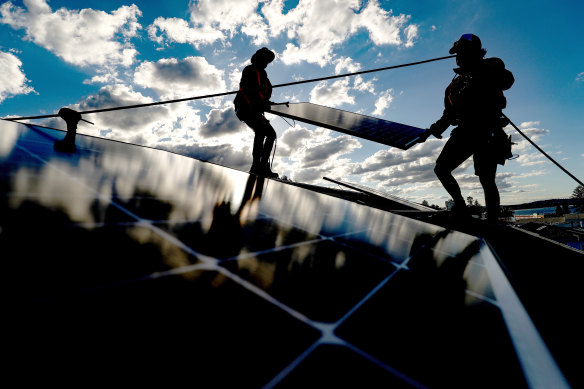
Support for the shift to renewables has risen to 74 per cent. Almost three-quarters of Australians identify renewable energy solutions as the fastest way to reduce power bills, spanning large-scale projects, household support and battery storage. Those aged 25 to 44, in particular, are among the most supportive of structural change. They are more likely to back the shift to cleaner energy, and a majority says Australia should get on with the job of moving to renewables and storage.
Imagine if this research was conducted after the Strait of Hormuz closed in March and households using diesel were paying over $3 a litre for their car?
These trends should be seen as both a red flag and a green light to political leaders, particularly those seeking to build durable electoral coalitions. These voters are not on the fringes; they are at the centre of Australia’s economic and social life. And their expectations are not radical. They are asking for policies that match the scale of the challenges they face.
These Australians know that large-scale reform is often difficult and messy. But they do expect honesty about trade-offs, ambition in direction and coherence in strategy. Above all, they want to feel that their leaders are grappling with the reality of their problems, not retreating into piecemeal Band-Aid fixes.
The risk for political leaders is not just that incrementalism will fail to solve the problems at hand, but that it will deepen public frustration and erode trust further. When people feel that their lived reality is not being matched by the scale of political response, disengagement follows – or worse, a turn towards more extreme political options such as One Nation.
Australia is a country that has wasted both opportunities and crises when it comes to reform. The public understands this instinctively. And increasingly people are asking a simple question: if not now, when? They have no illusion about the precarity of our energy supply. They don’t want to wait for another rolling fuel crisis.
Dr Rebecca Huntley is one of Australia’s foremost researchers on social trends and a fellow of the Research Society of Australia. She is director of research at 89 Degrees East.
Get a weekly wrap of views that will challenge, champion and inform your own. Sign up for our Opinion newsletter.
 Dr Rebecca Huntley is a leading social researcher and director of research at 89 Degrees East. She is the author of multiple books including How to Talk About Climate Change in a Way That Makes A Difference.
From our partners
Disclaimer : This story is auto aggregated by a computer programme and has not been created or edited by DOWNTHENEWS. Publisher: www.smh.com.au


