Akhtar Makoii and Paul Nuki
For Benjamin Netanyahu, a US-Iran peace deal that leaves the Islamic Republic in place and free to rebuild presents an existential threat.
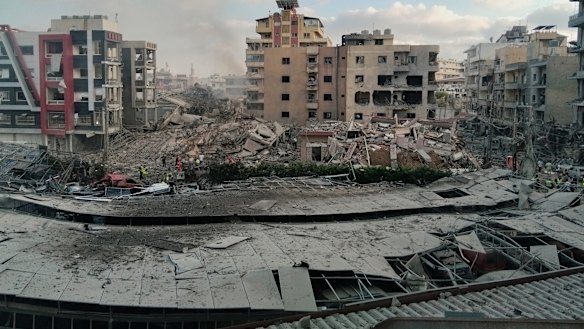
This prospect more than anything else explains why Israel’s prime minister ordered the rapid escalation of Israeli attacks on Lebanon in recent days, analysts said.
The bombing is designed to undermine the finely balanced peace negotiations, something that appeared to bear fruit on Monday when Iran said it was “suspending talks” with the US.
“Given the continuation of the Zionist regime’s crimes in Lebanon, and considering that Lebanon was among the preconditions of the ceasefire, which has now been violated on all fronts – including Lebanon – the Iranian negotiating team is suspending talks and the exchange of texts through the mediator,” Iran’s Tasnim news agency reported.
But just as quickly as he threatened Beirut, he was brought to heel by Donald Trump, who, in a phone call, persuaded – or told – Netanyahu to call the latest strikes off.
This leaves him in an uncomfortable position.
Netanyahu has built his brand and career around opposing Tehran.
When Israeli jets launched the first strikes of the attack on Iran in the early hours of February 28, the great majority of Jewish Israelis cheered Netanyahu on.
It was assumed that the man they call “Mr Iran” was but days away from realising his lifetime pledge: the destruction of the Islamic Republic.
With the might of the US military and a willing US president behind them, what could possibly go wrong? That was 93 days ago.
Another Israeli leader might reasonably bank the considerable military gains made against Iran and wait for time to take its probable course.
‘[It’s] a regime that has to be removed for the sake of the Iranian people, the region, and the free world, but first and foremost, for the survivability of Israel.’
David Horowitz, founding editor of The Times of Israel
Hamas, Iran’s proxy, has been all but destroyed in Gaza, and Hezbollah is nothing like the force it once was. In Iran itself, large swathes of the leadership have been taken out, and its economy and military-industrial complex have been set back years, if not decades.
Some analysts believe it is not improbable that the Islamic regime will collapse under rising domestic pressure and its own internal contradictions.
But that will not work for Netanyahu, who faces an election in October. In Israel, the failure of the war to topple the mullahs and deliver what Israelis call a “new reality” is generating widespread fear and angst.
The Israeli media is full of it.
David Horovitz, the founding editor of The Times of Israel and a relative moderate, wrote last week that if the terms of a proposed ceasefire between the US and Iran were accepted, the war would be remembered as an “epochal failure”.
“Israel’s leadership and citizenry, almost all the way across the spectrum, rightly regard the Islamic Republic as a direct, existential threat,” he added.
“[It’s] a regime that has to be removed for the sake of the Iranian people, the region, and the free world, but first and foremost, for the survivability of Israel.”
This is what Netanyahu must now contend with at the polls, having spent a political lifetime pushing a similar line.
Two weeks ago, it was reported that he had tried to persuade Trump to continue the war and reject a deal, a call which was said to have ended in sharp disagreement.
One US source briefed that “Bibi’s hair was on fire after the call”, according to the news service Axios.
Having failed to convince him to walk away from a deal, Netanyahu is now using Iran to do it for him by provoking Tehran into abandoning talks through the bombing of Lebanon.
Iran had established a framework under which it would secure a ceasefire in Lebanon first, then negotiate everything else – uranium, frozen assets and withdrawal from the Strait of Hormuz.
Mohammad Bagher Ghalibaf, Iran’s chief negotiator, said on Monday: “Escalation of war crimes in Lebanon by the genocidal Zionist regime are clear evidence of US non-compliance with the ceasefire.”
Netanyahu is playing a dangerous game. Yet, he is not alone in trying to scupper the proposed peace deal.
His ambitions were blunted by Trump on Monday night (UK time), which caused embarrassment back home.
“There will be no troops going to Beirut, and any troops that are on their way have already been turned back,” Trump said on Truth Social after what he called a “very productive” call with Netanyahu.
Iran’s hardliners have already threatened to overthrow Iranian Prime Minister Masoud Pezeshkian’s government if it accepts what they regard as a weak deal.
For this group, the bombing of Lebanon may provide exactly the ammunition they need: proof that Iran abandoned its regional allies for American concessions.
Netanyahu also has Trump’s people to worry about.
His secretary of state, Marco Rubio, his Middle East envoy, Steve Witkoff, and even his son-in-law, Jared Kushner, have all been subjected to character assassinations by Netanyahu’s media outriders in recent days.
In a string of interviews on Israeli television, they have been portrayed – in the words of one Israeli observer – as “naive, compromised, financially interested, Qatar-aligned, and even dangerous to Israel’s security”.
This could backfire. Trump, like Iran, wants to sign a deal that ends the war, while continuing to appear strong.
Trump lost his temper with Israeli actions at the end of the 12-day war with Iran last June.
When Netanyahu sought to scupper that deal with some last-minute strikes, Trump went on live television to order that they desist, saying that Israel and Iran and its proxies “have been fighting so long and so hard that they don’t know what the f— they’re doing”.
This time, the language was more gentle. But the overriding message was the same: Let us end the war.
The Telegraph, London
Get a note directly from our foreign correspondents on what’s making headlines around the world. Sign up for our weekly What in the World newsletter.
From our partners
Disclaimer : This story is auto aggregated by a computer programme and has not been created or edited by DOWNTHENEWS. Publisher: www.smh.com.au