Kareem Chehayeb, Hassan Ammar and Yomna Ehab
Updated ,first published
Beirut/Dubai/Jerusalem: Israel has conducted strikes against military targets in western and central Iran, hours after Iran fired a salvo of missiles at Israeli targets in retaliation for an attack on Beirut’s southern suburbs.
The strikes come despite reports that US President Donald Trump had told Israeli Prime Minister Benjamin Netanyahu not to retaliate and risk raising the possibility of reigniting a full-scale war with Iran.
Iranian state television reported the sound of explosions being heard in Tehran, Isfahan, and Tabriz, without immediately elaborating. Iran also closed the airspace around Tehran’s Imam Khomeini International Airport, the country’s main airfield, after the Israeli attack.
Iranian officials offered no details on what had been struck, nor any damage information. Iran’s paramilitary Revolutionary Guard said that Israel used air-launched ballistic missiles in its attack, without elaborating.
The White House did not respond to messages about the strikes and whether they were done in coordination with the US.
Iran has long said any peace deal with the US would depend on a ceasefire also holding in Lebanon, which Israel invaded in March in pursuit of Iran-backed Hezbollah fighters who fired rockets and drones across the border in solidarity with Tehran. But Israel earlier on Sunday launched strikes in the Beirut area for the first time since the US announced a truce plan for Lebanon last week.
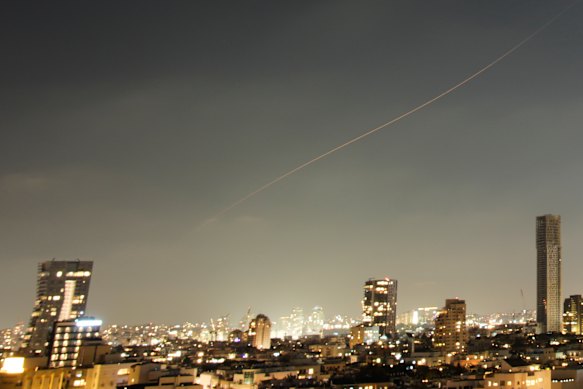
Iran’s Revolutionary Guards said they had targeted Ramat David air base, near Nazareth. The Israeli military said it identified missiles launched from Iran and that its defence systems had intercepted them.
Sirens sounded in several areas of Israel, sending millions running for shelter. Israel’s military said it intercepted the missiles, and multiple explosions were heard in the north. Less than an hour later, the military said people could leave areas reinforced against missile attacks.
“Iran has made a grave mistake,” Israel military spokesman, Brigadier General Effie Defrin, said. The military’s chief of staff, Lieutenant General Eyal Zamir, said it would “strike the enemy with determination as soon as the order is given”.
Trump, who was spending the weekend at his golf club in Bedminster, New Jersey, and Netanyahu spoke by phone for almost half an hour, an Israeli official said, without giving further details. The White House and the Israeli prime minister’s office did not immediately respond to requests for comment.
Earlier, Trump told Axios he would press Netanyahu not to retaliate.
“Israel had its strike and Iran had its strike. We don’t need another one,” Trump said. “We are very close to a final deal with Iran. It is going to be a good deal. I don’t want it to blow up because of what is happening now,” Trump told Axios
“I am going to call Bibi [Netanyahu’s nickname] right now and tell him not to retaliate. Each of them had their fun. Israel had its strike, and Iran had its strike. We don’t need another one.
“The Iranian strikes didn’t hurt anybody. Hopefully, Israel is not going to retaliate. If Bibi strikes them back, it’s just gonna keep going like the last 47 years – or the last 3000 years.”
Trump also told a Fox News Channel reporter on Monday (AEST) that he wanted the Iranians to stop firing missiles and return to the negotiating table. He also said that Israel’s strikes earlier Sunday were not co-ordinated with the US and “I’m not happy about it”.
Later, in an interview with the Financial Times, the US president said Netanyahu would have no choice but to accept whatever deal the US negotiates with Iran because Trump “calls the shots”.
“He won’t have any choice,” Trump was quoted as saying.
“I call the shots. I call all the shots. He doesn’t call the shots.”
Iran had warned that an attack on Beirut would renew full-scale war across the Middle East, even as Pakistan tries to restart talks between Tehran and Washington. Iran wants a deal to include ending the war in Lebanon.
Trump told the Financial Times that Iran’s strikes had not changed his desire to conclude negotiations. Asked what would happen if any such deal failed “on its merits”, Trump said he would consider a commando raid on Iran.
“US forces across the Middle East remain vigilant and ready,” US Central Command posted on X shortly before the missile launches.
Trump has leaned on Israel to stop its attacks in Lebanon to allow room for a peace deal with Iran, including rebuking Netanyahu with obscenities in a phone call last week. After that call, Netanyahu appeared to abandon plans to strike Beirut.
But Israel has never fully halted its Lebanon campaign, which has killed thousands of people and driven hundreds of thousands from their homes. Hezbollah, which did not take part in the truce talks, has also continued its attacks and says it will not give up its weapons unless Israel halts its attacks and withdraws from Lebanon.
Netanyahu said the Israeli strikes on Sunday on Beirut’s southern outskirts, a district known as Dahiyeh that has long been a Hezbollah stronghold, were ordered in response to Hezbollah firing toward Israel.
Associated Press journalists also heard loud explosions in the sky over Damascus. State media in Syria attributed the booms to Israeli air defences. Syria has temporarily closed its southern airspace for 12 hours and suspended operations at Damascus airport.
Iraq also temporarily closed its airspace and suspended air navigation for reasons related to air traffic safety after the launch of Iranian rockets, civil aviation officials told Reuters on Sunday. The Iraqi Civil Aviation Authority said Iraqi airspace would remain closed for 72 hours.
Israel’s strikes and ground invasion in Lebanon in pursuit of Hezbollah, and the militant group’s resistance to disarming, have complicated an overall deal to end the war in the Middle East. Iran says any deal must include an end to fighting in Lebanon.
Last week, Israel had announced it would strike the southern suburbs of Lebanon’s capital, but urgent talks via Washington halted that on the condition that Hezbollah stop targeting Israeli border towns.
On Sunday night, Hezbollah claimed responsibility for firing at Israel earlier in the day.
Hezbollah wants direct talks between Lebanon and Israel to end, instead supporting Iran’s stance that an overall ceasefire deal between Tehran and Washington include the situation in Lebanon.
Mediation efforts on that larger deal continued on Sunday as Pakistan’s interior minister visited Iran to talk to officials and Egypt said its foreign minister and his Qatari counterpart discussed “proposed elements” of a potential agreement, with no details.
More than 3500 people have been killed in Lebanon since the war began on March 2 when Hezbollah fired rockets at northern Israel, two days after Israel and the US began attacking Iran. More than 1 million people in Lebanon have been displaced. The fighting has killed at least 31 Israeli soldiers and three civilians.
Meanwhile, Iran continued to assert its grip on the Strait of Hormuz and the US continued its blockade of Iranian ports, with shipments of oil, natural gas and fertiliser affected and the global economy in pain.
Netanyahu, who faces elections this year, wants to press ahead with Israel’s offensive until he believes Hezbollah no longer poses a threat.
Pakistan’s interior minister was in Tehran on Sunday. Mohsin Naqvi was delivering a message to Iranian Supreme Leader Ayatollah Mojtaba Khamenei from Pakistan’s army chief, Field Marshal Asim Munir, according to Iran’s state-run IRNA news agency. There were no details on the message’s contents.
Khamenei has not been seen in public since he was named the Islamic Republic’s ruler after his father was killed on February 28, the first day of the war.
Reuters, AP
Get a note directly from our foreign correspondents on what’s making headlines around the world. Sign up for our weekly What in the World newsletter.
From our partners
Disclaimer : This story is auto aggregated by a computer programme and has not been created or edited by DOWNTHENEWS. Publisher: www.smh.com.au