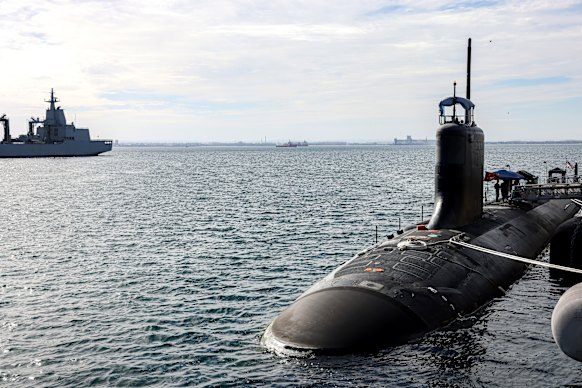

Washington: Defence Industry Minister Pat Conroy’s clarification on the future of American submarines at HMAS Stirling has satisfied the Pentagon, which says their presence in Western Australia will be “enduring”.
Conroy caused a political storm during a visit to Washington this week when he told the ABC’s 730 program that the rotation of US submarines at HMAS Stirling in Perth was limited to just five years.
That would have “come as a surprise to American ears”, former Home Affairs department secretary Michael Pezzullo said, while the Coalition’s defence spokesman James Paterson accused Conroy of evicting the Americans before they arrived.
Conroy then walked back his remarks in an interview with this masthead, saying the US was likely to maintain some kind of presence there indefinitely, and issued a statement to clarify his position.
“Submarine Rotational Force West is intended to be an enduring element of US force posture in Australia,” he said.
The issue at hand is whether American-owned nuclear-powered submarines depart HMAS Stirling when Australia’s Virginia-class boats begin arriving from the US, or if they maintain some form of presence there, either through rotations or ongoing visits.
Critics of the AUKUS defence agreement argue that the presence of US submarines in Perth represents a potential target in the event of a regional conflict.
Following Conroy’s initial remarks, the Pentagon did not respond to inquiries for 48 hours while it sought clarification on the Australian government’s position.
On Saturday (AEST), it provided a statement attributed to a Department of Defence official: “Minister Conroy released a statement noting that SRF-West is intended to be an enduring element of US force posture in Australia.”
Defence strategists in the US government, including Pentagon policy chief Elbridge Colby, have expressed reservations in the past about losing US-controlled submarines to Australia at a time when the US defence industrial base is not producing enough for the Navy’s own demands.
But they also view HMS Stirling near Perth as strategically useful for positioning US forces to deter Chinese aggression in the Indo-Pacific. In October, when Prime Minister Anthony Albanese visited Donald Trump at the White House, the US president declared AUKUS was “full steam ahead”.
Paterson also pointed to remarks by Defence Minister Richard Marles using the same language as the Pentagon – that the US presence in Western Australia would be enduring.
“I am relieved Richard Marles finally stepped in on Friday to clean up Pat Conroy’s unedifying and unnecessary mess,” he said. “The last thing AUKUS needs is uncertainty about core elements of the agreement like SRF-West.”
Conroy’s trip to the US included high-level meetings with the American navy and army, as well as visits to a shipyard that makes Virginia-class submarines and a missile factory in Tucson, Arizona.
In an interview in Washington, Conroy said Labor Party members who believed Australia was making a mistake with AUKUS were wrong.
“We’ve had this debate within the Labor Party for years – earlier it was about the joint facilities, about Pine Gap,” he said.
“This national conference, AUKUS wasn’t even debated … There wasn’t an amendment that had sufficient support to make it to the floor.
“The vast majority of the Labor movement support AUKUS and understand it. Not everyone, I’m not pretending everyone.”
Get a note directly from our foreign correspondents on what’s making headlines around the world. Sign up for our weekly What in the World newsletter.
 Michael Koziol is the North America correspondent for The Age and Sydney Morning Herald. He is a former Sydney editor, Sun-Herald deputy editor and a federal political reporter in Canberra.Connect via X or email.
From our partners
Disclaimer : This story is auto aggregated by a computer programme and has not been created or edited by DOWNTHENEWS. Publisher: www.smh.com.au