
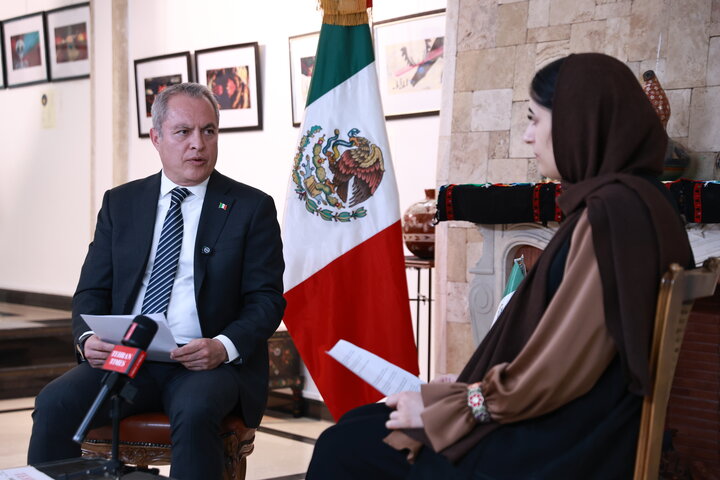
TEHRAN – In a warm and wide-ranging conversation at the Mexican Embassy in Tehran, Mexico’s Ambassador to Iran, Guillermo Puente Ordorica, sat down with the Tehran Times to discuss a special exhibition that was on display at the embassy, titled 68 Voices, 68 Hearts.
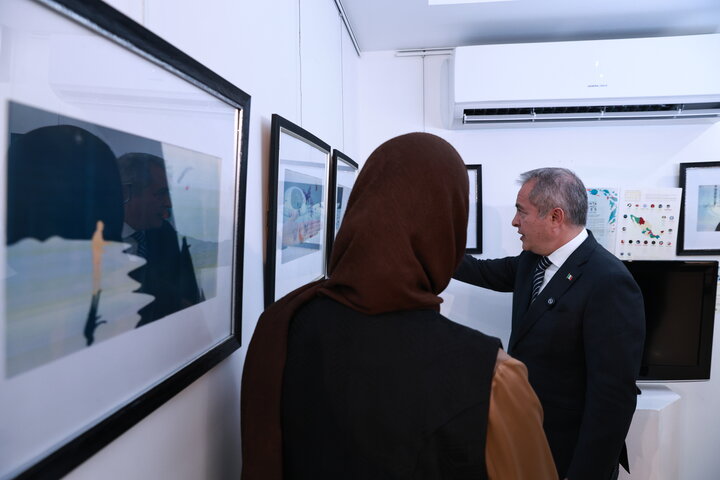
The exhibition, held as part of the third week of Mexico’s Indigenous Peoples and Communities Abroad, featured 40 images paired with 20 stories and was accompanied by audiovisual materials that narrated tales from various Indigenous traditions in their original languages.
Through these graphic and audiovisual resources, the exhibition sought to offer an opportunity to explore different ways of understanding and representing the world that form part of Mexico’s cultural and linguistic heritage, an embassy staff member told the Tehran Times.
During the interview, the ambassador also spoke about the deep parallels between Mexican and Iranian cultural diversity, the role of art in building people-to-people bridges, the state of bilateral ties, Mexico’s experience hosting the Iranian national team at the World Cup, and his personal reflections on living in Iran.
Below is the full text of the interview, edited for clarity and conciseness:
Your Excellency, thank you so much for granting us this interview today. For our first question, let’s begin with this beautiful exhibition here before us, 68 Voices, 68 Hearts. For those unfamiliar with the demographics of Mexico, could you tell us what this specific number signifies?
First of all, thank you for your interest. Thank you for coming to the Mexican Embassy and thank you for following up and promoting and informing people about what we are trying to showcase here at the Mexican Embassy with this particular exhibition. The title refers to Mexico’s 68 Indigenous linguistic groups and reflects the country’s broad cultural and linguistic diversity, one that is bigger and wider than this number in terms of cultural diversity and, of course, linguistic diversity in Mexico. It reflects, of course, the enthusiasm of the artist and director who has assembled the exhibition, trying to reflect, trying to have a piece of all the different idiomatic and ethnic cultural expressions of contemporary Mexico, but attached to our very long ancient past and traditions. Just to give you an example, we are talking about 360 different linguistic expressions in Mexico.
The people of Mexico and Iran are both very diverse. What do you think are the traits that both countries share, especially among their people?
Well, I think it’s difficult to name them all specifically because, again, it’s diversity. It’s wide, and it’s rooted in ancient expressions and ancient traditions. But beyond that general fact, I do believe that Iranian people particularly Iranian people will be able to understand what I am referring to, because this diversity, this ethnicity, is very much attached to the geography of our countries. If you go to the north, to the south, to the west, and to the east of the country, you will find this particular diversity these diverse, different expressions that come to us from the plurality of our cultures.
For example, I don’t know the numbers in Iran, but in the case of Mexico, we are one of the richest nations in terms of cultural diversity, which means different ethnic groups, which means different languages that have come to enrich the national Mexican culture as a whole.
The national culture is integrated, if I can say so, by all these different expressions sometimes local, sometimes in a wider sense, more let’s say provincial in terms of geographical extension. And nevertheless, they have a continuum in the diversity which creates and gives meaning to Mexico as a country, as a society, and of course as a culture. You will see in this exhibition the colors, the diverse expressions of color attached to the particular artistic expressions. I think you find this in Iran as well. Iran is, for many reasons, colors. And that makes a big difference when you make this exercise of comparing to other kinds of cultural expressions worldwide, without even mentioning one in particular.
Aside from this specific exhibition, what other cultural exchanges have existed that have helped build people-to-people bridges between our societies?
We have organized a number of activities in which we have been able to reflect the similarities between the Iranian and Mexican people. Just to give you an example, some years ago here at the embassy and we continue to organize them we held a kind of workshop devoted to popular expressions of Iranian and Mexican cultures. It was very important because, at one point in these workshops, we decided to work with an Iranian master who has devoted her life to promoting the popular expressions of Iran, reflected in this particular case in dolls dolls that can be ornaments, but dolls that can also be used for kids to play with. We have something very similar in Mexico.
In this particular workshop I was referring to, this Iranian teacher decided to create Mexican dolls with Iranian techniques. It was a very nice mixture. The other particularity of this workshop is that they were developing, creating Frida Kahlo dolls. The dolls were then showcased some years ago in the Niavaran Cultural Complex, in a beautiful exhibition of Frida Kahlo and Diego Rivera. That was the first time it was showcased over there, and it was integrated by three chapters. The first chapter I already explained. The second chapter was a photographic exhibition that was sent to us by Mexican cultural institutions.
The third part of that very beautiful exhibition was that we invited Iranian artists to depict their own interpretation of Frida Kahlo. We received so many paintings that we decided to work with an Iranian cultural association to choose the best. It was totally self-organized. We didn’t even interfere. They made a selection this jury, this association of Iranian cultural artists and painters. They chose 90 or so different paintings.
This was the third chapter that we showcased and showed in this exhibition for two weeks in Niavaran. It was very successful, not only because it received around 10,000 visitors in two weeks, but also because this particular workshop I was talking about at the beginning was a live workshop in the exhibition. Many kids and many people came to the place in which we were developing the workshop, attached to Frida Kahlo, and they not only had fun, but you cannot imagine how skillful and how important the things they created were in these two weeks with the help of the Iranian teachers, with Iranian techniques, but always thinking of these Mexican dolls attached to the very important expression of popular cultures in Mexico. This is one example; there are many more.
It appears to me that you believe art plays a very important role in building bridges between the people of Iran and Mexico. Is my assumption correct?
You are correct. I personally believe not because I have discovered something special, but because I genuinely believe that this kind of dialogue is the best way to build bridges and bring people closer together. When we started with these ideas for example, the workshop, or the exhibition of Frida Kahlo and Diego Rivera in Niavaran, and many other things we have done, such as at the Tehran International Book Fair, or a book that we published as part of workshops here at the embassy it is because we do believe that if we connect the Iranian people, particularly Iranian cultural promoters and Iranian artists, with their counterparts in Mexico, I am sure that in the future we will see many results from this kind of social and intercultural dialogue. If the Mexican Embassy can contribute to that especially thinking that in the future these young generations of Iranian and Mexican artists are going to continue to cooperate and talk together we are going to see very interesting things for the strengthening of bilateral relations, but also for knowing each other better beyond stereotypes. Stereotypes are generally very negative all the time. To know each other in a better way not only to develop a better bilateral relationship, but also to understand much better the complexities of our societies, full of history, full of cultural and plural diversity.
Let’s speak more about bilateral ties. Mexico and Iran have maintained diplomatic relations for decades, yet the intensity of engagement has fluctuated, especially due to Western sanctions and war. How would you characterize the current state of our bilateral relationship, especially in politics and trade?
Well, we have had a friendly relationship. As you already mentioned, it is a historical relationship. We can trace the roots of these diplomatic ties to the end of the 19th century in I’m not sure if that was the exact date in the Persian calendar. Since then, we have had a very friendly relationship. It has, of course, had its ups and downs, like all relationships. But I am hoping, as a Mexican ambassador, to continue working to strengthen that kind of dialogue. If you look at the historical background of the bilateral relationship, you will see that we have held many important and relevant ties. Let’s hope that the situation you refer to in terms of politics and that conflict in the region will come to an end, so we can return to those ideas and continue to strengthen our bilateral relationship. Mexico is a friendly country. Our foreign policy is based on principles enshrined in our constitution, and we always adhere to these principles in terms of foreign policy. We have a mandate not only from our constitution but also from our president she is the head of state and the head of government and in that regard, she orients and directs Mexican foreign policy.
If you had to set one clear, achievable goal for Mexico-Iran relations over the next three years whether in trade, sports, or diplomacy what would that single priority be, and what is your personal roadmap to get there?
Well, I hope that in the future we will have a stronger relationship. I think that our societies and our different communities, for different reasons, can be closer together as I was referring to at the beginning of our interview in terms of cultural ties. I believe that only together can we work toward a better kind of relationship in the future.
Mexico hosted Iran’s national team during this year’s World Cup, and from what I understand, the reception was very warm. The Iranian team also had its own unique circumstances that set them apart from the other teams. From your country’s perspective, what was that experience like hosting a team with such particular conditions?
Thank you for bringing that up, because I think this is a very good example of what I was trying to talk about before. Although it is related to sports and although it is a very small, recent example, if you want to put it that way I think it summarizes everything I was saying about bringing our societies closer together: the admiration that exists in Mexico for Iranian history and culture, and the other way around. After that experience, everywhere I go in Iran, when people find out that I am the Mexican ambassador, they come up to me spontaneously to thank me for Mexico hosting the Iranian national team at the World Cup. This is a very good example of what I was talking about.
To go to the specifics of your question: as you know, Mexico was co-hosting the World Cup along with the US and Canada. We had the honor of hosting, among other things, the inaugural match which, by the way, is a very interesting anecdote and a metaphor of history in terms of football. In 2010, when the World Cup was hosted by South Africa, the inaugural match was Mexico against South Africa. Fourteen years later, when Mexico was co-hosting the World Cup and particularly hosting the inaugural match, it was again Mexico against South Africa. We had the chance to reciprocate that, let’s say, kindness of our South African friends.
In terms of Iran, as you well know, and as your audience well knows, Iran was in many ways in a special situation. They came to us and asked if we could host Iran, since they were going to play their first-round matches in the US. The Mexican president said, “No problem, yes, we can do that. You have to speak to the organizers.” So, everything came together in a very positive way for us to host the Iranian football team in Tijuana.
Originally, Mexico was going to host the World Cup in only three cities: Mexico City, Guadalajara, and Monterrey. But then, with this particular situation, we had a fourth city hosting the World Cup. And as you know, and as we saw, it was a very successful thing, because the Iranians were feeling at home. The Mexican people in Tijuana and in that state, Baja California, were very happy to see the Iranian team. And it just happened the way I said before: people together, talking to each other. It was a fantastic occasion, and we are very happy that we contributed our grain of salt toward a successful Iranian participation at the World Cup.
You’ve been stationed in Iran for several years now how would you describe your experience living here and your interactions with the Iranian people?
Well, in terms of what I have seen during all these years serving as Mexican ambassador here, from the very first day I received the first courtesy and kindness of an Iranian person, it has been that way until today. If there is one thing that characterizes Iranian people, it is that they are always warm, welcoming, and kind. The only thing is that before coming to Iran, I didn’t know the sense and meaning of taarof. Now I understand it better. I know what it means, and it truly does justice to the profile and attitude of the Iranian people toward foreigners. I don’t know if this is the experience of all foreigners, but at least with Mexican people in Iran, the only thing I have received in all these years serving as Mexican ambassador is precisely that kind of kindness.
I think this is something deeply rooted in your history and culture. It is not new, and it is not simply because you welcome foreigners every day or every time. At certain points, I think it comes as I now understand from your ancient history and culture, and it is reflected today in the way you treat people. I am very grateful for that. This is what I always experience in the streets not only in the context of hosting the Iranian team, but simply because people find out that I am a visitor in your country.
If you could say just one sentence to the people of Iran, what would that sentence be?
In one sentence oh, well, it’s complicated but I would encourage Iranian people to be the way they are, to continue their efforts, not only to treat visitors well, but also to continue to showcase to the world, and in this case to Mexico, how kind and how warm you are as a people, and of course, how important you have been in world history and in terms of universal culture.
Disclaimer : This story is auto aggregated by a computer programme and has not been created or edited by DOWNTHENEWS. Publisher: tehrantimes.com




