On 9 September, a consignment of coffee left Koraput for Delhi. It had to reach the capital within 36 hours.
The order was headed for the 2026 BRICS Summit, where 1,500 packets of Tiger Bright — a 100% Arabica coffee grown in the forested hills of Koraput — were included in media kits for delegates and journalists.
The request came from the Ministry of External Affairs, which wanted Odisha to contribute a local product to the summit under the One District One Product initiative. From plantations spread across tribal-dominated blocks of southern Odisha, Koraput coffee travelled to an international gathering in New Delhi.
After MEA asked Odisha to send 1,500 packets of Koraput Coffee for BRICS summit, TDCCOL delivered the entire consignment to Delhi by air within just 36 hours.
The 100% Arabica Tiger Bright coffee, grown in Koraput’s forested hills, is being served to domestic and international… pic.twitter.com/UlFAv7GvKx
— Manas Muduli (@manas_muduli) September 12, 2026
The Better India looked at Coffee Board publications and Odisha government documents to trace how coffee came to be cultivated here, how its forest-based model works, and what has changed as the district tries to turn coffee from a raw agricultural commodity into a product associated with its place of origin.
A coffee landscape in the Ghats
Koraput’s coffee-growing areas include Laxmipur, Kashipur, Dasmantpur, Nandapur, Lamtaput, Koraput and Pottangi. Some plantations, particularly around Nandapur and Machhkund, sit at around 920–950 metres above sea level.
The Coffee Board considers Odisha a non-traditional coffee-growing region, unlike the established coffee belts of Karnataka, Kerala and Tamil Nadu.
Yet coffee has been part of Koraput’s landscape for nearly a century.
A Coffee Board publication records an experimental plantation at Bichalkota in 1930, established by the erstwhile Jeypore royals. In 1958, the Directorate of Soil Conservation and Watershed Development took over the programme, partly to address siltation around the Machhkund hydroelectric project. The plantations were expanded under the existing forest canopy.
The Coffee Board later established its regional research station at R V Nagar to develop technologies suited to coffee cultivation in the Eastern Ghats and explore coffee as an alternative livelihood while retaining the landscape’s ecological character.
The expansion gathered pace decades later. In 2016–17, the Koraput district administration established the Coffee Development Trust.
What ‘shade-grown’ means here
The phrase “100% shade-grown” can sound like a marketing claim unless you look at what actually grows above the coffee plants.
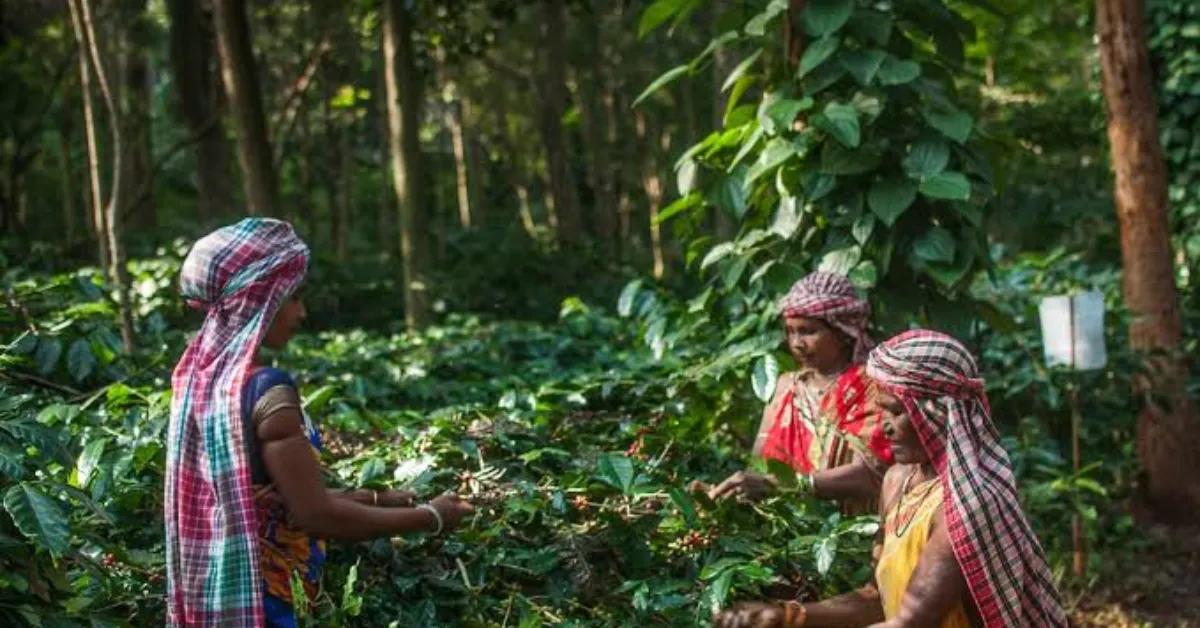
In parts of Koraput, coffee is cultivated beneath existing tree cover, with species such as mango, jackfruit, acacia and silver oak providing shade. The coffee forms part of a multi-layered landscape rather than replacing the canopy with a coffee-only plantation.
The Coffee Board notes that Arabica prefers cooler conditions and greater shade than Robusta.
From tribal livelihood to local brand
The Coffee Board recorded in 2021 that raw cherries from Koraput were being transported to Andhra Pradesh and Karnataka for processing. Farmers were receiving around Rs 35 per kg, while procurement prices could reach Rs 45 per kg.
Odisha’s 2021–22 government report estimated that around 3,000 hectares were under coffee cultivation in Koraput, involving 3,200 growers and producing 550 metric tonnes of raw coffee. It also noted that the crop had previously been marketed through middlemen from Andhra Pradesh and Karnataka.
That created a challenge beyond cultivation: how could more of the value generated by Koraput’s coffee stay closer to where it was grown?
Can BRICS change the equation?
TDCCOL (Tribal Development Co-operative Corporation of Odisha Ltd) has developed the Koraput Coffee brand, while government-supported infrastructure has expanded around processing and marketing.
The coffee has also received recognition through Coffee Board quality programmes. In 2024–25, Koraput A-1 Coffee was recognised in the Arabica Experimental category.
Koraput coffee is very tasty. It is the pride of Odisha!#MannKiBaatpic.twitter.com/FIp5yRhpT4
— Narendra Modi (@narendramodi) October 26, 2025
Then came BRICS.
The 1,500 packets of Tiger Bright sent to New Delhi have put a forest-grown coffee from one of India’s less conventional coffee-growing regions in front of an international audience.
For Koraput, the journey from experimental plantations in the 1930s to a branded coffee served at a global summit is also part of a longer effort: to build value around a crop that has grown here for generations, while keeping its connection to the region’s landscape and communities.
Sources:
‘BRICS delegates, mediapersons to get a taste of the exotic Arabica brew from Koraput’s hills’: By Sudarsan Maharana, Published on 12 September, 2026
‘ST & SC Development, Minorities & Backward Classes Welfare Department-Annual Activity Report’: By Government Of Odisha
Disclaimer : This story is auto aggregated by a computer programme and has not been created or edited by DOWNTHENEWS. Publisher: thebetterindia.com