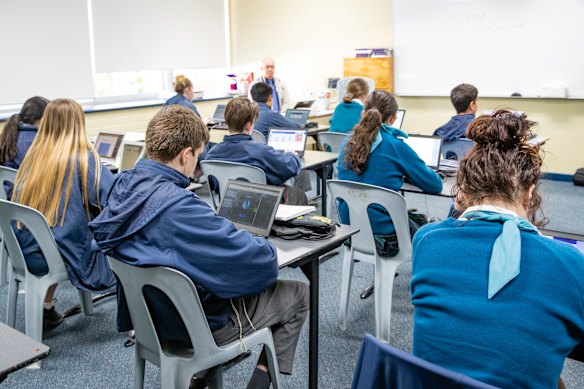
I used to think that shadow minister Julian Leeser was serious about his principles, but it seems he has now joined in the culture war officially (“Pride in flag, Western culture, and soldiers in schools: Coalition unveils education plan”, smh.com.au, September 19). There is no connection between what you teach at school and NAPLAN scores or Programme for International Student Assessment results. It is how you teach that matters. If pupils are not doing well in their literacy, how it will help by changing the curriculum is beyond understanding. While we have strong trade and some defence treaties and we are getting stronger, you would think that we’d want future generations to learn more about Asia to help build stronger relationships; instead, Leeser goes the other way. Strange indeed. So, what is the Coalition policy? American-style flag-waving and Western culture? It has never worked in Australia. It is understandable that the Coalition is desperate and trying to find some topic that can gain traction with voters. If this is the best it can come up with, good luck with that. Mukul Desai, Hunters Hill
Jingoism to the rescue. Scoundrels all. Pathetic. Alynn Pratt, Grenfell
Well done, Mr Leeser, with your ideas to rewrite the national curriculum. There is zero doubt in my mind that abolishing Indigenous culture and other such 21st century social studies-linked subjects will immediately improve NAPLAN results across the nation, particularly with male students. I sincerely hope that in the fine print of the policy will be the abolition of Advance Australia Fair, to be replaced each morning with boisterous renditions of God Save the King. Long socks and garters would not go astray, hemlines must be lengthened, girls, and haircuts above the collars, please boys. I always thought that military-style marching around (and around) the quadrangle was a great use of everyone’s time, and the newly minted soldiers-come-teachers would be ideal at running these activities. Finally, lessening screen time can easily be achieved by reinstating the 32″ AWA TV in the assembly hall and then have the entire school sit on the dusty floor and watch reruns of royal tours and Menzies orations. Tony Bennett, Broke
Julian Leeser, what makes you think that providing a fast track for veteran ADF personnel to become teachers is a good idea? It is hard to become a teacher, and so it should be. You must earn a master’s degree in teaching or a degree in a subject specialisation plus teacher training, including assessment in classroom management. To fast track ADF people just because they manage the discipline of “warriors” is not a well thought-through policy. Dealing with sensitive school students, and especially behaviourally difficult ones, is vastly different to dealing with adults who sign up expecting hard military control. By all means, retrain ex-military personnel as teachers, but require that they earn the qualifications now required by the profession. Brian O’Donnell, Burradoo

Your report on the Coalition’s plan to pare back Indigenous histories and cultures in the national curriculum made extraordinary reading. Yes, let’s tidy up Australian history. Put the uncomfortable bits neatly to one side and concentrate on the story we would prefer to tell ourselves. I have spent this week in Cowra, the town where I grew up. While there, I interviewed an Aboriginal woman in her 80s who grew up in the same town at roughly the same time. Listening to her describe an Australia profoundly different from the one I experienced was a wake-up call. We shared a town. We did not share the same Australia. I am 70 years old and I am learning parts of my own country’s history that I was never taught at school. I don’t find that threatening. I find it illuminating. Australia is full of people courageous enough to look squarely at our history, celebrate what deserves celebrating and accept responsibility for what does not. National pride should be strong enough to survive the truth. It might be time to read the room, Angus. Lynne Strong, Jamberoo
Here we go again. When a political party is struggling, apparently the answer is to discover that Australian education has been captured by dreadful lefty teachers teaching too much Indigenous history, sustainability and Asia, and that what children really need is more flags, Western civilisation and a few former soldiers to sort out the discipline. The Coalition’s latest education policy is not merely predictable; it is clueless. Teachers are highly trained professionals doing an extraordinarily demanding job, not ideological punching bags for politicians searching for a culture war and a few cheap headlines, taking potshots at teachers and pretending that waving the flag more vigorously constitutes education reform. It is insulting, intellectually lazy and utterly ludicrous. And how anyone in the Coalition remotely imagines that repeatedly attacking teachers and turning our schools into another battlefield in its fight for votes will persuade Australians to return to it is quite beyond me. Denise McHugh, Tamworth
Howard speaks sense
It’s not often I agree with former prime minister John Howard, but on this occasion, when he says, “the best way to deal with Pauline Hanson is to not pay her too much attention”, I must (“Immigration is a national success story, says Howard”, September 19). The Coalition hero also states that Australia’s immigration policy works and is one of our great achievements. In one interview, Howard displays more sensible leadership than anyone in the present Coalition, with the possible exception of Andrew Hastie. I’m not in the habit of advising the Coalition, but as the polls indicate, it is becoming increasingly irrelevant under the leadership of the vacuous Angus Taylor, allowing Hanson and her motley crew to dominate the headlines with questionable, unchallenged policy statements. Max Redmayne, Drummoyne
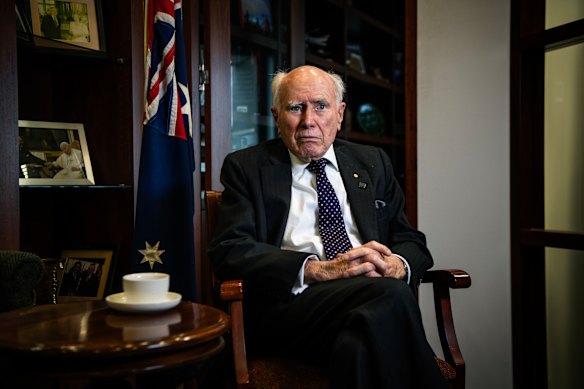
John Howard’s hypocrisy is astounding. It was he who demonised refugees; he lied about the Tampa incident to turn around a failing election campaign; it was he who opened the door to Pauline Hanson and her racist policies. He was a divisive figure against multiculturalism. Now he says that immigration is a success story and that we shouldn’t pay any attention to One Nation.
Unfortunately, it’s too late. He could have stopped that rot when he was prime minister. Manuela Epstein, Pyrmont
In the current strident questioning about the worthiness of immigrants, why is it left to our old has-been prime minister John Howard to make such unifying statements as everyone, irrespective of their ethnic background, should feel they are part of Australia? You disappoint and embarrass me, Albo. Pen G. Layton-Caisley, Marrickville
John Howard’s highlighting of the many benefits of migration is one of the few statesman-like acts in his long career. This follows Malcolm Turnbull’s call to the Coalition to work with the government to land a decent migration policy. Sadly, Angus Taylor has hedged, since he and his colleagues are more concerned with winning One Nation voters. Tony Simons, Balmain
Hanson is no patriot
To add to Paul Sakkal’s comments on Chris Bowen’s critique of Pauline Hanson’s patriotism, it was Hanson who concluded a speech in Florida with the words “God bless America and God help Australia” (“Labor takes the fight to Hanson on patriotism”, September 19). I mean, how unpatriotic can an Australian-born citizen get? Sakkal argues with some credence that Labor’s primary vote is in “perilous territory”, but if that’s the case, then so is that of One Nation and the Coalition, who are below Labor on that score in the polls. Sakkal also asserts that Bowen’s criticisms could bolster One Nation, but it could also erode that party’s support as part of an accumulation of exposing its brittle policies on immigration and superannuation and highlighting the insults that Hanson has sprayed like confetti on all and sundry. Frank Carroll, Moorooka (Qld)
Big Gas threatens to ruin reef
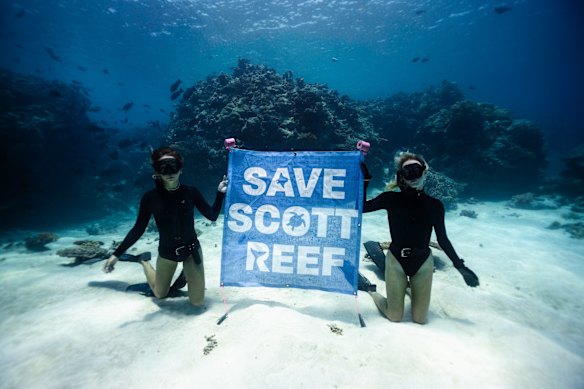
Thank you, Tim Winton, for the wonderful opinion piece “Big Gas drillers give us so little and take so much. They can’t have this treasure” (September 19), sharing with us “the riot of colour, the intensity of life, the overwhelming remoteness” and the sheer scale. All of which is “loaded with jeopardy” if our political leaders – PM Albanese, Environment Minister Watt and Premier Cook – put Scott Reef’s fate in the hands of the fossil fuel giants. One would hope that Winton’s eloquent descriptions of the reef’s beauty would move even the hardest politicians and gas industry executives to reject, outright, the Browse Basin project threatening the reef. However, the Browse Basin project, often referred to as a “carbon bomb” with its estimated 1.6 billion tonnes of greenhouse gas pollution, comes up for approval soon and Scott Reef’s protection is not certain. Our PM tells Pacific leaders our top three priorities are “climate change, climate change and climate change” and Minister for Climate Change and Energy Chris Bowen will be president of negotiations for the coming COP31 Climate Summit. But the real test of Labor’s commitment to a safe climate will happen when Browse comes up for approval. Please give it an emphatic “No!” Rob Firth, Red Hill (ACT)
Lucky Tim Winton to be a “sea-nerd”. He’s still young enough to dive on Scott Reef. Those of us older, however, share his concern for this healthy oceanic atoll, and plead with the powers that be to preserve this coral reef from Big Gas. It’s a gamble we must not take. Barbara Anderson, Waverton

Tim Winton’s passionate appeal for government reconsideration of its 40-year extension of Woodside’s WA gas extraction must be acted upon. In 2022, I visited the First Nations Murujuga rock carvings near Port Hedland under threat from Woodside’s application for an extension of its licence to extract offshore gas. The then environment minister, Tanya Plibersek, also visited these sites and, for the remainder of her term, was able to keep Woodside at bay. Following Labor’s re-election in 2025, I was horrified when, almost in the re-elected government’s first significant announcement, the new minister, Murray Watt, boasted about giving Woodside a 40-year extension to its gas extraction lease. Little did I know then of the huge impact this action would have on the biodiverse Scott Reef. On turning the page to Peter Hartcher’s analysis on the electoral impact of Labor’s recent focus on immigration and reduced action and commentary on climate change (“Labor’s enemy … with benefits”, September 19), I can only join him in urging the government to start taking real action on climate change in order to reach net zero by 2050. Elizabeth Elenius, Pyrmont

Witness wears thin
I want to compliment the unidentified solicitor assisting the commission who raised their eyebrows to express what words could not during yet another circuitous witness testimony at the ICAC – this time from Sharangan Maheswaran (“The eyebrows have it: Witness stretches credulity and patience”, September 19). Maheswaran seemed to find the commission’s questions acceptable provided they were accompanied by an expression of suitable reverence. On a day marked by arrogance and circumlocution, I found assisting counsel Dr Peggy Dwyer’s questioning admirably concise, and the solicitor’s raised eyebrows apposite. Salvatore Sorbello, Campsie
A super solution
There is more than one way to slow an economy when the imbalance between supply and demand results in inflation. Rather than using the traditional monetarists’ solution of raising interest rates (“RBA sends blunt signal before rates decision”, September 19), and thereby forcing the most vulnerable to shoulder the burden, we now have a fairer solution to the dilemma in the form of the virtually universal superannuation system. The Reserve can be empowered to order an increase in superannuation contributions, thus removing money from the economy, but these funds would remain in each member’s account rather than further bloating the banks’ profits. When the 2 per cent inflation target is achieved, the contribution rate would fall to the normal 12 per cent. Such a system would enable increments to be imposed quickly, thus making it far easier to control inflation. Geoff Bryan, Mayfield East
Plastic plan a priority
What can people do about the level of microplastics in their body even if it’s not possible to know exactly how much? (“Fat chance: Why a blood test to detect microplastics is a hard sell for scientists”, September 19). Lobby government to support (1) nationally standardised methods for measurement of micro and nano plastics in human samples, (2) a national micro and nano plastic and PFA biomonitoring research program, as well as (3) all the other recommendations of the federal inquiry into the impact of microplastics and other toxics on human health. Of course, we should be deplastifying our kitchen and eschewing synthetic clothes, but the toxic effects of plastic on our bodies and the environment need to be dealt with at source through strong legislation from our federal government. Jill Robinson, Randwick
Charging forward
When one considers that 80-85 per cent of EV owners in Australia charge their vehicles at home, the relatively small number of public charge points available does not seem so bad (“EVs are taking over as Australians flee the bowser, but a lot must happen next”, September 19). However, as increasing numbers of people choose to go all-electric, we will definitely need to improve our charging infrastructure. The nation has only about 5000 public charge points, compared with 23 million in China! That’s one for every 5500 people here, and one per 67 in China. We have a long way to go to catch up, so we’d better get moving! Ken Enderby, Concord

Painkillers a grey area
Great article, Malcolm Knox (“Anaesthetics before aesthetics in league’s painkiller knockouts”, September 19). The whiff of hypocrisy surely hangs over the seemingly now mainstream practice of high-performing athletes being injected with analgesics “not to enhance their performance but to bring the athlete back to normal health”, enabling them to continue playing, especially during finals season. As an octogenarian, while not playing on the field, I would like to be able to participate in this practice so that I can be brought back to normal health and override my crippling arthritic joints. I promise I would not abuse the system, and my finals season be short enough that addiction or dependency would not be an issue. Judy Finch, Taree
- To submit a letter to the Sydney Morning Herald, email letters@smh.com.au. Click here for tips on how to submit letters.
- The Opinion newsletter is a weekly wrap of views that will challenge, champion and inform. Sign up here.
Disclaimer : This story is auto aggregated by a computer programme and has not been created or edited by DOWNTHENEWS. Publisher: www.smh.com.au