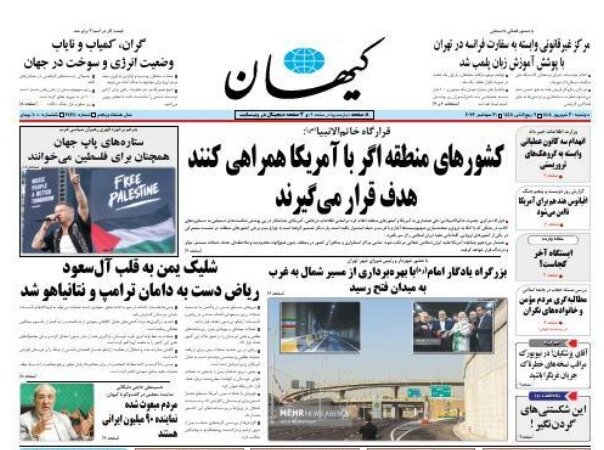
Kayhan, in a note, addressed the 205‑day war between Iran and the United States and the enemy’s critical situation. The more time passes since the foolish decision of the US and the Zionist regime to attack Iran, the more international observers recognize the scale of the American‑Israeli defeat.
A war that was supposed to end within weeks with the overthrow of the Islamic Republic has not only failed to achieve that result after 205 days, but has reached a point where Iran has gained the upper hand and is now pressuring the aggressors. After failing in the war, the US and Israel were forced to fight for another goal — reopening the Strait of Hormuz — but they have now encountered the reality that another strait, Bab al‑Mandab, is controlled by Yemeni fighters and is moving closer to closure. Now, the situation is not good at all for the US and the Zionist regime, even though they try to prove otherwise through media propaganda.
Siasat-e-Rooz: To achieve peace, one must be strong
Siasat-e-Rooz dedicated its editorial to how peace can be achieved. Over recent decades, the United States has had a record filled with killings and crimes around the world. Trump, claiming to counter nuclear proliferation, bombed Iran’s nuclear facilities during the 12‑day war while Iran was in the middle of nuclear negotiations with the US and the IAEA. In the Ramadan War, the US and the Zionist regime launched a war in the middle of negotiations under the false claim of supporting the Iranian people, while what they delivered to the people of Iran was the massacre of thousands. The Ramadan War once again proved that countries have only one option to confront aggression and injustice and to reach peace: turning toward strength based on internal capabilities. Iran, by relying on military power, diplomatic capacity, public mobilization, and the geopolitical position of the Strait of Hormuz, managed to build a strong barrier against the aggressors.
Ham‑Mihan: Trump is worried about his power
Ham‑Mihan, in an analysis, pointed to the reason behind Trump’s rhetoric. The war has continued without any major achievement or significant result. The US could not overthrow the Islamic Republic, destroy Iran’s missile or drone capabilities, or force Iran into nuclear surrender or acceptance of US nuclear demands. Although Iran suffered human and material losses, none of these amount to a major achievement for Trump. Trump is trying, by promising that the war with Iran will soon end and fuel prices will fall again — and by promising to pay $5,000 to Americans if Republicans win — to prevent Republican defeat and Democratic victory in the upcoming elections. He knows that if Republicans lose their majority in both chambers of Congress, Democrats could become a serious obstacle during the remaining two years of his presidency and weaken his power.
Arman-e-Emrooz: A unique diplomatic opportunity
Arman-e-Emrooz referred to the annual United Nations General Assembly in New York. This gathering is considered a rare and strategic opportunity for Iran’s foreign policy. By participating actively and in coordination with friendly and aligned countries, Iran can take practical steps to rebuild relations with Arab and European states and even exchange messages with the United States to revive the Islamabad memorandum. Losing such an opportunity would not only mean ignoring an important diplomatic capacity, but could also bring significant political and economic losses that would be difficult to repair in the future. Through active diplomacy and precise coordination with friendly countries in groups such as the Non‑Aligned Movement, BRICS, and its eastern partners, Iran can adopt a coherent and strong position against unilateral pressure. This coordination not only strengthens the international legitimacy of Iran’s positions but also creates a more favorable environment for bilateral and multilateral negotiations.
Resalat: Iran shifts global balances in favor of its national security
Resalat, in a commentary, discussed the importance of the recent veto in the UN Security Council by Russia and China. The paper wrote that the veto by these two eastern powers shows that Tehran’s current strategy is neither absolute dependence on a particular bloc nor a romantic belief in Moscow and Beijing as unconditional allies. Rather, it reflects a network‑based and realistic diplomacy that turns shared interests into leverage. Iran has managed to engage two major global powers with veto rights in its geopolitical environment in such a way that they are willing to bear the political and diplomatic cost of confronting Western hegemony to defend a strategic partner. It shows that Tehran has moved from being a passive observer in the global power game to an active player capable of shifting global weights in favor of its national security.
Disclaimer : This story is auto aggregated by a computer programme and has not been created or edited by DOWNTHENEWS. Publisher: tehrantimes.com