As temperatures rise, Melbourne will shift towards a nighttime economy. We trial a new app which makes walking more comfortable and safer.
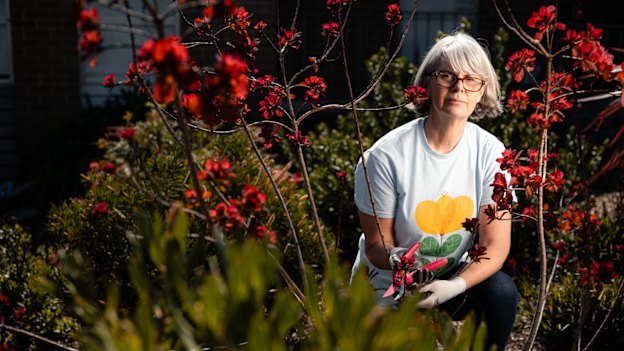
The morning has just turned light when Lisa Nicholson’s alarm sounds.
She taps her phone screen to turn it off, before sitting up and stretching muscles still tired from the day before.
After saying good morning to her teenage son, she walks out to her carport, where she hauls a lawn mower, whipper snipper, leaf blower and hand tools into the back of her little green Mazda 2.
Peering above the pile of metal in her rearview mirror, she backs out of her driveway, and sets off to create lush sanctuaries in Melbourne’s neighbourhoods of concrete and brick.
Tomorrow, she’ll do it all again – but as the city heats up, her days are getting earlier.
“I’ll try to get out and get all my work done in summer by midday,” says Nicholson, owner of gardening business Petite Gardens. “It’s a killer in the afternoon.
“Once the weather starts to really crank up – sometimes it’s earlier in the year, sometimes it’s later – it does affect the business.”
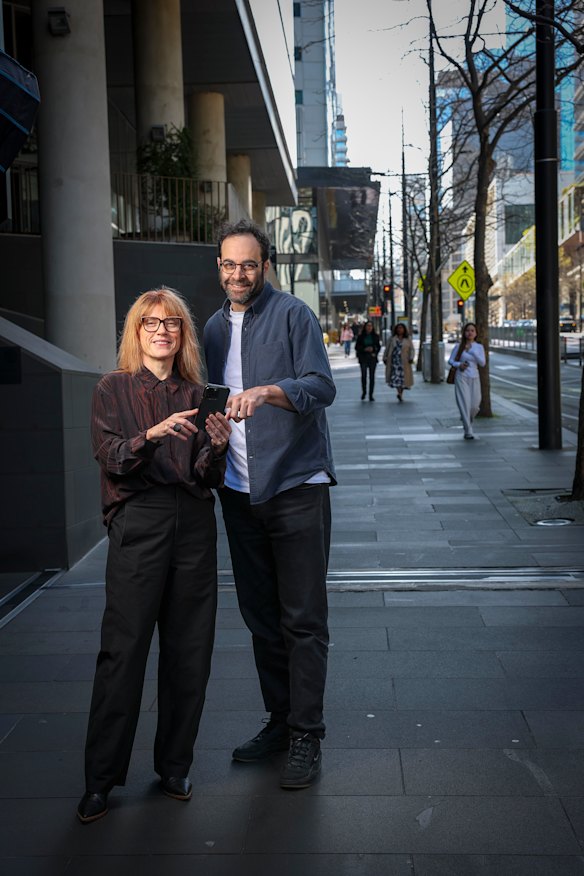
Gender and urban design expert Nicole Kalms says that, as temperatures rise with climate change, cities including Melbourne will shift their work, commerce and recreation to the nighttime economy.
Prioritising green space is a focus for Kalms, but she knows the shift to an after-dark economy also comes with an unintended cost for women. If women don’t feel safe out at night and in unlit areas, will they be excluded?
The topic of healthy places and people is one of the key pillars of Melbourne Assembly, a civic forum The Age is hosting in October, bringing together the world’s brightest minds, industry leaders, key decision-makers and the community to shape the city’s future.
Nicholson says that, if she didn’t have the agency to work around the heat, “I certainly wouldn’t do the work I’m doing”. “I’m not averse to being out there and working hard, and being sweaty and all the rest of it,” she says.
“But I will also not work in really extreme conditions because honestly, my clients don’t expect me to either.”
Escaping the heat isn’t just a matter of comfort. It’s a matter of health.
And, as the city looks to its future ahead of Melbourne Assembly, tree canopy experts are keeping a dogged watch over the state government’s plan to densify suburban transport hubs through designated “activity centres”.
Tree canopy has a direct correlation with all-cause mortality, cardiovascular disease mortality, and fatal or non-fatal heart attacks, an Australian study has found.
The activity centres run vast lines through Melbourne, with one in four concentrated in the Stonnington council area, in the leafy east.
But they also trace a path over sparse tree canopy hotspots, including West Footscray, Seddon, North Essendon, Brunswick, Thornbury and Preston.
RMIT University urban planner Thami Croeser, who helped compile tree canopy data for The Age, says experts are waiting to see whether developers prioritise good tree cover across the suburbs.
Historically, they’ve taken up almost entire parcels of land with apartment buildings, leaving little space for gardens or trees. Suburbs earmarked for Suburban Rail Loop stations could also bring in tens of thousands of new homes in towers of up to 20 stories across Melbourne.
“There is a bit of concern in the tree canopy space that it’s all housing-focused, and not on the vital tree canopy that needs to make that housing liveable,” Croeser says.
“As we densify, we want to ensure we don’t crush every tree in the neighbourhood.”
As Melbourne’s skyline pushes outward and upward, urban designers say the environment below has never been more crucial. Among them is Kalms, whose app is putting that premise into practice.
Walking comfortably and safely
At the top of a tree-lined suburban street in Melbourne’s outer south-east stands an unassuming green metal fence.
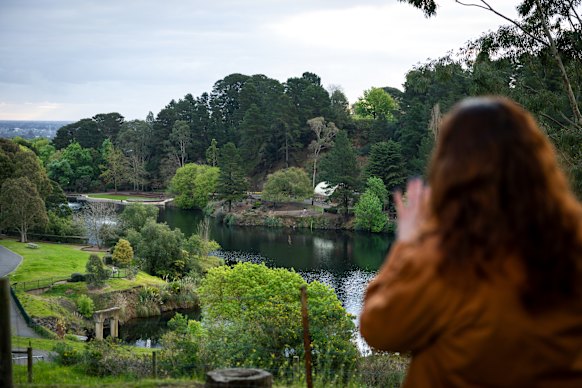
Taking a few steps beyond it reveals a ridge perched over a vast valley, where turtles crane their necks to break the surface of a lake cradled in its centre.
Rabbits burrow near the banks of the lake. And, up on the ridge at Wilson Botanic Park in Berwick, a kookaburra hops alongside the footpath, gobbling up a worm before it flies back to the oak tree from where it came.
This is a daytime route on the YourWalk app, created specifically with women and vulnerable people in mind.
Its walking routes prioritise tree cover, shade and accessible footpaths during the day, as well as adequate lighting at night – when many women don’t feel safe.
Rubina Nawabi is one of them – a 55-year-old mother of four living in the City of Casey, where the local council has partnered with Monash University XYX Lab and spatial data studio CrowdLab to pilot the YourWalk app.
After dark, the Hallam-based social worker rarely goes out, unless she’s driving (not a given for women in Casey, where many families share a single car).
She refuses to take her usual low-lit shortcut if she is out walking after sunset and fears for her teenage daughter, who recently walked home for three kilometres with friends from Westfield Fountain Gate at about 6pm.
“If I knew, I would have really gone and picked them up,” Nawabi says.
“It becomes really scary.
“Towards the Fountain Gate area, there is quite a lot of light. But as we come towards this way [Hallam], it becomes isolated with not many people on the roads, and there is not much light.”
Women consistently cite an absence of lighting (namely quality, warm lighting) as the biggest factor stopping them from going out at night, Kalms says.
That’s alongside the unpredictable behaviour of violent men.
Then there’s the lack of public toilets (which you can filter for on the YourWalk app), and accessible footpaths for prams – all of which create an inhospitable environment, excluding women from a growing economy.
Kalms says that councils have an excess of data mapping the safety and comfort of their suburbs. They know their tree canopy coverage and ground temperatures, and every streetlight they own, but they seldom use the data holistically.
“We know where all the CCTV cameras are. We’ve got crime data. We’ve got our own data about women’s safety for a lot of these communities,” says Kalms, director of Monash’s XYX Lab.
“All of this information is really about understanding quite stark statistics around how women and girls navigate cities.”
The Age tested two routes on the YourWalk app, which integrates council data to map the most comfortable and safe daytime and nighttime routes.
The app is being piloted with a view of being rolled out across Melbourne, incentivising councils to invest in more foliage and better lighting. The first route The Age took cut through the Wilson Botanic Park, simulating a journey a resident might take from Coles in central Berwick to a home on Bournevale Drive.
The second, with the app on night mode, avoided the park, instead taking the well-lit and higher-traffic Harkaway Road.
More than 4.1 million Australians – or almost 30 per cent of the workforce – regularly work at night, according to University of Melbourne urban studies researcher Anna Edwards.
In that workforce, there are slightly fewer women than men (27 per cent, compared with 29 per cent) – many of whom Kalms says don’t feel safe catching public transport at night.
Almost a third of night workers have at least one child at home aged 14 or under, Edwards says.
If governments don’t do more to accommodate women, they risk them falling further behind. Edwards points to the NSW government, which last year launched Australia’s first dedicated night worker “action plan” to improve safety and amenity after dark.
“If we’re to participate in the nighttime economy, we need to feel safe, and so we need to be planning for the 24-hour economy,” Edwards says.
That includes, experts argue, acknowledging how climate change is pushing Australian cities to later work. Extreme urban heat exposure has tripled since the 1980s, and the greatest impacts are falling on low-income and marginalised communities, Kalms says.
In Spain’s Barcelona, which just recorded its hottest summer on record (with a 61-day heatwave), the city’s council has built designated climate shelters to give locals and tourists respite.
Melbourne could become akin to some European cities, shifting more work and recreation into the evening and nighttime as temperatures rise, Bupa chief health officer Nic Woods says.
The health insurer is a major partner of Melbourne Assembly, where Woods will be a panellist in October.
“Climate change is increasingly impacting not only our physical environment, but also our mental wellbeing,” Woods says.
“As we plan the cities of the future, it is vital that we work together to create spaces that balance health, safety and equity alongside increased green spaces and healthier urban environments.”
More than 46 per cent of Australian women experience climate anxiety, according to research by the health insurer. The rate is almost 5 per cent higher than men.
Melbourne Assembly will be held from October 19 to October 21. More information is available on the Melbourne Assembly website.
Disclaimer : This story is auto aggregated by a computer programme and has not been created or edited by DOWNTHENEWS. Publisher: www.smh.com.au