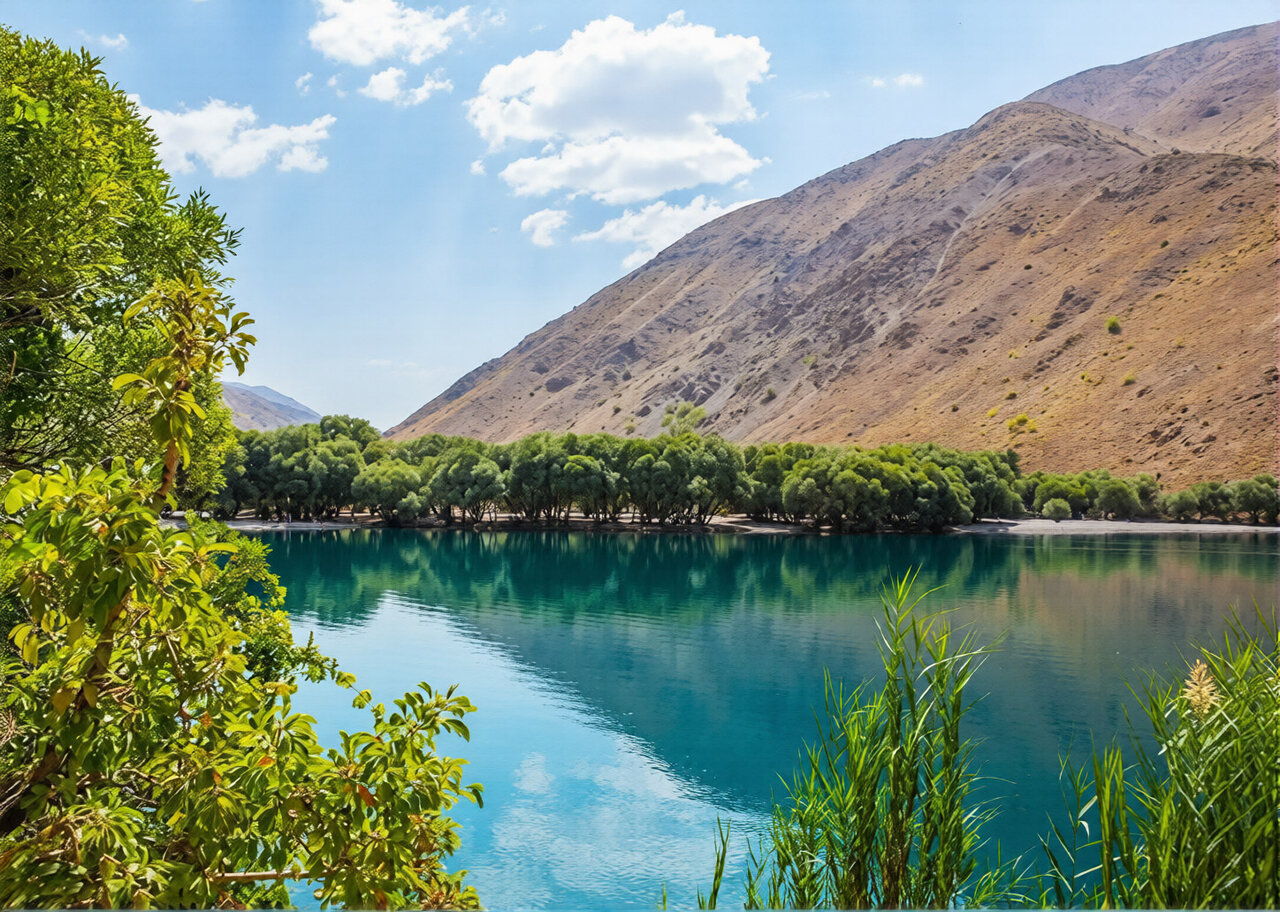
TEHRAN – Gahar, an ecologically significant freshwater lake located in western Lorestan province, has been registered in the Ramsar Convention as Iran’s 28th wetland of international importance.
Situated at an elevation of 2,360 meters within the mountainous Oshtorankuh Protected Area, the Lake is in fact made up of two smaller lakes that are situated within 100 meters of each other, named the Upper Gahar and the Lower Gahar.
The Lake’s rare features distinguish it from other lakes in the country, such as the freezing of its water surface in winter. Gahar and surrounding hills support unique biodiversity, including a number of nationally endemic species, such as the flowering plants Aethionema cephalanthum and Dionysia haussknechtii, and Capoeta pyragyi, a cypranid fish, according to the Ramsar Convention’s website.
It hosts 68 endemic and more than 600 plant species, 53 species of trees and shrubs, 45 mammal species, 30 reptile species, 195 bird species, five amphibian species, and numerous fish species, IRNA reported.
Trout, frogs, turtles, rams, ewes, antelopes, brown bears, foxes, boars, rabbits, eagles, vultures, and yellow falcons are among species living in this area.
The Site also provides habitat for internationally important species, notably the vulnerable leopard (Panthera pardus). It serves as an important stopover site for waterbirds such as the vulnerable eastern imperial eagle (Aquila heliaca).
Plant species include oak, willow, wild almond, wild pistachio, juniper, ash, milkvetch, thyme, and oregano; in spring and early summer the region is covered with beautiful wildflowers, particularly poppies and fritillaries.
Despite its natural beauty, the Site has remained relatively free from human disturbance due to its remote location. Access to the upstream area of the valley is limited to hiking trails, as construction of an access road has been prevented.
An established management plan addresses key threats, particularly nutrient enrichment, eutrophication, and disturbance to fish habitats, through regular monitoring supported by an environmental ranger station.
Alagol, Ulmagol and Ajigol Lakes in Mazandaran province, Amirkelayeh Lakein Gilan province, Anzali Wetland in Gilan province, Barm Alvan in Kohgiluyeh and Boyer-Ahmad province, Bujagh National Park in Gilan province, Choghakhor Wetland in Chahar Mahal and Bakhtiari province, Deltas of Rud-e-Gaz and Rud-e-Hara in Hormozgan province, Deltas of Rud-e-Shur, Rud-e-Shirin and Rud-e-Minab in Hormozgan province, Fereydoon Kenar, Ezbaran & Sorkh Ruds Ab-Bandans in Mazandaran province, Gandoman in Chaharmahal and Bakhtiari province, Gavkhouni Lake and marshes of the lower Zaindeh Rud in Isfahan province, Gomishan Lagoon in Golestan province, Govater Bay and Hur-e-Bahu in Sistan and Baluchestan province, Hamun-e-Puzak in Sistan and Baluchestan province, Hamun-e-Saberi & Hamun-e-Helmand in Sistan and Baluchestan province, Kanibarazan Wetland in West Azarbaijan province, Khuran Straits in Hormozgan province, Lake Gori in East Azarbaijan province, Lake Kobi in East Azarbaijan province, Lake Parishan and Dasht-e-Arjan in Fars province, Lake Urmia [or Orumiyeh] in West Azarbaijan province, Miankaleh Peninsula, Gorgan Bay and Lapoo-Zaghmarz Ab-bandan in Mazandaran province, Neiriz Lakes & Kamjan Marshes in Fars province, Shadegan Marshes & mudflats of Khor-al Amaya & Khor Musa in Khuzestan province, Sheedvar Island in Hormozgan province, Shurgol, Yadegarlu & Dorgeh Sangi Lakes in East Azarbaijan province, and Zarivar in Kordestan province have already been registered in the Ramsar Convention.
Wetlands most threatened ecosystems on Earth
Wetlands represent a vital ecosystem and are known as the kidneys of the Earth. These ecosystems, among other things, provide clean water, protect against floods, restore underground aquifers, and maintain surface water flow during dry periods.
However, they are among the ecosystems with the highest rates of decline, loss, and degradation; they are disappearing three times faster than forests and are Earth’s most threatened ecosystem.
In just 50 years — since 1970 — 35 per cent of the world’s wetlands have been lost. Human activities that lead to loss of wetlands include drainage and infilling for agriculture and construction, pollution, overfishing and overexploitation of resources, invasive species, and climate change.
Wetlands are ecosystems in which water is the primary factor controlling the environment and the associated plant and animal life. A broad definition of wetlands includes both freshwater and marine and coastal ecosystems, such as all lakes and rivers, underground aquifers, swamps and marshes, wet grasslands, peatlands, oases, estuaries, deltas and tidal flats, mangroves and other coastal areas, coral reefs, and all human-made sites such as fishponds, rice paddies, reservoirs, and saltpans.
These lands are critical to people and nature, given the intrinsic value of these ecosystems and their benefits and services, including their environmental, climate, ecological, social, economic, scientific, educational, cultural, recreational, and aesthetic contributions to sustainable development and human wellbeing.
In an effort to ensure the legal protection of wetlands, prevent encroachment, and establish state sovereignty over these valuable ecosystems, the Department of Environment (DOE) has issued titled deeds for 22 wetlands, covering an area of 1.34 million hectares, across the country.
Issuing title deeds for the rest of the wetlands is on the agenda, ISNA quoted Ahmad-Reza Lahijanzadeh, an official with the Department of Environment, as saying in July.
The effort will serve as a more effective measure to conserve wetlands, prevent unlawful land acquisition, unauthorized change of land use, and infringement of public rights, while paving the way for exercising legal authority over wetlands, as well as facilitating legal pursuit of water rights and proper management of water resources, the official highlighted.
Iran’s geography is distinct, teeming with diverse landscapes. In Iran, 141 wetlands with ecological value, with an area of over 3 million hectares, have been identified, 28 of which are listed in the International Ramsar Convention.
MT/MG
Disclaimer : This story is auto aggregated by a computer programme and has not been created or edited by DOWNTHENEWS. Publisher: tehrantimes.com