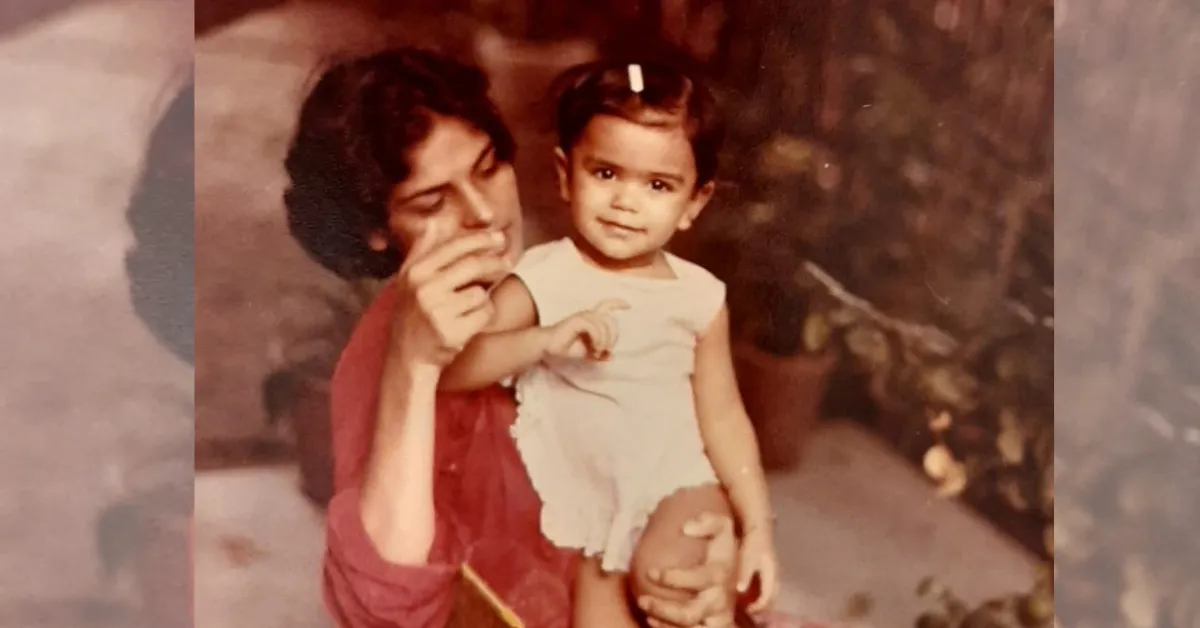
Neha Kirpal’s mother lived with undiagnosed and untreated schizophrenia for over 20 years, with her two children as her primary caregivers. The paranoia and hallucinations of the illness tore her family apart and drove her mother to leave her own home for over a decade. Finding her. Treating her. Caring for her while also growing herself up was a long, hard journey for Neha.
Today, she is the co-founder of some of the largest mental health organisations in the country; Amaha and India Mental Health Alliance, building and shaping a care ecosystem across the country for families like hers. As told to The Better India.
For the first 20 years of my life, I wanted to be as far from my truth as possible. A mental-health story wrapped in shame and stigma was not something I wanted to own in any shape or form.
We didn’t have a name for it.
When a parent lives with mental illness, it takes a while to even recognise the dysfunction you are living with. Home was stressful, unpredictable and often challenging. But we had no name for the illness at the centre of it, and no understanding of it.
That changed in 1994, when my mother took my younger brother and left home. She was gone for 10 years.
In her absence, my father and I began seeing doctors, and finally learnt what our family had been living with: paranoid schizophrenia. The hallucinations had filled my mother with fear. That fear and paranoia were why she left us.
Looking for them, and trying to bring them to safety & care, became a large part of my life for the next decade.
An invisible gaze
The child of a parent with mental illness carries fear, anger, resentment, fatigue, guilt and shame. These feelings stay inside you and touch every part of your life: your friendships, your school life and, above all, your sense of self.
It felt as if an invisible gaze followed me everywhere, full of judgement. At times I blamed myself. At times I blamed my mother for having a mental illness. At times I blamed God for crippling our family this way. How could I protect a parent from themselves?
Even when you are overwhelmed or burnt out, you feel the person you love is suffering so much more that their suffering must come first. So you minimise yourself. Settling for less becomes the mode. For me, it meant a life of neglect and a very low sense of self.
I also carried a dream of what a normal life might be, and I kept parts of my life sealed off just to feel normal. For the longest time, I never told my school friends and teachers what was happening at home. Shame, secrecy, and embarrassment were a constant companion.
The return of a stranger
When we found my mother and her treatment began, a new phase of my caregiving started. Before, I had longed and worried for a parent who was absent. Now I was actively managing her hospitalisation, medication, and treatment options, which went on tirelessly for years to come.
I was reuniting with my mother after a decade, yet I could see no part of a mother in her. The person who came back was someone I did not recognise in any way. The illness had the capacity to break relationships, and it would take us a lifetime to mend & heal together.
/filters:format(webp)/english-betterindia/media/media_files/2026/10/08/2-2026-10-08-23-28-58.png)
I was in my 20s, treating a parent against her will for an illness she didn’t realise she had, while trying to find a job and earn a living. It made me hyper-independent: realising I don’t have anyone to fall back on, so I must take care of myself. It was the start of my journey of self-help; grieving my childhood losses with the help of friends, therapists and support groups, as I tried to find a renewed sense of self and balance.
Adults who looked away
What doesn’t help is how little the world knows about mental illness, and how hard people find it to engage with. The words are often missing or not enough. The expression is limited, and safety is virtually absent.
I was surrounded by adults who looked away. Many blamed me for my mother’s absence and suffering, while others judged her for abandoning her little daughter. Neither was helpful or supportive. The invisible isolation lasted for years, and its impact on me lasted even longer.
I ran to save my life
Like many children responding to trauma — with fight, flight, or freeze — I leaned on sport. Hockey, badminton, swimming, track: anything that kept me in my body and in the moment, away from the fears and anxieties I carried.
Sport saved my life. I literally ran to save my life!
/filters:format(webp)/english-betterindia/media/media_files/2026/10/08/3-2026-10-08-23-28-58.png)
It can never be a long-term solution; eventually you have to face your truths. But for a young person with no tools and no support system, it carried me to my 20s, when I finally found the space to grieve.
Allowing myself to grieve
My mother had been in hospital for nearly a year when I went away to the UK to complete my master’s degree. On my flight out, I looked at myself in the mirror and realised I could finally feel all my feelings without needing to protect or watch over another. Allowing myself those few months of overwhelm and healing was probably the best thing I did in my 20s.
It was also the first time I understood boundaries and self-care: the need to preserve oneself while caregiving. Distance gave me perspective. It showed me it’s possible to be a caregiver and not lose myself altogether in the process.
One person who saw me
What helps children and young people is even one supportive adult. For me, that was my father’s older sister.
Hers was an Air Force family, always posted away. But just knowing that one person, somewhere, saw me and held me with love was a huge support. In my younger days, she was always available on a call for me to share my frustration, angst, and fears. I found strength and hope knowing she is looking out for me.
The people in my corner
As an adult, my biggest source of support and encouragement came from other caregivers and people with lived experience across support groups.
/filters:format(webp)/english-betterindia/media/media_files/2026/10/08/5-2026-10-08-23-31-55.jpg)
Hearing how they managed, how they navigated the healthcare system, what worked and what didn’t, gave me insight, validation, and hope. It held me through my caregiving journey far more than anything else I’ve done in the last two decades. Those who have suffered and learnt along the way have invaluable lessons to share, along with the enduring spirit that got them through it all.
A broken healthcare system
We carry an illusion of a care system, of specialists who will always know what is wrong and how to cure it. With mental illness, it can be hard even to bring yourself to access care and begin exploring treatment options.
My mother’s symptoms were first noticed in 1985. It took us nearly 10 years to reach a psychiatrist and receive the diagnosis of schizophrenia. None of our general physicians, family, or friends knew what this mental illness looked like or how to treat it. Getting past our own shame, society’s stigma, and unawareness is in itself a long journey for any family, however well resourced they may be.
All the big decisions continue to fall entirely on the family despite being under the care of specialists. When and how should she be hospitalised if she is unwilling? How should medicines be given if she is refusing them? How do we manage the side effects at home?
We felt completely ill-equipped, and nothing in the care system helped us navigate these big questions day on day. Months were spent chasing a psychiatrist in one place, a therapist in another, a hospital admission somewhere else. Years are lost working out where to go and whom to trust with the care of a loved one.
From those early days, I dreamt that someday this country would have a care ecosystem that could take care of a whole family’s mental healthcare needs.
The care gaps to be bridged
COVID has exposed the mental health needs in every household. Nearly every family in recent years has experienced some form of grief, trauma, addiction, depression and other such mental health challenges across the generations. The widespread recognition of mental health needs has reduced the stigma and increased help-seeking behaviour. Many people are reaching out in crisis mode to an overly burdened mental healthcare system.
/filters:format(webp)/english-betterindia/media/media_files/2026/10/08/6-2026-10-08-23-33-02.jpeg)
However, psychiatrists, psychologists, and hospital-based care is still fragmented, unregulated, and inaccessible to most. Quality of care varies widely, and that can make or break a family in crisis. Misdiagnosis, mistreatment, and violations of basic human rights inside mental-health facilities still happen in many places. Treatment is expensive, and insurance coverage is not yet fully available, as mandated to be on par with physical health as per our Mental Healthcare Act. So families give up trying. Breakdown of relationships is common and financial pressures from long-term caregiving lead to a life of neglect & hardship.
Inspite of their best intentions to provide care, we simply don’t have enough mental health professionals to support India’s demands for care. So we need to strengthen caregivers, support groups, and the institutional offerings in schools, colleges, and workplaces to get people the help they need in time.
Building the care I never had
For more than a decade, my working life was in a very different world. I founded India Art Fair in 2008 and spent nearly 10 years building a contemporary art fair. But my family’s experience of mental illness stayed with me. In 2018, I stepped away and joined psychiatrist Dr Amit Malik as co-founder of Amaha. It was a chance to share my lived experiences, to help build the kind of care my family had needed and never found.
While building Amaha, we realised after COVID that many people were seeking help without the right kind of help being accessible. So we built a mental-health ecosystem across the lifespan with our partner organisation Children First. Today we have over 300 clinicians, reach 600 cities and towns, and do about 40,000 sessions a month in 18 languages.
Amaha became an umbrella platform serving the mental health needs across generations through multiple centres, hospitals and online services. Our digital platform with over 6 million downloads offers information, self-help tools, mood trackers and therapy to people across India and globally. and online therapy to Indians in India and around the world.
Communities that care
It is not only the responsibility of mental-health professionals to provide care. Mental healthcare belongs to all of us and its our collective responsibility to support and nurture the mental wellbeing of our communities.
/filters:format(webp)/english-betterindia/media/media_files/2026/10/08/7-2026-10-08-23-36-23.png)
With this in mind, I’ve spent the last two years building a national alliance of nearly 400 member organisations working in health, gender, livelihood and education; a truly cross-sectoral community that centres mental health as a national development priority. The India Mental Health Alliance is founded by a cohort of people like me who have all had personal lived experiences and are inspired to build a mental health ecosystem for India.
Everyone is waiting for someone to share first
Through my own journey in my 20s and 30s, I realised how widespread this problem is. It touches every home, and yet everyone seems to be waiting for someone else to share first.
The more I spoke, the more I was met with people who wanted to listen and share in turn. I wonder if everyone is looking for the permission, and the safety, to have this long overdue conversation.
About a year ago, I set off on a journey with Nandini Murali and 10 other women that culminated in the book Homecoming: Mental Health Journeys of Resilience, Healing and Wholeness. We shared first-person narratives of our lives, and reflected on the care and support that worked and didn’t. We hope more people will own and share their mental-health journeys — not just to heal themselves, but to pay it forward.
Because every time you share, it changes the room. It makes the room safer, and makes it possible for someone else to begin their own journey of healing and hope.
Towards lightness
Forty years of caregiving have defined a large part of my identity, my beliefs and how I show up in the world. It gave me resilience and a desire to reduce other people’s suffering. But in recent years, I realised I want to carry myself along too — to include myself in my own life.
/filters:format(webp)/english-betterindia/media/media_files/2026/10/08/7-2026-10-08-23-40-21.png)
For a caregiver, that means being able to prioritise, draw boundaries and make choices towards personal fulfilment and joy. Sometimes it has meant doing less as a caregiver than one might consider necessary.
There is a social conditioning, often held by women — as mothers, daughters and sisters — to put ourselves last and assume the role of caregiver as a matter of course. For our own sake, we must break past it.
Today, caregiving does not define all my time, my priorities or my sense of self. I work, travel, enjoy time with friends and build on my purpose. I try to be as intentional about my own joy as I am about the caregiving role I continue to play with my mother.
Being a caregiver is not one’s entire identity. It is one part of life. We are worthy of the same care, love and attention we give to a loved one.
If you are where I once was
If you are in the middle of this right now, know that your life story and identity are not defined by the enormity of this moment or this illness.
Have faith in the resilience of the human spirit, and in the social support and medical help available today. Take that first step to reach out and share. The sooner you do, the sooner you can begin the journey of recovery and healing.
Disclaimer : This story is auto aggregated by a computer programme and has not been created or edited by DOWNTHENEWS. Publisher: thebetterindia.com