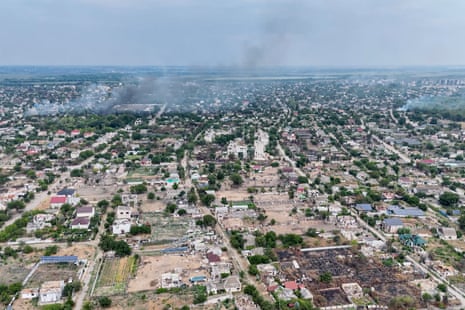
The White House has issued a statement saying Melania Trump has helped broker a ‘ceasefire’ in the Russian-occupied city of Oleshky, where residents have been enduring a worsening humanitarian crisis due to the lack of food, electricity and other resources.
The small town in southern Kherson has been the centre of an increasingly desperate humanitarian crisis under Russian occupation.
Since May, Russia has failed to deliver food, medicine or other essential goods to the area leading to deaths from starvation and disease. There has also been problems with the burial of bodies and sanitation, as the local morgue has been destroyed and there is no running water.
Russia and Ukraine have accused the other of blocking supplies to the population of the town which Ukrainian forces want to retake.
Ukraine has previously appealed for a ceasefire to evacuate the estimated 2,000 civilians left in the town – but Russia hadn’t made any commitments.
Earlier this week, Pope Leo called for an intervention while the Kremlin said Putin had discussed the situation with Donald Trump.
The White House now say both countries have agreed to pause military action “to allow for humanitarian aid to enter and to prepare a civilian evacuation through a designated safe passageway. A ceasefire is set to come into effect on 29 October.
“The situation in Oleshky is dire. Oleshky is a front-line war city on the brink of disaster. Oleshky’s remaining population is comprised primarily of elderly residents who urgently need medical attention, medicine, food, and clean water,” Melania Trump said in the statement.
“It was abundantly clear that without my intervention, the possibility to bring humanitarian aid into the city and to evacuate the elderly would be impossible,” she added.
There is no comment from Moscow or Ukraine yet. The Guardian’s international correspondents are looking into the statement and attempting to corroborate it with their sources.
Today’s blog is coming to a close. Here is a summary of today’s events in Europe:
-
Kyiv and Moscow have confirmed that a localised ceasefire in the Russian-occupied Ukrainian town of Oleshky, brokered with the involvement of the US first lady Melania Trump, will begin on 27 October.
-
France is reeling from “a terrorist attack with racist, likely Islamophobic, overtones”, according to Ali Rabeh, the mayor of Trappes, a town near Paris where a deadly attack claimed the life of one person of African origin and wounded several other people. The French president called the incident “a turning point for the Republic”.
-
The International Atomic Energy Agency said on Friday that repairs to key power infrastructure near the Zaporizhzhia nuclear power plant had been completed under a temporary ceasefire it brokered.
-
European leaders gathered in Budapest at the invitation of prime minister Péter Magyar to take part in an event commemorating the 70th anniversary of the 1956 Hungarian revolution. Magyar said that he wanted Hungary to be a “reliable ally” after the Orbán era.
Ukraine’s lead negotiator has confirmed that a localised ceasefire with Russia will begin on 27 October, with the humanitarian mission led by the US first lady Melania Trump to start two days later on Thursday 29 October – which may explain the earlier divergence between the ceasefire start dates stated by Moscow and Washington.
The first lady also said “an impartial American media organization” will accompany and document Russian and Ukrainian teams on the ground during the mission. The chosen news organization is Newsmax, a conservative outlet founded by Christopher Ruddy, a longtime friend of President Trump.
Russia’s justice ministry has published a list of 12 citizens who would be facing “restrictive measures” related to a law curbing the rights of government critics abroad that came into effect in August.
It is not clear what the restrictions are but the law stipulates that anyone “evading punishment” in Russia could have their assets seized and access to consular support withdrawn.
The list included the names of former oil tycoon Mikhail Khodorkovsky and the political scientist Ekaterina Schulmann.
France’s public broadcaster is reporting that several loud bangs were heard close to the home of the suspect arrested for carrying out a deadly attack in Paris today.
The country’s National Anti-Terrorism Prosecutor’s office said the house had been booby-trapped with “three gas canisters and electrical wires connected to a timer”. France Télévisions suggested the sound may have been a result of work being conducted by bomb disposal technicians.
In a post on X, the French foreign minister, Jean-Noël Barrot, said his thoughts were with the victims, their loved ones and law enforcement officers.
He added: “The investigation must shed full light on the tragedy that has struck Trappes and La Verrière today, but one thing is certain: hate speech always ends up leading to the worst outcomes.”
In recent weeks, some coverage of the student protests in France focused on the assumed religious and ethnic backgrounds of the demonstrators, with the US president making a baseless claim that “Paris is going to be a Muslim city very soon”.
The Kremlin spokesperson Dmitry Peskov said trilateral talks between the United States, Russia and Ukraine are scheduled to take place in Abu Dhabi next month.
Ukraine’s president, Volodymyr Zelenskyy, confirmed the plan – to meet in the Emirati capital during the first half of November – in a post on X.
He said: “Now we all need to focus on making these meetings happen – together with America, Europe and all our partners. Can they happen without America or without American pressure on Russia? Probably not. That’s why we are really counting on America to keep this a priority at every level.”
In an emotional speech, Emmanuel Macron spoke of how the deadly shooting attack in a Paris suburb earlier today marked “a turning point in the life of our republic and our nation”.
One person of north African origin was killed and several other people were wounded, including a 12-year-old girl in an incident that was reported to have lasted for nearly 15 minutes. A 39-year-old suspect is currently in police custody.
The French president said: “We will yield nothing, and we have nothing to yield. This marks a turning point, because it is the first time there has been a terrorist act planned to kill our fellow citizens, our children, on the basis of their skin colour or the religion attributed to them.”
Ukraine and Russia have signed an agreement clarifying details for the “humanitarian mission” in Russian-occupied Oleshky, Reuters reports.
In comments to the news agency, Kyiv’s ombudsman Dmytro Lubinets said Ukraine is also working on “expanding the mission” to other areas.
The multi-staged mission will involve demining roads to Oleshky, food deliveries and evacuations, he said, and should be implemented starting 27 October. That date is in line with the one given by the Kremlin earlier, but is different to Washington’s date of 29 October.
Melania Trump’s “personal involvement” made the agreement possible, Lubinets added.
Earlier on Friday, Emmanuel Macron met directly with around 20 student representatives for the first time since protests began a month ago, as his government prepares for further demonstrations over the weekend.
Macron promised an overhaul of France’s much-criticised university admissions system Parcoursup, student groups said after the meeting at the presidential palace, according to France24.
The French president is now in Trappes, where he will speak this evening alongside the mayor, “to express his solidarity with all those mobilized following today’s racist terrorist attack,” the Élysée Palace said.
A ceasefire aimed at providing humanitarian aid to the ravaged Russian-occupied Ukrainian city of Oleshky will begin in the early hours of Tuesday, Russia’s army chief has said.
“The Russian army are ceasing fire in the Kherson sector and entering a regime of silence from 4am Moscow time on October 27,” army chief Valery Gerasimov was quoted as saying on Friday by the Russian defence ministry, AFP reports.
The White House said earlier that the ceasefire would begin on 29 October. I’ll bring you more clarity on the timings of the truce as we get it.
In other news, guests representing countries across Europe visited Hungary’s capital on Friday to take part in an event commemorating the 70th anniversary of the 1956 anti-Soviet uprising — and to signal a new chapter in their countries’ relations with Budapest after this year’s ousting of former prime minister Viktor Orbán.
The visiting dignitaries – including European Commission president Ursula von der Leyen and president of the European Council António Costa – were in Budapest at the invitation of prime minister Péter Magyar, who has spent his first months in office rebuilding Hungary’s ties with Europe that had unraveled under his predecessor.
Addressing tens of thousands of people in Kossuth Square beside Parliament, Magyar praised the bravery of Hungarians who rose up against Soviet oppression in 1956 and “gave their lives for a democratic and independent Hungary.”
He said he wanted Hungary to be a “reliable ally” after the Orbán era:
Since 1956, every Hungarian leader, and I repeat every Hungarian leader, must know that his power can never be more important than the freedom of his country.
Hungary is not a country that can drift forever between east and west. In 1956, the Hungarians made a clear choice: We belong to a free and democratic Europe.
We want to be reliable allies who sit at the shared table with our heads held high, not fortune-seekers who isolate themselves through blackmail and pursuing a separate path.
Earlier on Friday, Magyar placed flowers at the graveside of Hungarians who were killed during the popular 1956 uprising that began with a students’ march in Budapest on 23 October and spread across the country.
Later, he oversaw a ceremonial raising of Hungary’s flag on Kossuth Square beside Parliament, accompanied by President András Baka and speaker of the national assembly Ágnes Forsthoffer.
Von der Leyen, the head of the EU’s executive Commission, was expected to deliver a speech alongside Magyar later in the day. She and other foreign dignitaries were scheduled to take part in a formal commemoration in the Parliament and attend a gala performance in the National Opera.
Pjotr Sauer and Peter Beaumont
Despite the White House’s claim the Oleshky ceasefire had been brokered by Melania Trump, there had already been protracted efforts to organise a humanitarian ceasefire, with claims by Ukrainian officials that it had been Russia that had rejected previous calls.
Calls for a ceasefire had been issued by Pope Leo XIV – who discussed the issue with the Ukrainian president, Volodymyr Zelenskyy – the United Nations, EU officials and the Council of Europe. As recently as 18 October, Ukraine’s ombudsman, Dmytro Lubinets, had also said he thought agreement was close without any mention of the first lady’s involvement.
Ukraine has for weeks been pushing for a civilian evacuation from Oleshky and nearby settlements, at times using drones to airdrop emergency food and medical supplies into town.
Here’s Pjotr and Peter’s report:
A suspect has been arrested and taken into police custody after a gunman fired from a vehicle in a Paris suburb on Friday, killing one person and wounded several others, including a 12-year-old girl, in a “deadly rampage” that French authorities suspect may have been a “racist, likely Islamophobic” attack.
France’s National Anti-Terrorism Prosecutor’s office took charge of the case and interior minister Laurent Nuñez spoke of a “terrorist crime.”
The shootings happened at three separate locations in the towns of Trappes and La Verrière, near Paris, and took less than 15 minutes in total, Nuñez said.
“A deadly rampage took place this morning,” he told reporters in Trappes. According to Nuñez, the attacker fatally shot one person and wounded five others, three of them very seriously, with their lives in danger.
Nuñez said the attack was considered a “terrorist crime” by prosecutors, with a possible racist motive.
Aurore Bergé, the minister for gender equality and fight against discriminations, said the 12-year-old girl was very seriously injured.
As quoted by the Associated Press, she added:
If a racist motive is established, I hope that the whole nation will stand alongside the residents of Trappes, La Verrière, and the victims. We cannot tolerate even the slightest racist remark in the French Republic.
Nuñez said the suspect fired “what appears to have been a military-grade weapon, or at least an automatic weapon.”
Trappes mayor Ali Rabeh said earlier that the gunman appeared to have fired relatively randomly, targeting passersby at several locations including a playground.
He told reporters:
This is probably one of the first attempted mass killings motivated by Islamophobia and racism. This was a terrorist attack with racist, likely Islamophobic, overtones.
Rabeh previously said the person killed was of African origin, while one of those critically wounded was of North African origin.
France’s National Anti-Terrorism Prosecutor’s office said it opened a criminal investigation into several offences, including “murder in connection with a terrorist enterprise with the aggravating circumstance that the act was committed on account of the victim’s actual or perceived membership of a particular race, ethnic group, nationality or religion.”
Further detail on that now with Donald Trump saying that he would speak to Elon Musk if there are still problems with Ukraine’s military-grade version of the Starlink service.
“If there is a problem, I will get it straightened out,” Trump told reporters at the White House after Ukraine said it was still having problems with the Starshield communications platform.
Asked if he had contacted Musk to restore access, Trump replied: “I have not spoken to him. I might have to, but I have not. I’ve heard it was fixed, but if it’s not, I’ll speak to him.”
As we’ve been reporting, it comes after Trump had said on Thursday that Musk, whose SpaceX is behind the Starshield system, had restored access.
The US president on Friday also rejected suggestions that Musk had too much power over a system that is vital for Ukraine’s fight against Russia’s invasion, now in its fifth year.
“I don’t think he does,” Trump said. “Elon will never do anything wrong. I know him very well, he is a fair person.”
Trump has had a complicated relationship with Musk, who led the (supposedly) cost-cutting Department of Government Efficiency (DOGE) last year before an almighty falling out last year. The pair appear to have made up again in recent months.
Further to that, Donald Trump was just asked by a reporter at the White House if he was aware of who ordered the Starlink access in Ukraine to be restricted.
Trump replied:
Well, I wouldn’t tell you if I did know. I have no idea. But I wouldn’t tell you if I did know.
He also said that he had not spoken to Elon Musk regarding the issue, but suggested he would do so if the access wasn’t fixed.
Disclaimer : This story is auto aggregated by a computer programme and has not been created or edited by DOWNTHENEWS. Publisher: theguardian.com