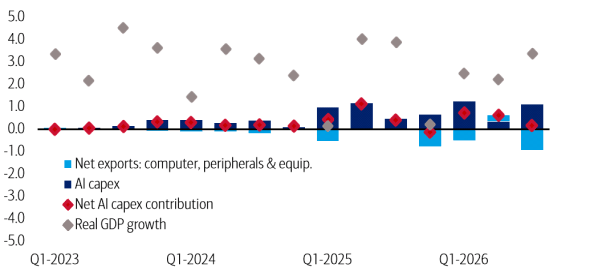
“A sustained correction in the AI trade is a major risk to the global economy,” BofA Global Research’s economists wrote Monday, the day before a midterm vote in which data centers are on the ballot in 10 states.
“Investors are increasingly concerned about the sustainability of the AI trade, and the more capex rises, the more risks loom,” they wrote. A slowdown would hit growth directly and through the wealth effect, as stock gains that have propped up spending reverse. They also tie some of the rise in interest rates to the borrowing needed to pay for the buildout.
Voters have their own complaints about the buildout. They will decide 41 local data-center ballot measures on Tuesday, from new requirements for developers to outright bans on construction, Axios reported, citing Ballotpedia. All six data-center measures already decided this year, in New Hampshire, Wisconsin, Michigan and California, went against development.
The backlash has reached the top of the ticket. In Texas, Gov. Greg Abbott halted new data-center approvals pending an audit after facing a backlash in rural communities, and his Democratic challenger, Gina Hinojosa, supports a moratorium. In Ohio, Sen. Jon Husted is on the defensive over his past support for data centers in a race that could help decide control of the Senate; the state has 21 data-center measures on Tuesday’s ballot.
Goldman Sachs expects attention to data centers to fade after Tuesday. Data centers “emerged as a theme in some campaigns this year,” Goldman’s Alec Phillips wrote in a Nov. 1 preview, but the issue ranks low among voter priorities, and he expects the focus to “fade somewhat” once governors stop campaigning. Congress might limit tax breaks for data centers, he wrote, but a national moratorium looks unlikely under any outcome.
The outcome itself looks less in doubt. Polling suggests national sentiment has swung about 10 to 11 points toward Democrats, and prediction markets imply they’ll win the House with around 236 seats, a wider margin than either party has held in several years, Phillips wrote. The Senate is a closer call.
The boom
The data centers are going up anyway. Spending on data-center construction hit a preliminary record annual rate of $84.95 billion in August, up 73% from a year earlier, according to the Census Bureau. J.P. Morgan Asset Management’s David Kelly told Fortune he expects the squeeze they put on construction workers and materials to intensify in 2027. AI-related hardware investment is now $613 billion above its 2022 level, about 1.9% of GDP, Goldman’s economists estimate. The biggest tech companies are on track to spend roughly $800 billion on capex this year, up 96%, and analysts expect $1.2 trillion next year, according to Goldman’s Ben Snider.
The rest of the stock market has started to pull its own weight. Since earnings season began, the S&P 500 has fallen 3% while the S&P 500 excluding AI stocks has risen 5%, Snider wrote.
The jobs
AI is also showing up in the job numbers. Some 24.6% of U.S. businesses now use AIin at least one business function, up 0.8 points in a month, and 28.6% expect to within six months, Goldman’s Sarah Dong and Joseph Briggs wrote, citing Census Bureau data. In information, professional services and finance, adoption is approaching half.
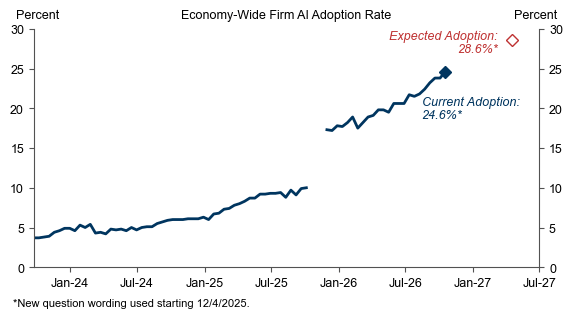
The labor market impact “has become increasingly visible in recent months,” they wrote. Industries with higher AI adoption now show weaker job growth and higher unemployment, a relationship Goldman calls statistically significant. Marketing, graphic design, customer service and some tech jobs are taking the hit. Layoffs attributed to AI reached 4,000 in September and 207,000 since May 2023.
The buildout hires its own workers. Construction jobs tied to data centers are up about 315,000 since 2022 relative to broader construction trends, Goldman estimates.
The rest of the economy
Outside AI, the order books are thinning. The Goldman Sachs Analyst Index, which surveys the bank’s own stock analysts on the companies they cover, fell 6.5 points to 49.1 in October, below 50 for the first time since April 2025. New orders fell 33 points to 29.5, the lowest since May 2020.
Asked about the top risks for 2027, the analysts named the war in Iran most often, including higher input costs and supply disruptions. AI spending and adoption came next.
After Tuesday
Tariffs go up, whoever wins. Democrats would likely target a few countries or products, such as Canada, but Goldman expects President Trump to announce new tariff increases after the election that more than offset them, raising the effective tariff rate by a little under 2 percentage points.
A Democratic House would focus on spending deadlines and the debt limit, with the Iran war, tariff rollbacks, reversing spending cuts and expanding health benefits at the top of its agenda, Goldman expects. Reversing last year’s cuts would add about 0.25% of GDP in spending in 2027.
In Congress, Phillips expects the AI fight to move from data centers to regulation, where Goldman sees room for a compromise on basic federal oversight and self-testing, and little appetite for anything restrictive.
Generative AI was used for research assistance and/or transcription of this article. The reporter independently reported and verified the factual claims in this article, and a human editor reviewed it before publication.
Disclaimer : This story is auto aggregated by a computer programme and has not been created or edited by DOWNTHENEWS. Publisher: fortune.com