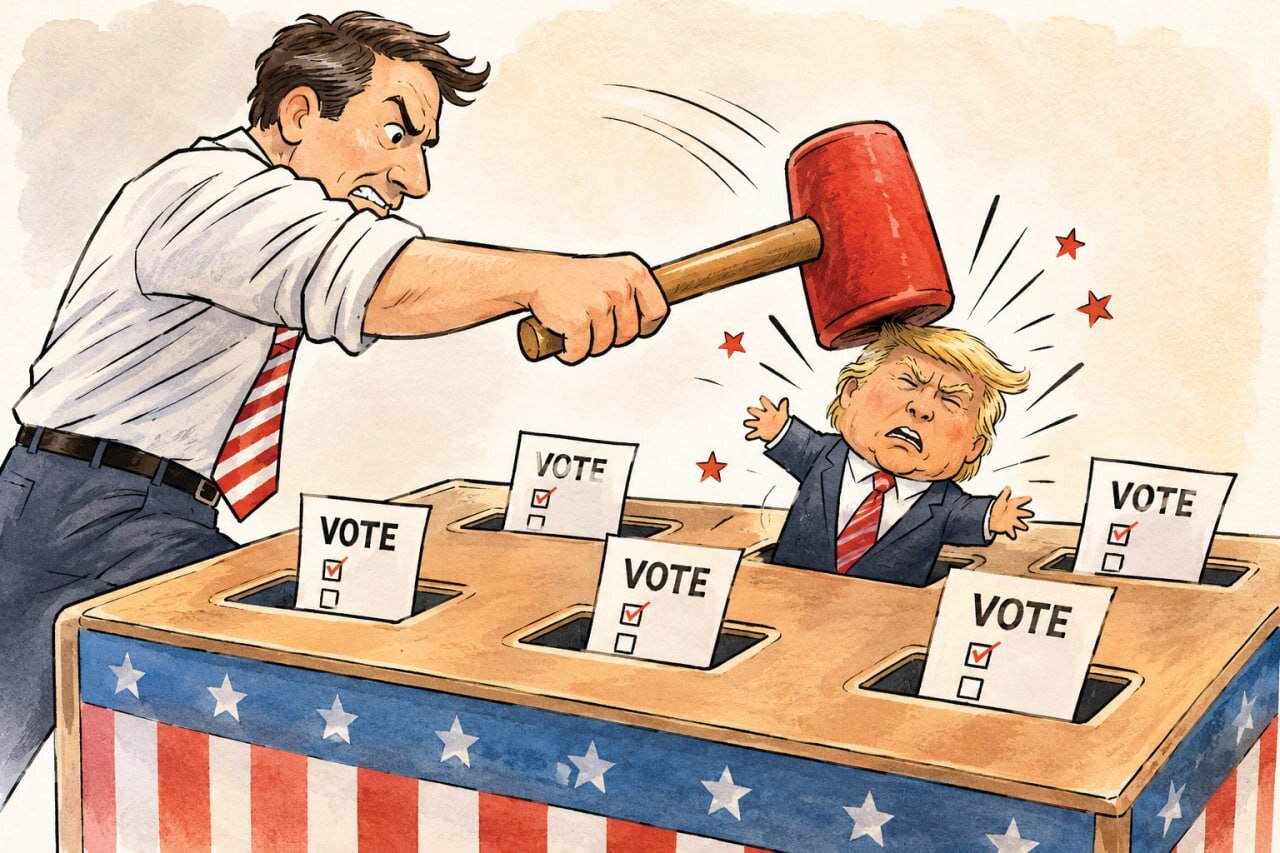
TEHRAN — Washington once imagined that its war against Iran would be a swift demonstration of American military superiority. Months later, with the conflict still exacting a heavy economic and political price, the White House is discovering that wars do not always end when their architects declare victory. Sometimes, they come back home — and this time, they may arrive at the ballot box.
Call it Operation Midterms Hammer.
The name is a deliberate play on Operation Midnight Hammer, the US military operation launched against Iranian nuclear facilities in June 2025. That operation was presented by the Trump administration as a decisive blow against Iran’s nuclear program. But the larger confrontation that followed has become a far more complicated affair, one whose consequences are now threatening to overshadow the Republican Party’s campaign to retain control of Congress.
The irony is difficult to miss. A president who returned to the White House promising to put America first and steer clear of costly foreign entanglements has presided over an extensive war with Iran — a conflict that has continued far beyond the optimistic timelines initially offered by his administration. What was supposed to be a demonstration of overwhelming force has turned into a prolonged strategic and economic challenge.
And American voters are being asked to foot the bill.
The political warning signs have been accumulating for months. A September Reuters/Ipsos poll found that only 34 percent of Americans approved of the US strikes on Iran, while 82 percent believed the conflict was likely to continue for an extended period. The same poll found Democrats leading Republicans by eight points among registered voters on the generic congressional ballot, 43 percent to 35 percent. Trump’s approval rating had also fallen to 32 percent.
The latest numbers offer little comfort to the White House. A Reuters/Ipsos poll completed on November 2 put Trump’s approval at 32 percent, close to the lowest level of his political career. Democrats led Republicans by 46 percent to 38 percent on the generic congressional ballot. Half of independent voters said their vote was intended to oppose Trump, compared with just 13 percent who said it was intended to support him.
The economy, meanwhile, remains the central concern for voters. The same poll found that 78 percent considered the cost of living a very important or top issue in deciding their vote. That is where the Iran war becomes especially damaging for the administration: even voters who do not follow developments on the battlefield are feeling the consequences of a conflict that has disrupted energy markets and contributed to the pressure on household budgets.
The Chicago Council on Global Affairs found in its 2026 survey that 86 percent of Americans believed the war with Iran had been bad for the cost of living in the United States. More broadly, 68 percent said the war had not been worth fighting, compared with 31 percent who considered it worthwhile. Among independent voters, opposition to the war was particularly pronounced, with 76 percent saying its costs outweighed its benefits.
In other words, the war may not be the first issue voters mention when asked what matters most to them. But it has become part of the economic reality shaping their decisions.
That distinction matters. Elections are rarely decided by foreign policy in isolation. They are decided by the price of groceries, the cost of filling a car’s tank, the security of employment and the general sense of whether a government is making people’s lives better or worse. A war that pushes up those costs can become a domestic political problem even for voters who have little interest in the details of military operations thousands of miles away.
The administration’s own political calculations appear to reflect this reality. A Reuters investigation in September reported that senior Trump aides were seeking to prevent the Iran conflict from escalating ahead of the midterms, fearing that a renewed military confrontation could deepen Republican electoral losses. One White House official was quoted as saying: “November is a priority.” The administration’s apparent preference was to keep the conflict relatively contained until voters had cast their ballots.
There is something revealing about that calculation. If the war were the unqualified success its political advocates have portrayed, why would the White House be so concerned about its visibility during an election campaign?
The problem for Trump is not simply that the war has lasted longer than anticipated. It is that the administration has struggled to translate military action into a clear and convincing political outcome. The stated objectives have shifted, the timeline has repeatedly changed, and the promise of a quick resolution has given way to a conflict whose economic and strategic consequences remain difficult to contain.
For Republicans, the danger is that the midterms will become a referendum on the gap between Trump’s promises and the realities of his presidency. The president himself is not on the ballot, but his policies, decisions and public statements are. With the party defending narrow congressional majorities, even modest shifts among independent voters and disillusioned Republicans could prove consequential.
There is, of course, no guarantee that the Iran war alone will determine the outcome. Domestic issues, candidate quality, turnout and the broader political climate all matter. Nor does every American who opposes the war necessarily intend to vote against the president’s party. But the available polling suggests that the conflict has become one more burden for Republicans to carry into an already difficult election.
The tolls of war are now being collected at the polls.
Operation Midnight Hammer was meant to send a message to Tehran. Operation Midterms Hammer may deliver a very different message to Washington: military power can destroy targets abroad, but it cannot shield a government from the political consequences of its decisions at home.
And unlike the bombs dropped on Iran, this one will be delivered by voters.
Disclaimer : This story is auto aggregated by a computer programme and has not been created or edited by DOWNTHENEWS. Publisher: tehrantimes.com