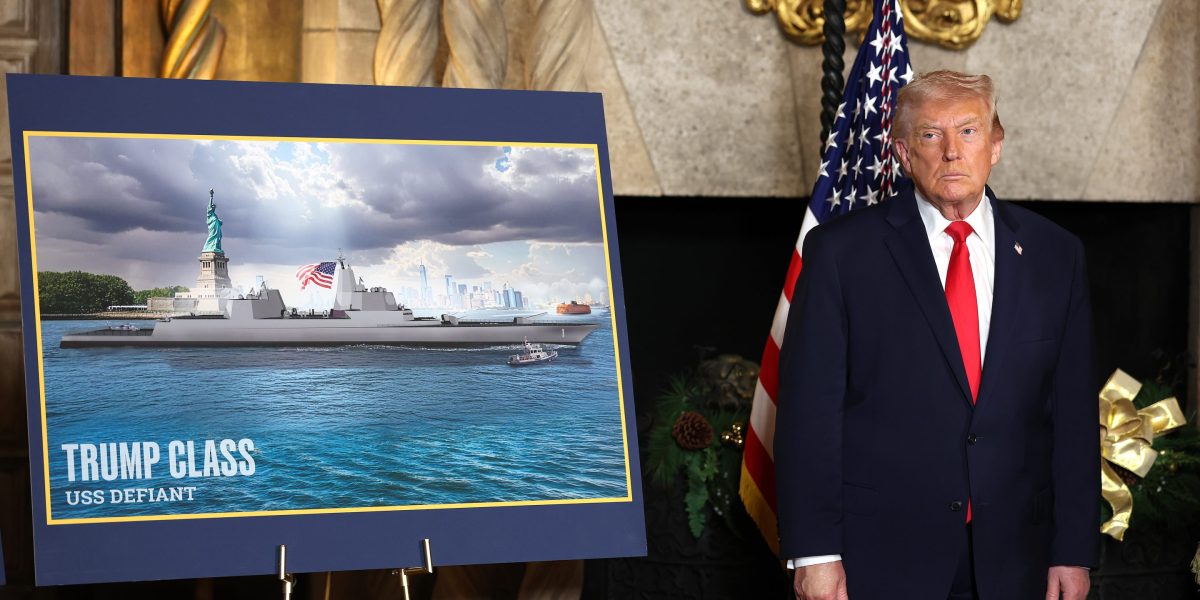
President Donald Trump last month announced a record-setting $1.5 trillion defense budget for fiscal year 2027. But in that towering proposal, experts say there’s obvious signs of waste and overspend.
A recent Cato Institute report identified several weapons in next year’s defense budget request that the think tank deems unnecessary and ineffective. Among them is a battleship Trump announced in December, which the president named after himself. But the ship, in this case, the “Trump-class” battleship is what the Cato Institute considers to be technology so obsolete, as it’s from a time before the states of Alaska and Hawaii even existed.
Here’s the issue: the U.S. Navy hasn’t operated a battleship since the last Iowa-class vessel was retired in 1992, a type of vessel which hasn’t even been constructed since the mid-20th century. The Trump-class battleship, which the Department of Defense is requesting upwards of $1 billion to build, will inherently be stuck in WWII, and would be rendered helpless against modern-day weapons. In fact, despite the billion-dollar price tag, Cato puts the true cost at $20 billion apiece, and it still won’t be able to subvert modern-day, advanced anti-ship missiles.
“We haven’t used this since World War II,” Ben Giltner, policy analyst at Cato Institute, told Fortune, “because the aircraft was able to pick it off in the ocean.”
Giltner said this type of ship shouldn’t even be on the Defense Department’s list: it’s not an aircraft carrier, meaning it can’t carry jets or other supplies. The proposed Trump-class vessel lacks all usefulness in this and future conflicts because of its incompatibility with modern weapons technology.
Why experts say Trump’s battleship is a waste of money
The defense funding request would just pile onto a $39 trillion national debt, one which recently surpassed 100% of GDP for the first time since WWII. While defense spending as a share of GDP remains far below its mid-20th century peak, Cato estimates the U.S. would need to cut spending or raise taxes by $827 billion annually to prevent the debt-to-GDP ratio from doubling by 2054, a figure that rivals entire past defense budgets. The $1.5 trillion proposal is a 44% increase from last year’s budget request. While Congress is unlikely to fund the entire proposal, the request signals the direction of the Trump administration’s defense ambitions.
Giltner said Cato’s estimated $20 billion price tag on a single battleship is a conservative estimate, one which only takes into account the acquisition and procurement of the vessel. That estimate, Giltner said, fails to take into account the long-term expenses associated with the standard upkeep of a ship and for specialized training required for ship crew.
Instead of adding to the debt, Giltner said that opting to pay down the debt would be a better allocation of tax dollars. “We could be doing something even as simple as helping to pay down the debt, the interest on the debt right now, which is absolutely enormous,” he said.
It’s $49 billion to weapons with ‘a lot of flaws’
Trump said the Navy aims to have about 20 to 25 battleships, with construction of the first battleship, the U.S.S. Defiant, targeted to begin in the early 2030s.
Navy Secretary John Phelan said during the new class’s announcement in December that the Navy “desperately needs” the battleships. “The future Trump-class battleship, the U.S.S. Defiant, will be the largest, deadliest, and most versatile and best-looking warship anywhere on the world’s oceans,” he said.
Following the budget request announcement in April, JPMorgan said the proposal signals a fundamental shift in how Washington views military investment.
“A global security environment that is less reliant on norms and more reliant on force continues to put upward pressure on defense spending; at the same time, the Trump administration is seeking to remake the U.S. defense industrial base, and there is more capital entering the sector as well,” JPMorgan said in a note.
In addition to the battleship, the Cato Institute report listed four other weapons systems it deemed wasteful: the F-35; the LGM-35A Sentinel intercontinental ballistic missile (ICBM), an updated version of the U.S.’s existing ICBM system, estimated to cost $4.6 billion; the F-47 stealth aircraft, estimated at $5 billion; and Trump’s Golden Dome missile defense shield, which carries a total estimated cost of up to $1.1 trillion. Together with the battleship, those systems would cost the U.S. nearly $49 billion in 2027 alone.
“These weapons systems, as I point out, they just have a lot of flaws,” Giltner said. “So then the question is, ‘why are we spending all this money on these certain systems in the first place?’”
Disclaimer : This story is auto aggregated by a computer programme and has not been created or edited by DOWNTHENEWS. Publisher: fortune.com