The day is Saturday, Dec. 14, 2024. A nervous and stressed Owen Wilson is backstage during Travis Scott’s headlining set at Rolling Loud Miami. He’s with his two sons (who are both Rolling Loud and Scott enthusiasts), Scott’s best friend and hype man “OG,” as well as movie director Jeremy Garelick. A full film crew , both backstage and riddled throughout the crowd, is anxiously hoping to capture the pinnacle moment for “Rolling Loud: The Movie,” based loosely on Garelick’s own experience sneakily bringing his 13-year-old son, Zion, to the festival and losing him. The only issue is, no one is quite sure if the moment they’ve all been waiting for — Scott bringing out Wilson in front of 50,000 fans — is actually going to happen due to all the moving parts. They are awaiting confirmation as Garelick repeatedly checks his texts.
Out in the audience, stars Matt Rife and Christine Ko, other actors, and the crew brave the festivalgoers and try to set up for the perfect multi-angled shots of the entrance. At one point, Rife and Ko, who play a zany, chaotic comedic duo assisting Wilson throughout the film, are told the moment isn’t going to happen and that they can head out. They reply with a swift, “No, we’re staying here,” as they remain hopeful and enthused about the performance. They are too synchronized with the vibe to bail.
Backstage, where shots of tequila are being poured and passed between adults, Wilson is continually checking in about the plan for his entrance. “I’m not supposed to dance, right? Where exactly do I stand?” he inquires nervously. He’s answered first by OG, who shouts, “Yeah, you can dance, dance your a— off when you get out there!” Then by Garelick, with the reminder that he just has to run out, take the mic, and roar his command, “I’m ‘fiening’ for more,” to ignite the crowd for a rendition of Scott’s hit song “Fein.” This proclamation by Wilson was Scott‘s own idea, which they discussed in a prior meeting.
In the audience, Rife, Ko and others begin to lose their minds. They see Wilson grab the mic, look out into the crowd full of adrenaline, scream the agreed-upon phrase, and lift his arms into the air in euphoria. Like magic, upon the proclamation, arm lift, and beat drop, pouring rain storms down upon the audience.
Not only did the crew grab the moment from a multitude of angles, to the deep delight and relief of Garelick, but so did the audience, who made the event go infinitely viral. Gen Z fans were both ecstatic and hilariously confused to see Lightning McQueen onstage with one of their musical heroes. “You can see how musicians have a hard time winding down after concerts because I was on an adrenaline rush for days because of that energy I felt,” Wilson recalled about the thrill-filled sequence. “I didn’t really dance, but I did jump up and down a lot. I’ve worked on a million movies and had lots of different funny, memorable experiences. That would definitely be in the top five of anything I’ve done.” The scene naturally became the ultimate climax of the film, which has a core aim stylistically — to make you feel like you’re at a real festival.
The partnership between Garelick’s American High Studios, Live Nation Studios, and, in turn, the Rolling Loud founders and organizers, was essential to make that goal achievable. “We’re Live Nation; we cannot make a movie where the festival looks fake,” executive Ryan Kroft proclaimed about the specific drive toward authenticity. “There are other movies I won’t name; they’re set at a festival, but it’s very clear they’re in a parking lot and there’s 150 people. To try to build a fake festival to scale and have a headliner perform with 50,000 fans would make a very expensive movie. But if you can partner with a company like Live Nation, you get access.”
That access resulted in Garelick bringing his team to the festival itself, first in L.A., then with Wilson and others in Miami, to not only shoot big scenes like the Scott moment, but also to experience the energy and be able to replicate it for later filming. “It’s so much easier to create something when you know the environment,” Garelick explained about the process of world-building. “We needed to build an array camera to capture it. It’s three cameras pointing in different directions where no one can be within a 20-foot radius to make sure no one [roguely] enters and blocks the frame. If you’ve been to Rolling Loud, you know it was not an easy thing to do.”
They used the difficult-to-capture footage as a reference to build a fake world that precisely matched the real one, on a volume stage in Atlanta where the rest of the film was shot. Garelick chose this type of stage due to his experience seeing U2 at the Sphere in Vegas (also on a volume stage), as he believed it would naturally parallel the necessary resonance and boom of a festival grounds. “It was just so loud that I couldn’t hear myself think,” Garelick recalled about the feeling he knew he’d have to replicate. “Communication was so difficult that I had to wear gun-shooting earmuffs to focus.”
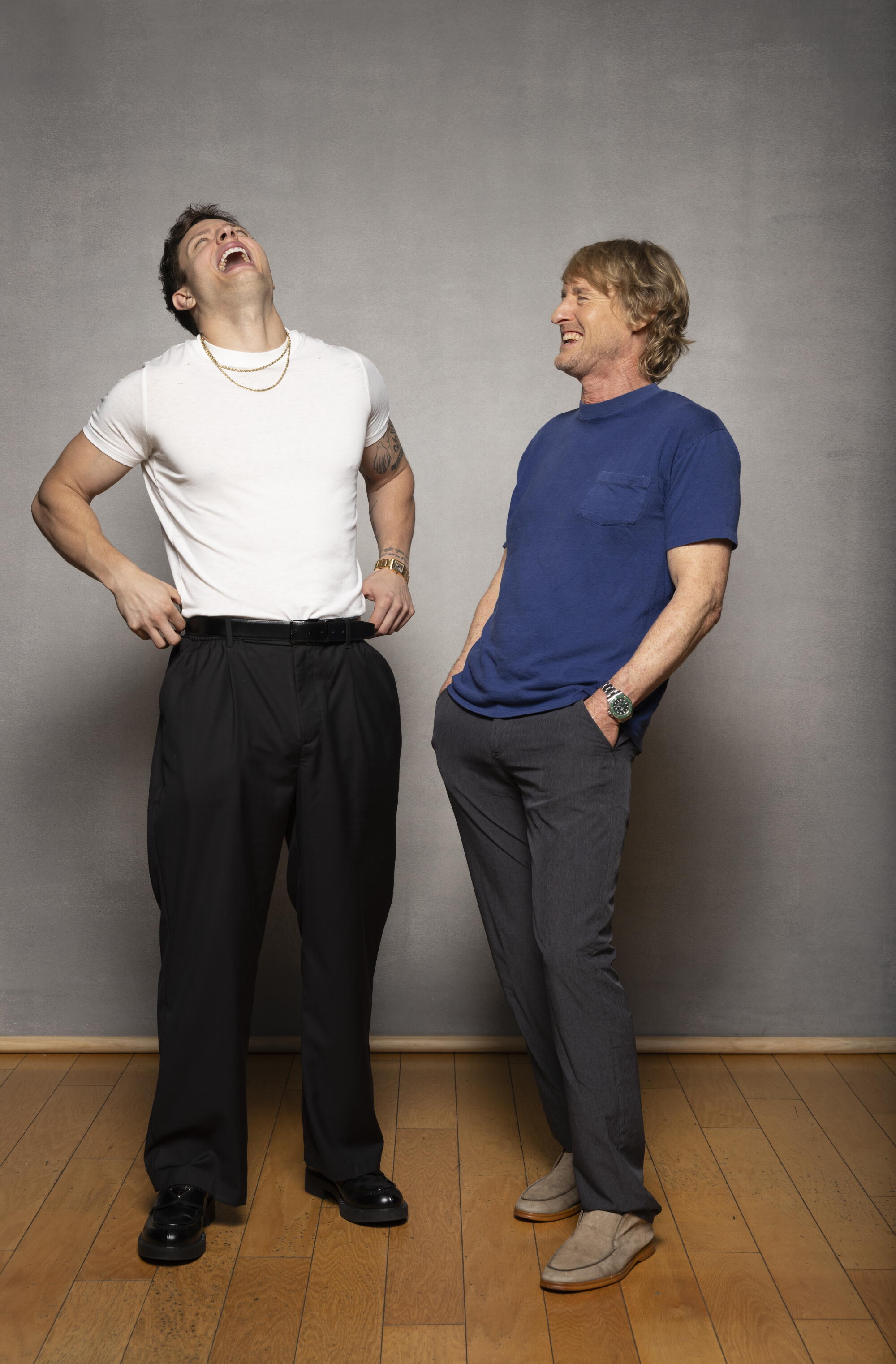
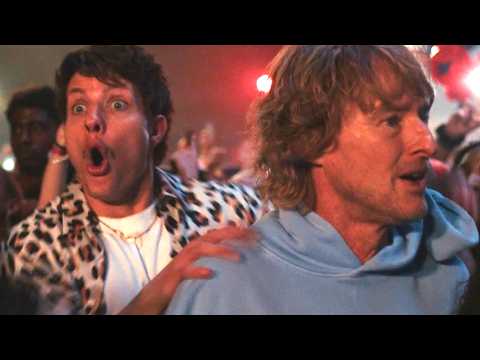
Matt Rife, left, and Owen Wilson of “Rolling Loud.”
(Ian Spanier / For The Times)
When watching the film, the festival sets captured live blend seamlessly with the shots of the crowd, which were captured both live and simulated later in Atlanta. In one moment, you can watch a fervent set by Playboi Carti or Sexyy Red and the next feel like you are weaving through a mob of scantily clad festivalgoers with Rife, Ko and Wilson, who are bolting past in drug-riddled passion. “We were forced into a lot of mosh pits,” Rife remembered about shooting at the festival. “One time we worked our way so far into the crowd that we were swaying around without power to walk in the direction we wanted. With Owen, it was what I would imagine a parent feels like [when] taking their kid through a haunted house. I was also scared, but I couldn’t let him know I was scared.”
Ko had many moments in her own scenes that exuded a similar chaos, which helped her immensely once they changed locations. “That was great because when we went to Georgia and shot everything else, we knew exactly what it felt like,“ she explained. “We remembered the heat, the wind, the rain, and it was really easy to get into character.”
Maintaining the rage-filled pandemonium was most essential in supporting the stakes of the core story — a terrified, fish-out-of-water father who loses his son and desperately needs to find him. “Seeing the energy and setup of the place, it became easy to imagine that if you got separated at this thing, that would be wild,” Owen recalled viscerally.
The father-son tale at the center was what drove Garelick to take on such a daunting project. “It was logistically stressful, and I could have walked away many times,” he said. “I didn’t because I wanted to show my son this story as a gift to celebrate that pivotal moment in our lives.”
Much of what actually happened in Garelick’s real life made it into the film, including him and Zion getting separated by the food trucks and porta-potties (though in real life he was found after only 20 minutes). But the most interesting thing they reenacted is exactly how Garelick snuck Zion in. He was 13 at the time, and Rolling Loud’s age requirement is 16. “We go there, and the first security guard says, ‘Oh, you can’t come in,’” Garelick recalled about the real moment, which was dramatized almost identically.
“We were walking away, and I was like, ‘You know what, Zion? This is not great parenting, but we’re gonna go to a different entryway. When they ask for your ID, just say you’re 16, and you left your ID at home.’ We go there. He lies. He’s so much better at it than I was. I was so nervous, thinking my wife was gonna kill me the whole time. Then, we get in. We weren’t celebrating because we didn’t want to get caught. We just walked away and did that silent fist bump together, which made it into the movie.”

Matt Rife, left, and Owen Wilson of “Rolling Loud.”
(Ian Spanier / For The Times)
Matt Zingler, one of the co-founders of Rolling Loud, was amused when Garelick told him about the slippery moment while first pitching the film. “I laughed about it because I was like, ‘Well, at least you were there as a parent, sneaking in your kid,’ which is honestly pretty cool,” he said. Zingler and his team received a plethora of earlier offers for films about the festival, yet something about what Garelick wanted to portray hit home. “I do feel like Rolling Loud is for families in a weird way,” he said. “It’s a way to connect parents with their kids. It also felt timeless and like something my father and I could watch together.”
The R-rated comedy, filled with improvised mania like self-pepper spraying, comedic nudity and swirling mosh pits, does still maintain a sentimental throughline. Thus, the proposed familial wholesomeness of the film strangely holds. For Wilson, though, as a dad who brought his sons to see him onstage at their beloved Rolling Loud, the intergenerational connection didn’t necessarily lead to total understanding. “I still don’t quite know what ‘fiening’ is. I guess it’s a version of fiending. I suppose that’s how I played it,” he said with a chuckle.
More to Read
Disclaimer : This story is auto aggregated by a computer programme and has not been created or edited by DOWNTHENEWS. Publisher: latimes.com