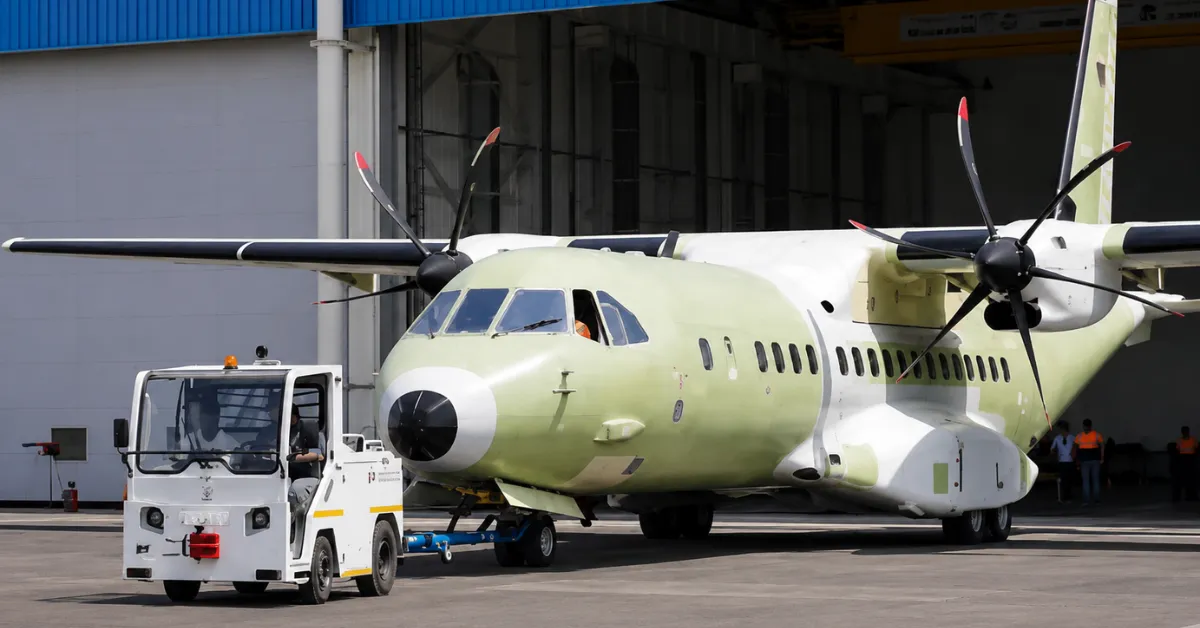
On June 10, 2026, a twin-engine military transport aircraft lifted off from the Tata-Airbus Final Assembly Line (FAL) in Vadodara, Gujarat. It was not the first C295 to fly in Indian skies — but it was the first one built there. That distinction matters enormously.
The aircraft, assembled by Tata Advanced Systems Limited (TASL) in partnership with Airbus Defence and Space, completed its maiden test flight to validate key systems and manufacturing standards before entering the certification and delivery process.
The flight forms part of the post-production testing required before delivery, with partners aiming to hand the aircraft over to the Indian Air Force later this year.
For a country that has long been among the world’s largest defence importers, this is a watershed moment. But what does ‘made in India’ actually mean in this context, and how deep does the indigenous content really go?
The deal behind the aircraft
The C295 programme is based on a Rs 21,935-crore contract signed between India and Airbus in 2021 for the acquisition of 56 transport aircraft. Under the agreement, 16 aircraft were delivered directly from Airbus’s facility in Spain, while the remaining 40 are being produced in India.
The Spanish-built aircraft have already begun serving the IAF, replacing the ageing Avro-748 fleet that entered service over six decades ago.
This rollout marks a historic first — it is the first occasion a private sector entity in India has successfully built and rolled out a full military aircraft, a domain traditionally led by state-owned enterprises, and notably executed months ahead of the original September 2026 deadline.
So how indigenous is it, really?
This is the most important question, and the answer is: it depends on which aircraft you’re looking at — and when.
TASL began manufacturing major airframe components, such as the fuselage and tail, in Hyderabad in 2023. In 2024, engines from Pratt & Whitney and avionics from Collins Aerospace — both imported from the US — were fitted in Vadodara.
So the first aircraft is assembled in India, with key structural work done locally, but critical components like engines and avionics remain imported.
The C295’s airframe comprises over 14,000 components, of which around 3,500 parts are slated to be domestically produced annually by Tata. Jorge Tamarit, head of the C-295 India programme at Airbus, has stated that indigenisation is measured by labour hours, and that by the 32nd aircraft, it will reach 98%, with the last eight aircraft — numbers 32 to 40 — carrying the maximum indigenous content.
Alongside TASL, Indian public sector companies are already contributing meaningfully. Bharat Electronics Limited developed the indigenous radar warning receivers and missile approach warning systems, while Bharat Dynamics Limited manufactured the countermeasure dispensing system.
What this means for the ecosystem
The more significant story may be what this programme is building around the aircraft itself. The project could create more than 15,000 skilled direct and indirect jobs across the aerospace ecosystem.
For Indian MSMEs and Tier-II/Tier-III aerospace suppliers, the programme creates opportunities to enter a highly specialised global aerospace manufacturing ecosystem that demands strict quality standards and advanced engineering practices.
Industry experts believe the experience gained could eventually help Indian suppliers integrate into global Airbus supply chains beyond the C295 itself.
This is how industrial capability compounds. Each aircraft assembled, each component indigenised, each engineer trained in Vadodara or at Airbus’s facility in Seville builds a layer of expertise that did not exist before.
India’s broader defence manufacturing push has seen output rise to a record ₹1.46 lakh crore in 2024-25, and the C295 programme sits at the heart of that momentum.
The road ahead
The FAL in Vadodara is projected to deliver all 40 C295s from 2026 to 2031, with each year’s assembly line expected to produce 12 aircraft. As each successive aircraft rolls out of Vadodara, the indigenisation percentage climbs.
By the time the final aircraft is delivered, the programme will have transferred significant manufacturing technology, built a deep domestic supply chain, and produced a generation of aerospace engineers who cut their teeth on one of India’s most complex industrial projects.
India remained heavily dependent on imported military platforms for decades despite being one of the world’s largest defence markets. Recent policy shifts have increasingly focused on creating domestic manufacturing capability, reducing import dependency, and building long-term industrial resilience.
The C295’s first flight from Vadodara is proof that those shifts are beginning to take shape, not as a finished product, but as a process now firmly underway.
The aircraft that lifted off from Gujarat on June 10 is not fully indigenous. But it is the beginning of one. And in aerospace, beginnings are everything.
Images courtesy of PIB
Sources
‘First Made-in-India Airbus C295 Successfully Completes Maiden Test Flight‘: by Newsd Staff for Defence Newsd, Published on 11 June 2026
‘Made in India: First Indigenous Airbus C-295 Completes Maiden Test Flight‘: by Outlook India, Published on 11 June 2026
‘First Made-in-India C295 Completes Maiden Test Flight‘: by Airforce Technology, Published on 11 June 2026
‘First Made-in-India C295 Aircraft Successfully Rolls Out at Tata Vadodara Facility‘: by Defence.in, Published on 13 May 2026
‘Tata Advanced Systems Rolls Out Its First India-Assembled C295 Military Aircraft‘: by MRO Business Today, Published on 12 May 2026
Disclaimer : This story is auto aggregated by a computer programme and has not been created or edited by DOWNTHENEWS. Publisher: thebetterindia.com