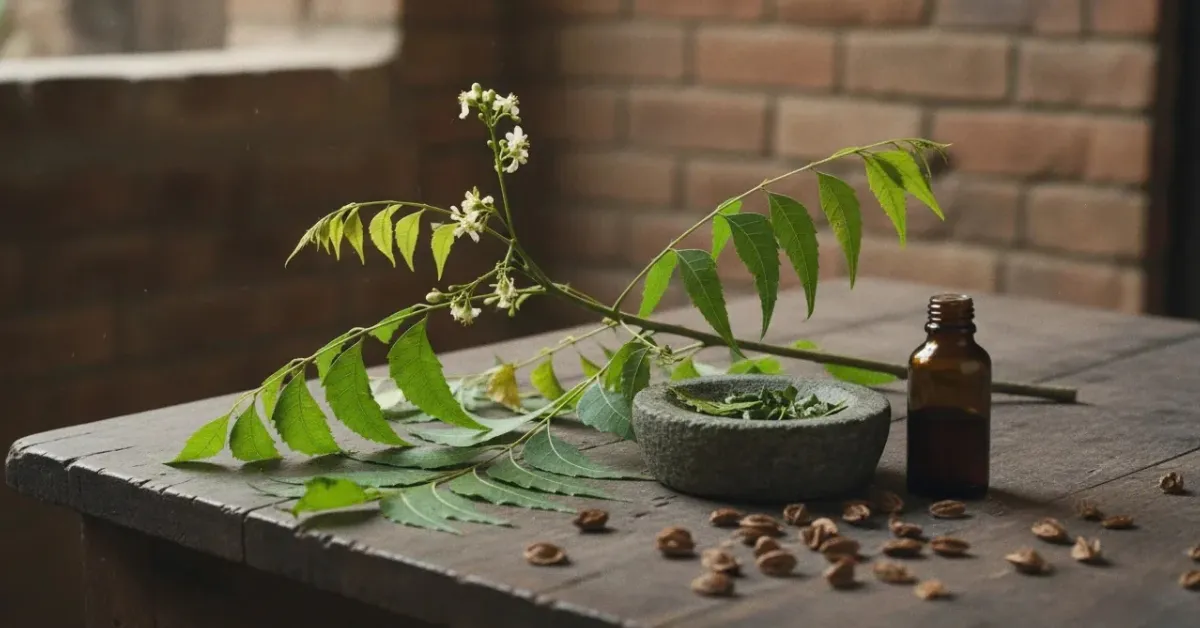
1 Plant, 100 Uses explores the many ways familiar Indian plants, leaves, fruits and trees have been part of everyday life — from food and farming to homes, traditions and natural remedies. Each story takes one plant and uncovers the surprising ways people have found it useful, often across generations.
For generations, the neem tree has been part of everyday life across India.
It grows beside homes, along roads, around farms, and in village commons. Its shade is welcome in summer. People use its leaves at home, its twigs as natural toothbrushes, its seeds for oil, and its wood for everyday products.
The scientific name of neem is Azadirachta indica. The tree is native to the Indian subcontinent and has been used for centuries in agriculture, traditional medicine, household practices, and rural livelihoods.
The National Research Council’s book on neem documents uses for almost every part of the tree, from its leaves and seeds to its bark, flowers, fruit, and wood.
That is what makes neem special. It is not just a tree with one useful product. Its different parts have found different purposes.
The leaves protect more than they shade
Neem leaves are perhaps the part most familiar to Indian households.
People have traditionally placed dried leaves among stored grains and clothes to deter insects. The Indian Council of Agricultural Research has also documented the use of dried neem leaves, neem kernel powder and neem oil in grain storage.
The leaves can also be made into extracts used in agriculture.
One of neem’s best-studied compounds is azadirachtin, which is found mainly in the seeds. It affects insects by interfering with feeding, growth, and development. Neem-based products are therefore used as part of integrated pest management.
A fallen neem leaf, in other words, can have a second life beyond the tree.
The seed becomes oil
When the neem fruit ripens, its seeds can be collected and pressed to produce neem oil.
The oil has traditionally been used for making soaps, cosmetics, and other household products. It is also an important source of compounds used in botanical pest control.
Farmers can use neem-based formulations to manage several crop pests. The Indian Council of Agricultural Research has documented neem and azadirachtin-based products as part of integrated pest management.
The same seed can therefore serve both the household and the farm.
What remains becomes neem cake
Oil extraction does not end the story.
The solid material left after pressing neem seeds is called neem cake. It can be added to soil as an organic input and is also used in agriculture to help manage certain soil pests.
This creates a simple cycle.
The seed gives oil.
The leftover cake returns to the soil.
For farmers, very little of the seed needs to be treated as waste.
A twig becomes a toothbrush
Long before plastic toothbrushes became common, neem twigs were used for cleaning teeth.
A small branch can be chewed at one end until it becomes fibrous, creating a natural brush. Neem has also been used in traditional oral care preparations.
Scientific research has examined neem’s antimicrobial properties and its potential role in oral hygiene. But traditional use should not be taken to mean that neem products can replace established dental treatment.
Still, the practice tells us something about how closely the tree was once woven into everyday routines.
A branch growing outside the house could become part of the morning ritual.
The bark and flowers have uses too
The plant’s usefulness does not stop with its leaves and seeds.
The bark has featured in traditional systems of medicine and has also been studied for its chemical compounds.
Its small white flowers have been used in traditional food and medicinal preparations. They also provide nectar for bees. The National Research Council notes neem as a source of nectar for honey production.
/filters:format(webp)/english-betterindia/media/media_files/2026/09/29/neem-uses-in-india-2026-09-29-17-26-52.png)
The fruit itself surrounds the seed that produces neem oil, making it an important part of the tree’s natural cycle.
Neem has a place in farming
Perhaps the most important modern use of neem is in agriculture.
Neem-based products can help farmers manage pests without relying only on conventional chemical pesticides. Azadirachtin works differently from many conventional insecticides, affecting insect feeding, growth, and reproduction.
Neem products have been studied against several agricultural pests and are used in integrated pest management.
Neem cake also has a role in soil management.
This makes the tree useful at several stages of farming, from protecting crops to improving the soil after harvest.
The oil becomes soap and more
Neem oil has been used in India for making soap for decades.
The National Research Council records its use in laundry soaps, speciality soaps, and other products. Today, neem oil and leaf extracts can also be found in a range of personal care products, including soaps, creams, shampoos, and hair products.
Some of these products draw on traditional uses, while others are marketed for specific cosmetic properties. The presence of neem in a product, however, does not by itself prove that every health claim associated with it is scientifically established.
Even the wood has a purpose
Neem is also a timber tree.
Its wood has been used for furniture, construction, and other wooden products. Older trees can therefore continue to be useful even after they are no longer producing as much fruit.
Branches and woody material can also be used as fuel.
The tree’s usefulness can therefore continue through several stages of its life.
Nothing needs to end with the harvest
What makes neem important is not one particular use.
It is the chain.
/filters:format(webp)/english-betterindia/media/media_files/2026/09/29/neem-uses-in-india-2026-09-29-17-30-11.png)
Leaves can be used in traditional household practices and agricultural preparations. Seeds can be pressed for oil. The residue becomes neem cake. Twigs can be used for oral cleaning. Flowers provide nectar for bees. Bark has traditional uses. Wood can become furniture or fuel.
Even fallen leaves eventually decompose and return organic matter to the soil.
For generations, people have looked at the whole tree rather than only the part they needed. That is perhaps the real lesson of neem. Its value lies not in one spectacular use, but in how many ordinary uses can come from a single tree.
Disclaimer : This story is auto aggregated by a computer programme and has not been created or edited by DOWNTHENEWS. Publisher: thebetterindia.com