Updated ,first published
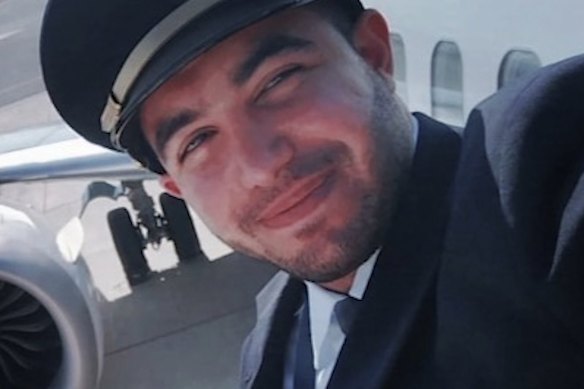
The flydubai co-pilot accused of trying to hijack an aircraft bound for Israel last month began his descent into extremism while living in Melbourne, according to UAE authorities.
Hammam al-Hammami told authorities he acted alone but that he drew inspiration from the September 11, 2001, terrorist attacks in the US, the state-run Emirates News Agency said on Friday, citing Attorney-General Hamad Saif Al Shamsi. The co-pilot had made the trip two previous times to familiarise himself with the route and the airport, the agency reported.
The update from the UAE contains the most detailed account so far of the attack, as well as the co-pilot’s history and the events contributing to what the attorney-general described as his extremist views, which he traced to his time living in Melbourne from 2015 to 2017.
According to the news agency, al-Hammami began gravitating “towards extremism and terrorism” in 2017 when he was studying in Australia, where he was influenced by radical ideology.
“During that period, he was influenced by takfiri [radical] ideology through reading extremist literature and following online content glorifying terrorist organisations and suicide attacks,” it reported, in comments attributed to the United Arab Emirates attorney-general.
Al-Hammami was pursuing a mechanical engineering degree at Melbourne’s RMIT University. The news agency reported that he had admitted regularly attending a mosque affiliated with RMIT, where he became acquainted with individuals associated with MyCentre, an Islamic organisation based in Broadmeadows.
“He stated that the centre was managed by a Lebanese man known as Abu Hamza and allegedly received support from an association linked to the Muslim Brotherhood,” it reported.
“He also said that he had prepared himself both psychologically and physically to carry out the plot by intensifying his exposure to material promoting terrorism and training in boxing under a private coach.”
Hamza, a cleric also known as Samir Mohtadi, is described on MyCentre’s website as its community leader. This masthead sought to contact him for comment on Saturday.
This masthead is not suggesting he intentionally taught al-Hammami to engage in violence or terrorism, only that al-Hammami claims to have been connected to Hamza’s organisation.
According al-Hammami’s tweets, unearthed by this masthead this week, he dropped out of his course at RMIT for a job and said it was “the best decision I ever made in my life”.
His tweets, which were written in Arabic, also featured misogynistic commentary and homophobic abuse.
Last Sunday, it was announced that the Victorian Joint Counter Terrorism Team was probing al-Hammami’s time in Australia, including his time studying at RMIT.
London’s Financial Times reported that the nation’s intelligence services had opened a file on al-Hammami while he was living in Melbourne. However, a senior source in the national security community strongly denied this.
Al-Hammami might have been included in a database or mentioned in relation to someone else but had not been investigated by ASIO at a serious level, the source said, speaking on condition of anonymity to discuss sensitive matters.
The 29-year-old Omani co-pilot attacked the captain of flydubai Flight FZ1073, which was travelling from Dubai on September 30, with the intent of crashing the plane into Ben Gurion Airport in Tel Aviv. The aim of the premeditated plot was to cause “the greatest possible loss of life”, Emirates News Agency said.
The plane plunged more than 4000 metres in less than 30 seconds before passengers, a separate pilot onboard and cabin crew were able to subdue the co-pilot and stabilise the aircraft. The pilot who intervened was assigned to the return flight and happened to be near the cockpit when the attack occurred.
“He noticed the cockpit door opening and closing repeatedly in an unusual manner, which aroused his suspicions,” the news agency said. He attempted to enter the cockpit using the access code and witnessed the attack after gaining entry, it said.
The return-flight captain and his co-pilot safely landed the plane at Tabuk airport in Saudi Arabia.
Before joining flydubai in January 2026, al-Hammami was employed by Royal Air Maroc, beginning in early 2025, and Oman Air before that from 2020 to 2024, the news agency said.
The UAE said it looked at flydubai’s procedures for recruiting al-Hammami. Investigators found that he met the requirements for employment, including holding a pilot’s license, providing a certificate of good conduct and completing necessary checks, the state-run news agency said. “However, none of the procedures revealed any indications of his extremist views or his intention to carry out a terrorist plot,” it said.
The suspect gave a detailed confession outlining his motives and the stages of planning and execution in “the presence of his lawyer and with all legally prescribed safeguards ensured”, the agency said, without identifying the attorney. The investigation into the co-pilot’s actions remains ongoing.
Extremism expert Dr Josh Roose said he was not surprised that al-Hammami had reportedly begun to be radicalised in Melbourne during the peak of the Islamic State movement, at a time when Australia produced more foreign fighters than most other Western nations.
The Deakin University associate professor said since then, a strong political base had spread online.
“It’s very conservative, and a lot of it is quite anti-government,” he said. “Many of these hardline fundamentalist Imams are spreading hate in their sermons.”
The Muslim Brotherhood was difficult to pin down, Roose said, but was an opaque term for a movement that wanted to build a caliphate and had links to Hamas, the designated terror group.
He said the UAE’s report was an opportunity for Australia to open up a conversation about the group’s influence, and the International Union of Muslim Scholars, which was founded by the Muslim Brotherhood’s spiritual leader, Yusuf Al-Qaradawi.
”The Australian government should be looking very closely at any organisation associated with the International Union of Muslim Scholars, and I’m confident that elements of the Australian security apparatus might be, but we need to consider whether or not association with the IUMS should be banned in Australia,” he said.
Roose said Australia’s reckoning with hate speech following the Bondi Beach massacre was unfortunately “plagued by politics”. The federal government was forced to abandon its most strident anti-vilification reforms in February because it could not get the support of the opposition or Greens.
“Unfortunately, that has restricted the capability of government to react or be proactive with people who are using hate speech in their sermons online and in other forums. And obviously, this is going to be an ongoing issue,” Roose said.
The European Union this week voted to outlaw elements of the Muslim Brotherhood, following the United States which designated specific regional chapters of the group late last year.
Home Affairs Minister Tony Burke on Saturday would not comment on whether Australia would consider listing the Muslim Brotherhood as a terrorist organisation, and pointed to the Victorian Joint Counter Terrorism Team’s ongoing investigation.
“We will not pre-judge the outcome of their investigation,” he said.
– with Bloomberg
Read more on the flydubai incident:
 Brittany Busch is a federal politics reporter for The Age and The Sydney Morning Herald.Connect via email.
 Carla Jaeger is a journalist for The Age. Got a tip? Email carla.jaeger@theage.com.au or message carlajaeger.62 on Signal.Connect via X or email.
From our partners
Disclaimer : This story is auto aggregated by a computer programme and has not been created or edited by DOWNTHENEWS. Publisher: www.smh.com.au