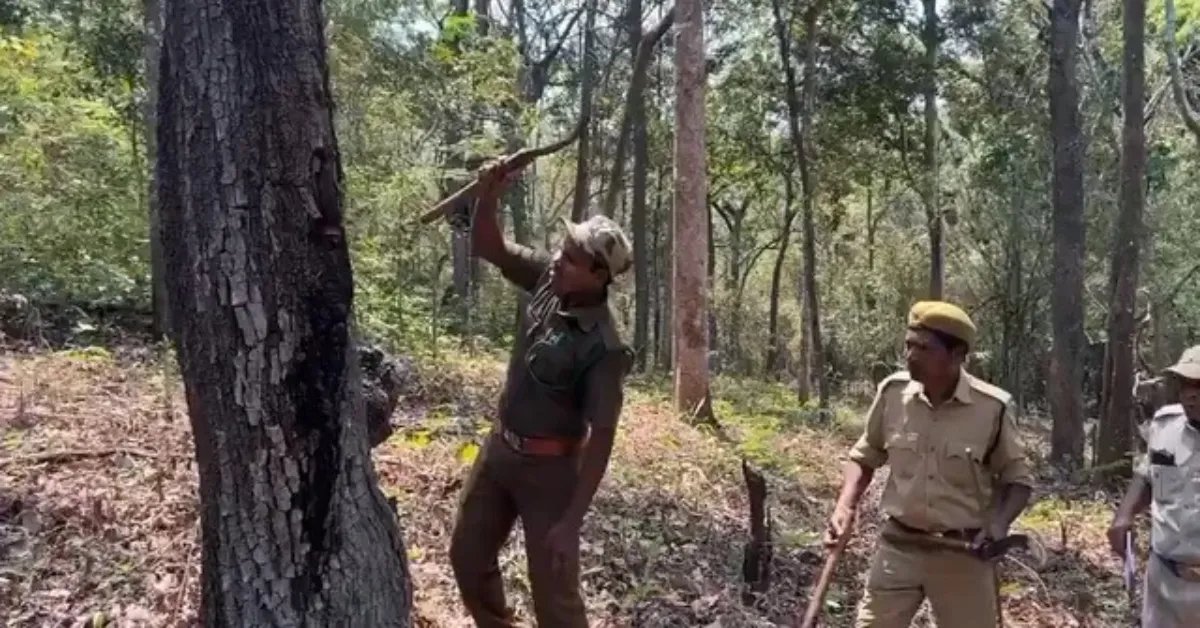
A forest official taps into the trunk of a seemingly ordinary tree in a dry Indian forest. Water flows out into his cupped hands. He drinks it, smiles, and says it tastes good.
The moment, captured in a widely shared reel by Jungle Diaries, surprised many viewers because the tree itself looks entirely unremarkable: rough bark, bare branches, no obvious sign that it holds litres of drinkable water within.
The species is Terminalia tomentosa — known as saj, asan, marutham, or ain depending on where you are in India — and it belongs to a remarkable group of trees that survive drought by storing water inside their trunks, roots, or tissues.
Across India’s dry deciduous forests, rocky hillsides, and desert landscapes, several tree species have evolved versions of the same strategy: save water during the monsoon, then spend it slowly through punishing summers. Some swell into bottle-shaped trunks. Others hide reserves in roots or soft wood.
Together, they form some of the subcontinent’s most extraordinary survival systems.
Here are some of the most fascinating among them.
1. Saj / Asan (Terminalia tomentosa)
This is the tree seen in the viral video. Common across central and peninsular India, saj trees are known for their thick, deeply fissured “crocodile bark” and their ability to survive long dry spells.
Not every tree stores water. Research from Bandipur National Park found that only around 5–10 percent of mature individuals develop water-filled cavities within the trunk. These trees often show a raised ridge or swelling on the bark — a sign recognised by forest communities long before scientists documented it.
During summer, people living near forests sometimes tap these cavities for drinking water. Traditional knowledge systems have long considered the water safe and even medicinal for stomach ailments.
2. Semal / Red Silk Cotton (Bombax ceiba)
Few trees dominate a dry forest landscape like the semal. In late winter, when most vegetation looks exhausted, this giant erupts into massive scarlet flowers on completely leafless branches.
The spectacle is powered by water stored within its soft, spongy trunk. These reserves allow the tree to flower before the monsoon arrives, providing nectar and food during one of the harshest periods of the year. Sunbirds, hornets, bats, and even sloth bears depend on these blooms.
Ecologically, the semal functions almost like a seasonal water tower — converting stored moisture into food when little else is available.
3. Givotia (Givotia rottleriformis)
One of India’s least-known drought-adapted trees is also among its most unusual. Native to parts of Andhra Pradesh, Telangana, Karnataka, Tamil Nadu, Maharashtra, and Odisha, Givotia rottleriformis has a pale, swollen trunk packed with water-storing tissue.
Its wood is exceptionally soft and lightweight, making it prized for traditional toy-making industries such as Kondapalli and Nirmal crafts. But that same commercial demand has pushed the species into decline in several regions.
Biologically, it behaves like a classic “bottle tree” — designed less like conventional timber and more like a living reservoir.
4. Drumstick Tree / Moringa (Moringa oleifera)
India’s everyday drumstick tree is also a drought specialist hiding in plain sight.
Known as murungai in Tamil and Shevga in Marathi, moringa survives dry conditions using a swollen taproot system that stores water and nutrients underground. Even when cut back severely, it regenerates rapidly because it is drawing on hidden reserves rather than starting from scratch.
/filters:format(webp)/english-betterindia/media/media_files/2026/05/21/2-2026-05-21-19-16-58.png)
Its scientific name itself reflects India’s relationship with the species: “Moringa” is believed to derive from the Tamil word murungai.
5. Baobab (Adansonia digitata)
India’s baobabs feel almost mythical — giant, swollen trees standing in pockets of Gujarat, Rajasthan, and Karnataka. Introduced centuries ago by Arab traders, some are believed to be over a thousand years old.
The reason baobabs became legendary is simple: they are among the greatest natural water-storage systems on Earth. Their trunks can contain enormous quantities of water, allowing them to survive extreme drought.
/filters:format(webp)/english-betterindia/media/media_files/2026/05/21/3-2026-05-21-19-17-29.png)
During dry seasons, the trunk visibly shrinks as reserves are used up. In Africa, elephants are known to break into baobabs for moisture. In India, many trees are treated as sacred landmarks and community gathering spaces.
6. Khejri (Prosopis cineraria)
In the Thar Desert, Khejri is less a tree than a survival infrastructure.
Unlike bottle trees, it does not store large quantities of water in its trunk. Instead, it survives by sending roots astonishingly deep into the earth — sometimes more than 30 metres — to reach groundwater inaccessible to most other plants.
Everything about the tree supports desert life: its pods become food, its leaves feed livestock, and its canopy enables farming beneath it. The tree is so revered that, in 1730, 363 members of Rajasthan’s Bishnoi community sacrificed their lives protecting khejri trees from being cut down.
7. Salai / Indian Frankincense (Boswellia serrata)
Growing from rocky cliffs and dry hillsides across central India, salai appears to thrive where few large trees can survive.
Its swollen base stores moisture and carbohydrates that sustain the tree through extreme heat. Meanwhile, its papery bark reflects sunlight and reduces water loss.
/filters:format(webp)/english-betterindia/media/media_files/2026/05/21/4-2026-05-21-19-17-53.png)
The species is best known for its resin — used in Ayurvedic medicine as shallaki — but its true marvel is its timing. Salai flowers and produces seeds during the hottest months of the year, relying almost entirely on stored reserves.
8. Ghost Tree / Karaya (Sterculia urens)
Leafless for much of the hot season, the ghost tree looks spectral in dry forests — smooth, pale trunks glowing against brown hillsides.
The trunk itself performs photosynthesis, allowing the tree to produce energy without maintaining water-hungry leaves. Beneath that waxy bark lies soft tissue capable of retaining significant moisture.
/filters:format(webp)/english-betterindia/media/media_files/2026/05/21/5-2026-05-21-19-18-09.png)
The tree is also commercially important for karaya gum, used in food and industry, while its hollows provide habitat for birds and small animals.
9. Hildegardia (Hildegardia populifolia)
Perhaps the rarest tree on this list, Hildegardia populifolia survives in fragments of the southern Eastern Ghats across Tamil Nadu, Andhra Pradesh, and Karnataka.
It has a swollen, bottle-like trunk adapted for storing water on steep, rocky slopes with poor soil. Yet despite its remarkable biology, the species is under threat from logging, fire, and land-use change. Some populations are now reduced to only a handful of trees.
Its disappearance would mean losing not only a rare species, but an entire evolutionary strategy perfected over millions of years.
/filters:format(webp)/english-betterindia/media/media_files/2026/05/21/6-2026-05-21-19-18-26.png)
What connects all these trees is convergent evolution: unrelated species arriving at the same answer to the same problem. In landscapes where rain arrives briefly and disappears quickly, survival depends on holding on to water for as long as possible.
Some became ecological lifelines. Others became sacred. Many remain overlooked despite quietly sustaining wildlife, forests, and human communities through India’s harshest summers.
The viral reel lasts barely a minute. But the story behind it stretches across deserts, forests, and centuries of adaptation — a reminder that some of the most sophisticated water systems in India were designed not by humans, but by trees.
Sources:
‘Water storage in Terminalia tomentosa’: by R. Shyama Prasad Rao, ResearchGate, Published on 25 August 2004
‘Forest official drinks water from a saj tree trunk: by Jungle Diaries‘, Instagram, Published in 2025
‘When Amrita Devi and 362 Bishnois Sacrificed Their Lives for the Khejri Tree’: by Dr S Natesh, Sahapedia, Published on 11 September 2020
‘Standing Tall: African Baobabs in Mumbai’: by Tanvi Sawant, for Roundglass Sustain, Published in 2021
‘In Praise of the Ghost Tree: by Wildlife Conservation Trust’, by Wildlife Conservation Trust, Published on 16 October 2021
Disclaimer : This story is auto aggregated by a computer programme and has not been created or edited by DOWNTHENEWS. Publisher: thebetterindia.com