The AI layoff panic that peaked this spring has gone quiet. Goldman Sachs thinks the layoffs are waiting for a recession.
“Concerns of imminent AI-related labor displacement have cooled in recent months after hitting a fever pitch this spring,” Goldman economist Joseph Briggs wrote in a note published Thursday. Then he laid out what may be coming. Under the bank’s forecast that AI eventually lifts productivity by 15% in the U.S. and other developed economies, he found that up to 9% of workers could be “displaced during the AI transition,” with slower hiring weighing on employment by another 3%. That’s roughly one in 11 workers.
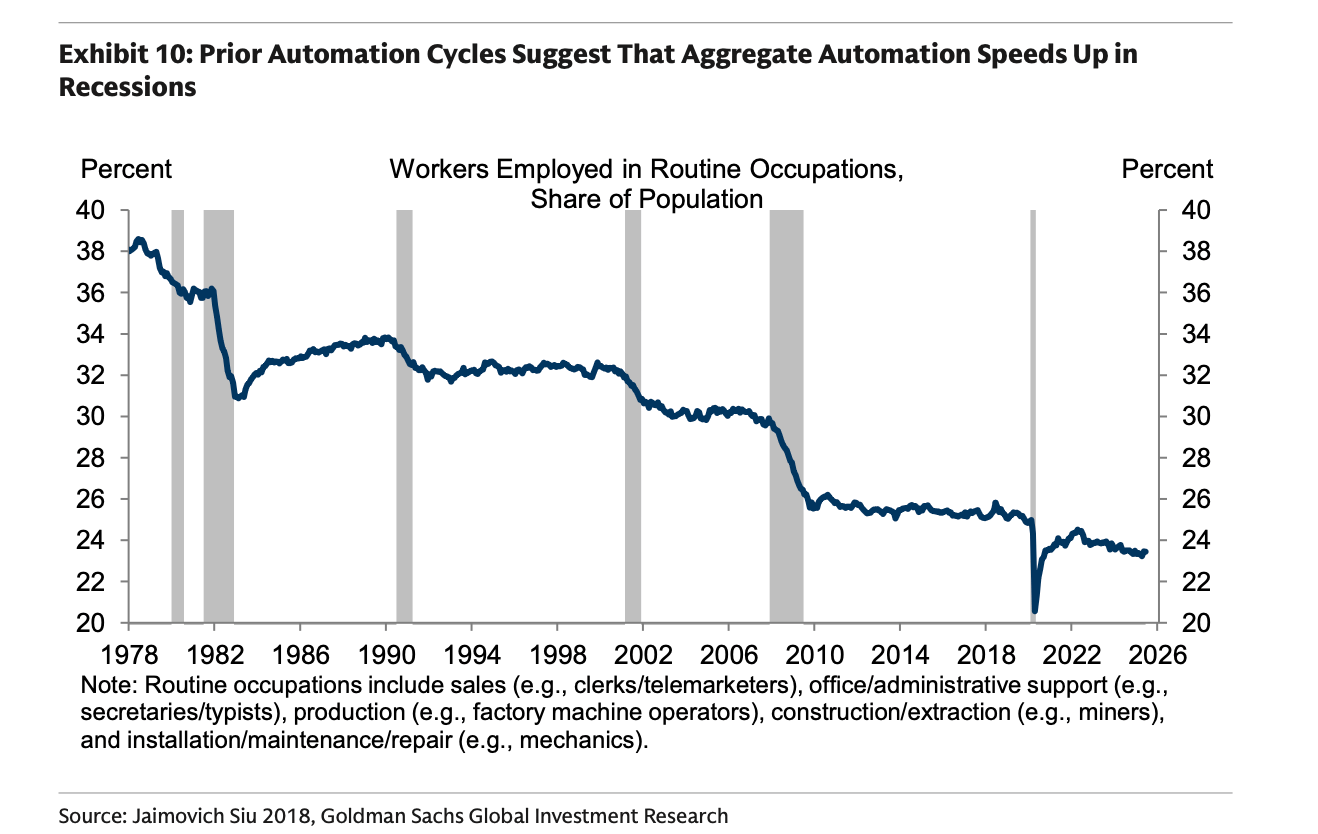
The bigger finding is about timing. Briggs went back through decades of data on how technology has replaced workers and found that “automation-related labor disruption is limited when the overall economy is healthy but accelerates during cyclical slowdowns.”
“AI-related labor disruptions could well amplify the broader business cycle,” he wrote.
Goldman has now made this argument twice, a year apart, from two different teams. In October 2025, Goldman’s U.S. economists David Mericle and Pierfrancesco Mei called “jobless growth” the likely new normal, Fortune reported at the time. “The modest job growth alongside robust GDP growth seen recently is likely to be normal to some degree in the years ahead,” they wrote. Then came their warning: “History also suggests that the full consequences of AI for the labor market might not become apparent until a recession hits.”
Briggs reached the same conclusion. “The timing and extent of automation and labor disruption will likely track the overall economic cycle,” he wrote.
The pattern goes back decades. “Historically automation-related labor disruption is quite cyclical,” Briggs writes, “with companies tending to automate work and shed labor costs when the economy starts to slow.” Mericle and Mei cited a leading explanation last year: “companies use recessions to restructure and streamline their workforce by laying off workers in less productive areas.”
The chart that makes the case tracks the share of Americans in routine jobs: clerks, secretaries, factory machine operators, mechanics. That share “has remained stable during expansions but declined sharply during downturns,” Briggs writes. The line drops in steps at the recessions of the early 1980s, 2001, 2008 and 2020, and it doesn’t climb back to where it was. “Historically most of the labor headwinds from routine job automation are concentrated in economic recessions,” he wrote.
Mericle and Mei pointed to the same pattern last year with the “jobless recovery” that followed the dot-com bust. “During that recovery, despite a soft labor market, productivity growth remained elevated, and GDP growth rebounded earlier than employment growth,” they wrote.
Looking industry by industry, Briggs found that “labor market displacement is more severe when the economic backdrop is less favorable.” The hit to unemployment from a technology-driven productivity gain was 0.1 to 0.2 percentage points bigger when the overall jobless rate was rising. Across 25 occupations that past technology upended, employment fell an extra 4% over five years for every point the national unemployment rate climbed.
“A more concerning takeaway from our analysis is that a cyclical slowdown would likely accelerate AI-related automation and job losses, thereby amplifying the broader business cycle,” he wrote.
How 6% became 9%
Briggs has been raising this number for a while. In August 2025, he and Goldman economist Sarah Dong estimated AI could displace 6% to 7% of the U.S. workforce if widely adopted, within a range of 3% to 14%. That used the same 15% productivity assumption. By June, on Goldman’s Exchanges podcast, Briggs put the figure at about 9%, or 15 million workers over a decade. He first described them as workers who would be “reallocated to new positions.” Thursday’s note calls them displaced.
That’s a long way from where Goldman’s U.S. team stood last fall. Mericle and Mei said then that they were “skeptical of the boldest claims that rapid technological progress could lead to very high unemployment,” citing Goldman’s global economics team, which Briggs co-leads. Briggs can square his estimate with that: he says the displacement is temporary. On the podcast he said that “even under our forecast for nine percent of workers being displaced, we’d still expect that the unemployment rate increase in any given year would be less than one percentage point.”
Part of the answer is in what Briggs counts. Thursday’s note measures gross job losses rather than unemployment, because the jobless rate hides people. “Some workers that are displaced may find jobs relatively quickly,” he writes, “while others may decide to exit the labor force.”
Historically, each 1% gain in technology-driven productivity pushed the unemployment rate up 0.3 to 0.4 points at its peak, fading to zero after two years. Over the same stretch, it raised the cumulative gross job-loss rate by 0.5 to 0.6 points. Multiply the top of that range by 15 and you get 9.
The occupation data shows how bad it can get in one line of work. Briggs looked at 25 jobs hit hard by past technology, including photo processors, movie projectionists, proofreaders, file clerks and bank tellers. On average, employment in those jobs fell 25% in the five years after it started to decline, “suggesting that very large job losses are possible when technology makes labor redundant.” He calls those numbers “likely upper bounds” for AI, since he picked the cases where technology hit hardest.
Most of the shrinkage came from people losing or leaving jobs, more than from employers hiring fewer people. Separation rates rose in 19 of the 25 occupations, by 3.8 points on average. Hiring rates fell in 13, by 0.7 points on average. That’s why Briggs says AI-related layoffs “should provide a good real-time guide” to disruption.
He also lists reasons the 9% could be low. Displacement ran higher during the late-1990s/early-2000s productivity boom, “the period most widely viewed as comparable to today.” It also ran higher after unusually large productivity jumps, and Goldman expects AI’s boost to beat most past ones. “This pattern suggests more scope for displacement during the AI transition,” he wrote.
Why it’s quiet now
“Given that our estimates point to a significant amount of technology-related job losses to come, why has the impact been limited so far?” Briggs asks.
For now, the layoff gauge reads low. AI-attributed layoffs in Challenger’s tracking have pulled back sharply from their spring peak. News coverage of AI job losses has fallen back to levels from the start of 2026. Job growth in the most AI-exposed industries has run about 10,000 below its long-run trend over the past three months, roughly offset by hiring for AI-related construction. “While these patterns suggest that a modest labor market headwind is emerging, the near-term headwinds remain smaller than feared earlier this year,” Briggs wrote.
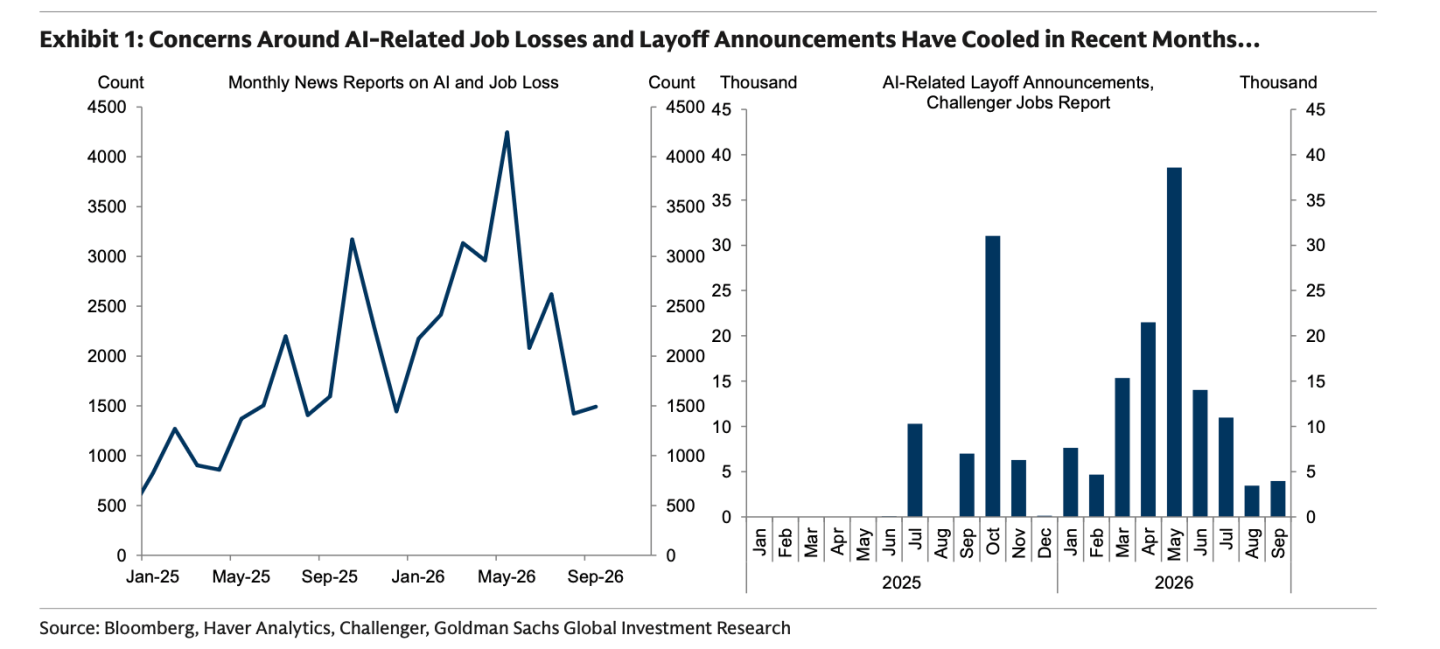
Some of the most prominent voices warning about AI job losses have softened their tone. Anthropic CEO Dario Amodei spent much of 2025 warning that AI could eliminate half of entry-level white-collar jobs. Onstage with JPMorgan Chase CEO Jamie Dimon at an Anthropic event in New York in May, he reached for the Jevons paradox instead, as Fortune reported at the time. “If you automate 90% of the job, then everyone does the 10% of the job,” Amodei said. “And the 10% kind of expands to be 100% of what people do and kind of 10xs their productivity.” He kept one caveat, and it’s the one Briggs’ note is about: “AI is moving faster than all these previous technologies,” he said. “It’s possible you get these weird behaviors and this big disruption.”
Briggs’ first answer is that it’s still early: only 23% of U.S. establishments have built AI into regular workflows, and most AI-enabled productivity gains remain in the future. His second is the economy. “Given that the overall economy and labor market have remained resilient in 2026,” he wrote, “companies may have had less incentive to focus on aggressively cutting labor costs.”
Generative AI was used for research assistance and/or transcription of this article. The reporter independently reported and verified the factual claims in this article, and a human editor reviewed it before publication.
Disclaimer : This story is auto aggregated by a computer programme and has not been created or edited by DOWNTHENEWS. Publisher: fortune.com