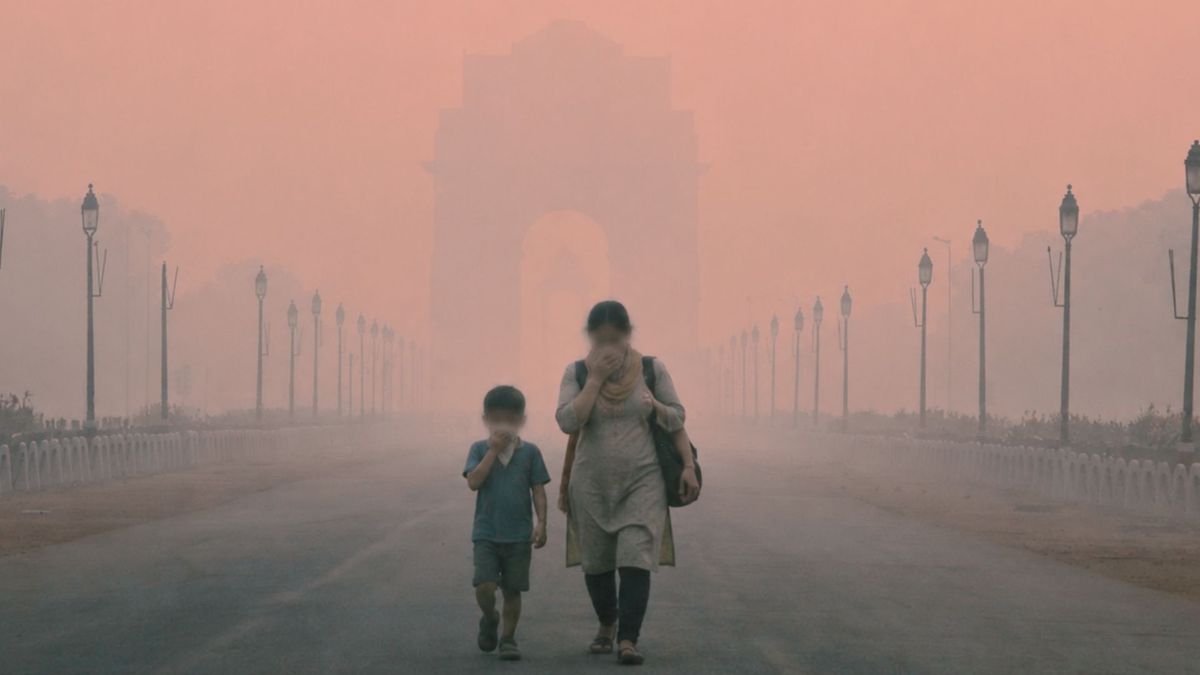
Air Pollution in India Kills 2 Million a Year. Climate Plan Ignores It
Every winter, millions of Indians wake up to grey skies, stinging eyes and coughing children. Air pollution in India is a mass killer, claiming about 2 million lives a year. Yet when India wrote its most important climate promise to the world this year, the poisoned air its people breathe did not get a single mention.
That is the finding of a global scorecard released on 14 October in Geneva by the Global Climate and Health Alliance (GCHA), a coalition of more than 300 health professional and health civil society organisations from around the world. The group studied 117 national climate plans covering 132 countries and scored each one on how well it protects people’s health. India got 2 points out of a possible 32.
Only one plan on the entire list, that of the Holy See, scored lower.
Also Read: Uttarakhand Tiger Poaching Thrives Amid NTCA Silence
No Mention of Air Pollution in India’s UN Pledge
Under the 2015 Paris Agreement, every country must file a national climate plan with the United Nations. These plans, known as Nationally Determined Contributions, set out what each country will do over the next decade. India submitted its latest plan, covering 2031 to 2035, on 24 April 2026, among the last of the G20 nations to do so.
The plan makes three headline promises for 2035. India will cut its greenhouse gas emissions per unit of GDP by 47% from 2005 levels. It will get 60% of its power capacity from non-fossil sources. And it will grow forests and tree cover that absorb an extra 3.5 to 4 billion tonnes of carbon dioxide.
A close reading of the document India filed with the UN shows that the words “air pollution” and “air quality” do not appear anywhere in it. Neither do “heatwave” or “coal“, even though India relies heavily on coal for its electricity. Health shows up only in passing: in a list of sectors vulnerable to climate change, and as one of nine missions under India’s National Action Plan on Climate Change. The only other nod is a pledge to promote healthy, sustainable lifestyles through the government’s LiFE campaign.
The document also explains how it was written. Ten inter-ministerial working groups drafted it, covering the economy, power, industry, buildings, transport, agriculture, climate finance, critical minerals, the social side of the energy transition, and policy synthesis. None of the ten dealt with health.
At one point, the UN’s standard form asks countries to describe the added benefits of their adaptation and economic plans. India’s answer was two words: “Not Applicable”.
GCHA’s assessment matches what the document shows. Its India scorecard says the plan does not meaningfully address the health impacts of climate change or the health benefits of acting on it. It also notes that India’s plan does not mention air pollutants at all, which it calls notable given the country’s high death rate from dirty air.
Also Read: Corbett Tiger Poaching: CBI Names Officers, State Says Nothing Happened
The Deadly Cost of Air Pollution in India
The silence in India’s climate plan stands against some of the grimmest health numbers anywhere in the world.
The State of Global Air 2025 report, by the US-based Health Effects Institute and the Institute for Health Metrics and Evaluation, found that air pollution in India was linked to about 2 million deaths in 2023, a 43% rise since 2000. That works out to 186 deaths for every 1 lakh people, more than ten times the rate in high-income countries, where it is 17.
The Lancet Countdown on Health and Climate Change, released in October 2025 with the backing of the World Health Organization (WHO), put the toll from human-caused fine particle pollution at over 17 lakh Indian deaths in 2022, up 38% since 2010. Fossil fuels were behind 44% of those deaths. Coal alone caused 3.94 lakh deaths, mostly from power plants, and petrol used in road transport another 2.69 lakh. The premature deaths from outdoor air pollution cost India $339.4 billion that year, equal to 9.5% of its GDP.
The WHO’s own health and environment scorecard for India says fine particle levels in the country are about ten times the WHO’s safe guideline. It estimates that 39% of deaths from stroke and heart disease in India are caused by air pollution.
No Indian escapes it. A 2024 study in The Lancet Planetary Health found that the entire population of India lives in areas where fine particle levels exceed WHO guidelines. It linked long-term exposure to about 15 lakh extra deaths every year. India’s own national limit for these particles is 40 micrograms per cubic metre, eight times weaker than the WHO guideline of 5.
The United Nations has been raising the alarm on air pollution in India too. In November 2025, the head of the UN Environment Programme’s office in India warned in an interview with UN News that the country’s air pollution was nearing the level of a disaster. A report released this year by UNEP and the Climate and Clean Air Coalition found that South Asia carries the heaviest economic burden from air pollution of any region, equal to about 10% of its GDP. The same report estimated that cleaner air and climate measures could return about $21 for every $1 spent in the region.
The government’s own position has drawn criticism. In December 2025, the Union Health Ministry told the Rajya Sabha there was “no conclusive data available in the country to establish direct correlation” of death or disease exclusively due to air pollution. In the same reply, the ministry pointed to its climate and health programme and its health adaptation plan for air pollution. India’s Health Ministry has had a national action plan on climate change and human health since 2018. Beyond a passing reference to the health mission, that work is absent from the climate promise India made to the world.
Also Read: Mussoorie Forest Scam: HC Notices Expose a Crisis of Governance
India’s Neighbours Did Better, and the Clock Is Ticking
India shares its score of 2 with Japan and New Zealand, two wealthy nations that GCHA also faulted for failing to adequately consider health. The difference is what is at stake. GCHA singles out India as carrying a high burden of deaths from air pollution, yet its plan does not even mention the problem. When a rich country leaves health out of its climate plan, it is a missed opportunity. When India does the same, it leaves out a crisis that kills about 2 million of its people every year.
India’s neighbours, many of them poorer and facing the same smog and heat, did far better. Nepal and Sri Lanka each scored 19. Bangladesh, which has an even higher air pollution death rate than India, scored 13. Pakistan scored 12 and Bhutan 10. Worldwide, the average score was 11.8.
At the top, Colombia scored 29, Nigeria 25 and Cambodia 24. Nineteen of the top 20 scores went to low- and middle-income countries. GCHA also found that plans which say the health ministry was consulted in drafting them scored far higher, averaging 17.8 points against 11.8 overall.
“The human face of climate change has never been more obvious,” said Dr Nova Tebbe, the GCHA researcher who led the study.
There are caveats. GCHA scored only what is written in each climate plan, and the group itself acknowledges that it did not assess what governments actually do on the ground. India has a clean air programme, heat action plans in many states and its climate and health programme. India’s plan also makes a strong case on fairness. It points out that India is home to about 17% of the world’s population but accounts for less than 4% of all carbon dioxide emitted since 1850. It says its targets depend on receiving its due share of international climate finance, and may be modified to match the support made available.
GCHA agrees that rich countries must pay. Its policy lead, Jess Beagley, said that a large share of the money developing countries need to carry out their plans must come from developed nations under the Paris Agreement.
But none of that explains why one of the biggest threats to Indian lives is missing from the document. Much of the air pollution in India and the gases heating the planet come from the same source: burning coal, oil and gas. Cutting one helps cut the other. GCHA argues that leaving health out of climate plans wastes money, costs lives and weakens public support for climate action.
The timing makes the gap harder to ignore. World leaders meet in Antalya, Türkiye, from 9 to 20 November for the COP31 climate summit, and India will arrive with a climate plan that says nothing about air pollution.
As smog returns to north India this winter, the gap is likely to come up at COP31, where health will be discussed formally for the first time.
Disclaimer : This story is auto aggregated by a computer programme and has not been created or edited by DOWNTHENEWS. Publisher: theprobe.in