More small businesses would be spared paying capital gains tax under concessions being considered by Labor to avoid a growing backlash, as analysis predicts house prices will fall in Sydney and Melbourne due to tax changes and interest rate rises.
Labor MPs said poor explanations of the budget’s tax reforms have confused mum-and-dad traders across Australia, and senior ministers are worried about the political pain the government will endure if it is drawn out.
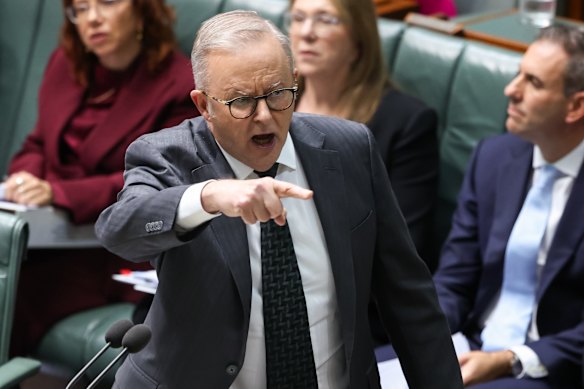
One option being explored is widening existing exemptions from CGT. Those existing rules were highlighted by Prime Minister Anthony Albanese in question time on Tuesday as Coalition leader Angus Taylor asked if “hairdressers, builders, gyms [and] pharmacies” would suffer from Labor’s broken promises.
Several sources, some in Labor and others familiar with thinking inside Treasury, said Albanese and Treasurer Jim Chalmers may expand the number of Australians who are exempt from CGT.
Albanese could make these allowances quickly – by the time a first set of laws is rushed through parliament by early July, rather than in later amendments – to deny the opposition ammunition as it seeks to rally the small business community against Labor.
Currently, businesses with a turnover of up to $2 million and net assets of up to $6 million do not need to pay any CGT if the owner is over 55 and has held their business for at least 15 years. They also receive a further reduction on top of the existing concession, making their CGT discount 75 per cent. Capital gains are also exempt up to a lifetime limit of $500,000 if the gain is put into super, with an ability to defer the gain for two years.
Under pressure from economists, political opponents and business groups to deal with unintended consequences of the CGT remodelling, Albanese said on Monday that the government was consulting a wider group of outfits including the Council of Small Business Australia.
Chief executive Skye Cappuccio told this masthead she wanted the thresholds, which have not changed since 2007, to increase to $10 million for turnover and at least $12 million for net assets.
“It’s not a radical idea,” she said. “A very similar idea was put forward by the tax board in 2019.”
Cappuccio said worry among small business people was “widespread” over the changes to CGT and trust arrangements for 370,000 “small family businesses”.
The extent to which the government might go along with the small business body’s requests is unclear. Already, 2.5 million businesses have less than $2 million in annual turnover. Going further would allow Albanese and Treasurer Jim Chalmers to reassure the army of smaller businesses that they were not being targeted.
It would represent the second potential shift after Labor’s bold and controversial budget. This masthead revealed last week that Labor could wind back a proposal to tax trusts in a small number of people’s wills at 30 per cent.
The CGT concessions would be separate from any changes that would protect start-ups.
Economists have mostly applauded Labor’s moves to cut down on tax concessions that fuelled rapid property price rises for years. But critics have revolted over the model of discounting CGT based on inflation on non-housing assets.
UNSW economist Richard Holden previously released analysis labelling the change a “productivity tax”, and on Tuesday released a note which argued that bumping up the caps for CGT concessions would not be the right move.
“The higher the concession gets, the more selective the productivity tax is and the more it punishes high-growth, job-creating businesses,” he said.
“It is selective in the worst possible way. In the middle of a productivity crisis that is a profound policy oversight.”
Albanese sought to put a spotlight on the current CGT exemptions in question time. “We are consulting, as we said we would on budget night, including with the Council of Small Business,” he said.
Labor argues the effect of its new inflation-adjusted CGT discount is vastly overstated. Treasury analysis shows the average tax rate on capital gains will grow from 19.3 per cent to 21.5 per cent, and will not significantly dent investment. Some businesses, particularly ones that grow more slowly, may be better off under the new model.
Chalmers’ budget also included $3.5 billion in small business support, including making the $20,000 instant asset write-off permanent, creating a loss carry-back scheme, and more favourable treatment of research and development and venture capital. The business community welcomed all these changes.
Chalmers dared Taylor to vote against Labor’s bill, which includes a $250 tax offset for workers as well as the negative gearing and CGT reforms.
“This legislation is a test for the Coalition, and it’s a test that they have failed before,” Chalmers said. “Let me be very clear: if they vote against this legislation, they are voting for higher income taxes once again.”
Asked about the CGT exemptions on Monday, Chalmers told The Australian Financial Review: “We try to give consideration to the feedback.”
In an analysis of the tax policies and the prospect of more interest rate hikes, Westpac economists said property prices would likely stall this year, with total turnover in the property market to drop by 20 per cent.
Westpac estimated that dwelling prices would fall by 3 per cent in Sydney this year and by 4 per cent in Melbourne. Growth in other cities will ease.
The changes to negative gearing and the less generous capital gains tax discount are expected to result in a sharp fall in new investor loans.
But they believe “investment in newly built dwellings will be significantly more attractive”, with the share of loans for new homes growing from around 18 per cent to almost 50 per cent.
Cut through the noise of federal politics with news, views and expert analysis. Subscribers can sign up to our weekly Inside Politics newsletter.
 Paul Sakkal is Chief Political Correspondent. He previously covered Victorian politics and won a Walkley award and the 2025 Press Gallery Journalist of the Year. Contact him securely on Signal @paulsakkal.14.Connect via X or email.
 Shane Wright is a senior economics correspondent for The Sydney Morning Herald and The Age.Connect via X or email.
From our partners
Disclaimer : This story is auto aggregated by a computer programme and has not been created or edited by DOWNTHENEWS. Publisher: www.smh.com.au