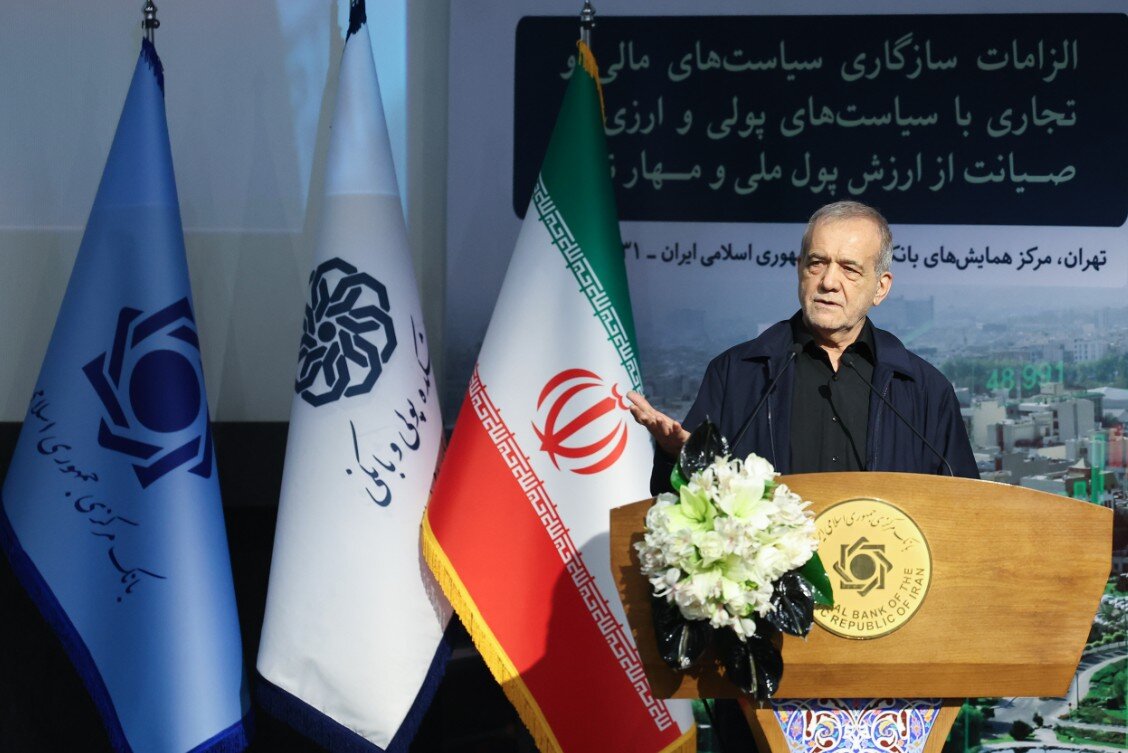
TEHRAN- The 33rd Annual Conference on Monetary and Foreign Exchange Policies opened on Sunday morning under the theme “Requirements for Aligning Fiscal and Trade Policies with Monetary and Foreign Exchange Policies to Protect the National Currency and Control Inflation.” The event was attended by the President of Iran and held at the Central Bank of Iran’s conference center.
The conference, regarded as the most important platform for announcing the Central Bank’s monetary, foreign exchange, and banking policies, brought together senior Central Bank officials, the Minister of Economic Affairs and Finance, economists, researchers, and business leaders.
At this ceremony, in addition to the President, Seyyed Ali Madanizadeh (Minister of Economic Affairs and Finance) and Asghar Abolhasani (Deputy Governor of the Central Bank) delivered speeches.
In his speech at this conference, the President emphasized that the continuation of chronic inflation and the persistent decline in people’s purchasing power is unacceptable, stating that Iran’s economy needs structural reform in the resource allocation system to overcome existing problems.
According to Mehr News Agency, Masoud Pezeshkian stated: We all have a duty to provide practical solutions for establishing justice and improving the country’s economic conditions. The fact that a society lives with 40% and 60% inflation for years and witnesses a daily decline in people’s purchasing power is not an issue that can be easily overlooked.
He added: In today’s world, there are dozens and hundreds of solutions for overcoming economic problems, and it cannot be accepted that there is no way out of the current situation. It is the duty of policymakers, experts, and academic centers to identify and present practical and implementable solutions.
Resource-expenditure imbalance, the source of many economic crises
The President, referring to some imbalances formed in the country’s economy, said: One of the most obvious economic issues is creating a balance between resources and expenditures. In many areas, including energy, gas, electricity, higher education, and urban development, new commitments and expenditures have been created without sufficient attention to resource capacity.
Pezeshkian added: When the level of consumption and created expectations exceeds the capacity to supply resources, the result will be crisis and imbalance. Development carried out without regard to the country’s real capacities will ultimately lead to economic and managerial problems.
Referring to the country’s energy consumption situation, he stated: In past years, infrastructure development and increased consumption commitments in some sectors have not been proportional to the real capacity of available resources, and today the government is facing the consequences of this situation.
Development without support will challenge the economy
The President, referring to the expansion of educational centers, urban development, and some past policies, stated: Development is successful when it is designed based on real needs, available facilities, and the country’s economic capacities.
He added: In some cases, without regard to quality, facilities, and productivity, quantitative development was prioritized, resulting in reduced efficiency and increased costs.
Resource allocation system requires serious revision
Pezeshkian, criticizing some methods of resource and facility allocation in the country’s economy, said: The country’s financial resources should be directed toward productive, technology-oriented activities with economic returns.
He added: One of the most important duties of the banking system is to ensure the proper use of resources and the return of paid capital. The process of allocating facilities, monitoring resource consumption, and evaluating the effectiveness of investments needs to be carried out with greater precision.
The President emphasized: Every rial spent in the economy must be clear in which sector it was consumed, how much value-added it created, and what impact it had on economic growth and employment.
Government seeks cost control and performance-based budgeting
Referring to the government’s plans for reforming the country’s financial and budgetary structure, he said: One of the government’s serious axes is controlling costs and moving toward performance-based budgeting.
Pezeshkian added: Payments should be made in proportion to the performance and productivity level of organizations. The country’s administrative system needs reforms in which efficiency, effectiveness, and performance outcomes become the basis for resource allocation.
Iran’s economic future must be based on knowledge, technology, and innovation
The President, emphasizing the necessity of changing the country’s development approaches, stated: In economic planning, more attention must be paid to knowledge, technology, innovation, artificial intelligence, and knowledge-based industries.
He added: Investment in technology and knowledge development can create much higher value-added compared to many traditional activities and pave the way for the country’s sustainable economic growth.
Academics and experts should reach consensus on solving economic problems
Pezeshkian, addressing the professors, researchers, and experts present at the conference, said: Economic experts are expected to, by summarizing expert opinions, present specific and implementable solutions for solving the country’s problems.
He added: Differences of opinion are natural, but the country needs a common language and expert consensus in policymaking to overcome economic problems.
Inflation exerts the most pressure on vulnerable groups
Pezeshkian, emphasizing the necessity of curbing inflation, said: The effects of inflation mostly affect low-income groups, retirees, the unemployed, and vulnerable segments of society.
He added: The government considers itself obligated to strive for improving people’s livelihoods, controlling inflation, reforming economic structures, and creating a brighter future for the country’s younger generation, and will not allow economic and social gaps to widen further.
He continued by emphasizing the necessity of cooperation from all sectors of the country to solve economic problems, saying: Economic realities must be explained to the people, and academics, experts, the banking system, the media, and the government must work together to find scientific and practical solutions.
The President added: If the trend of high inflation continues, more pressure will be exerted on society, and everyone must help ensure that such conditions do not persist.
Economic war has begun; reforming economic governance is a prerequisite for victory
According to IRNA, Seyyed Ali Madanizadeh, the Minister of Economic Affairs and Finance, also stated at this conference, emphasizing that after the victory of the Iranian nation on the battlefield, the country has entered a phase of economic jihad, saying: Controlling inflation, reforming the banking system, revising budgeting, removing obstacles to production and trade, and reforming economic governance are the main prerequisites for overcoming recession and realizing investment on the path to building Iran 1414 (2035).
Referring to the country’s conditions after the war, he said: Thankfully, this path ultimately led to the victory of the Iranian nation, and the battlefield and the streets, alongside the government, brought about this victory. The battlefield war has ended, but it can be said that the economic war has begun, and now we must enter economic jihad.
He added: The commanders and officers of this economic war must stand together so that, just as we were victorious on the battlefield, we may also achieve victory in the economic arena.
Madanizadeh, stating that the country in the coming year may still face the special conditions of the past year and the effects of the war, said: We are currently facing high inflation, and as the respected Governor of the Central Bank also reported, last year’s economic growth was negative. Therefore, all economic officials have a duty to combat inflation and economic recession.
The Minister of Economic Affairs and Finance continued: If we properly examine the conditions created after the war, opportunities have been provided for the country that can pave the way for better planning to manage Iran’s economy. The people need vision, hope, and confidence for production and investment, and accordingly, a clear picture of the country’s economic future must be drawn.
Emphasizing the necessity of drawing a ten-year horizon for Iran’s economy, he said: My suggestion is to think about the 1414 horizon; what Iran 1414 will be like, what characteristics it should have, and what opportunities lie ahead for building it. The reason for choosing this time horizon is that due to rapid technological developments and fast-paced global changes, very long-term horizons cannot be accurately mapped.
Madanizadeh added: Economic policies and even educational policies in schools and universities must be based on how we define the country’s goal for the next ten years. Iran on the 1414 horizon should be a country with high public participation in the economy; because the economy we have managed so far has been predominantly government-centered, and the private sector and the people have not had a sufficient role in it.
He identified economic and social justice as the second important axis in the future vision of Iran and said: Despite many slogans about justice, many adopted policies have in practice had the opposite effect. The future Iran must be an Iran in which economic and social justice has been realized.
Madanizadeh, stating that production is not possible without investment, said: Investment also does not take shape without stability, economic security, efficiency in the economy, and justice-orientation. If these factors come together, high-rate investment and, consequently, production will be realized.
He identified controlling inflation as an essential condition for creating economic stability and stated: With high inflation, uncertainty in the economy will not disappear. Therefore, to create a foundation upon which investment can take shape, inflation must be controlled, uncertainty reduced, and investment security established.
The Minister of Economy, elaborating on the main axes of the country’s economic foundation, said: If we imagine this foundation as a pyramid, at its apex lies the country’s banking, monetary, foreign exchange, and financial system. To control inflation, we have no choice but to reform the banking system, the monetary system, the foreign exchange system, and the financial system of the country.
The Minister of Economic Affairs and Finance, referring to the country’s conditions after the war, said: Thankfully, this path ultimately led to the victory of the Iranian nation, and the battlefield and the streets, alongside the government, brought about this victory. The battlefield war has ended, but it can be said that the economic war has begun, and now we must enter economic jihad.
He added: The commanders and officers of this economic war must stand together so that, just as we were victorious on the battlefield, we may also achieve victory in the economic arena.
Madanizadeh, stating that the country in the coming year may still face the special conditions of the past year and the effects of the war, said: We are currently facing high inflation, and as the respected Governor of the Central Bank also reported, last year’s economic growth was negative. Therefore, all economic officials have a duty to combat inflation and economic recession.
The Minister of Economic Affairs and Finance continued: If we properly examine the conditions created after the war, opportunities have been provided for the country that can pave the way for better planning to manage Iran’s economy. The people need vision, hope, and confidence for production and investment, and accordingly, a clear picture of the country’s economic future must be drawn.
Emphasizing the necessity of drawing a ten-year horizon for Iran’s economy, he said: My suggestion is to think about the 1414 horizon; what Iran 1414 will be like, what characteristics it should have, and what opportunities lie ahead for building it. The reason for choosing this time horizon is that due to rapid technological developments and fast-paced global changes, very long-term horizons cannot be accurately mapped.
Roadmap for overcoming current economic situation / $4.5 billion added to forex reserves during war
The Governor of the Central Bank, presenting the roadmap for Iran’s economy to overcome the current situation, said: The gross national product growth at the end of last year was negative 0.7 percent. If we exclude the oil sector, the gross national product without oil was negative 1.1 percent, which means about a one percent decrease in national production.
According to IRNA from the Central Bank, Abdolnaser Hemmati, in a video message at the opening ceremony of the 33rd Annual Conference on Monetary and Foreign Exchange Policies, emphasizing that a realistic picture of the country’s economy must be presented at present, said: Iran’s economy is entangled in numerous challenges, and these challenges include both internal structural problems and issues affected by political sectors imposed from outside the country.
He added: The accumulation of issues such as war and unjust sanctions has confronted the country’s economy with serious challenges. Most importantly, the matter of people’s livelihood and daily subsistence has been severely damaged due to various economic sectors being affected by sanctions.
The Governor of the Central Bank, pointing out that alongside paying attention to the livelihood issue, the matter of people’s welfare is also important, noted: We cannot merely manage crises; therefore, we hope that a day will come when we can address the issue of “development-centeredness of the country” alongside crisis management. With the movement currently underway in the country, the negotiations taking place, and the agreement that has been signed, a positive process has begun.
Controlling inflation and preserving national currency’s value require cooperation from all sectors
Hemmati continued, emphasizing the necessity of national consensus in the economic arena and coordination among institutions, stating: The country’s economy needs “consensus and empathy.” Just as we were able to resolve problems and defeat the enemy in the security and defense sector through consensus and unity, we must employ the same approach in the economic arena.
The highest-ranking official of the Central Bank, stating that this bank alone is not capable of controlling inflation in the country, said: This institution needs other economic sectors and other governing bodies to stand alongside it so that it can overcome challenges such as inflation, negative production growth, liquidity growth, trade problems, and issues related to supplying the needs of production units. Realizing this requires a coordinated action.
Strengthening production and supporting enterprises is the country’s main economic priority
Hemmati, presenting a report on the status of macroeconomic indicators and the effects of recent tensions in the country, said: Presenting a report on the current situation shows that we need very serious effort. The latest annual inflation rate at the end of Ordibehesht (May 21) reached 53 percent, and liquidity growth at the end of the same month reached 52 percent, which are roughly similar rates. Unfortunately, according to the latest statistics provided by the Central Bank, the gross national product growth at the end of last year was negative 0.7 percent. If we exclude the oil sector, the gross national product without oil was negative 1.1 percent, which means about a one percent decrease in national production.
According to the Governor of the Central Bank, by the end of this year, due to the production trends and the situation of production units that have been taken out of operation or damaged due to the crimes of the Zionist regime and America, the country’s production will decrease and economic sector activities will be disrupted; therefore, there is a possibility that by the end of the year, economic growth will become even lower than this figure.
Increasing capital adequacy of state-owned banks requires government assistance
The Deputy Governor of the Central Bank, emphasizing that increasing the capital adequacy of state-owned banks requires government assistance, said: We must sterilize the negative effects of monetary base growth.
According to IRNA, Asghar Abolhasani, Deputy Governor of the Central Bank, stated at the 33rd Conference on Monetary and Banking Policies: The goal of our annual conferences is to summarize theories and make practical use of them; in this conference, economists have presented solutions for the two objectives of curbing inflation and preserving the national currency’s value.
He added: Inflation has causes that must be examined, and they can be studied in three categories. The first category relates to the monetary and banking sector, liquidity creation, and the demand side of the economy, which are under the authority of the Central Bank and the banking network—though even on the “necessary amount” of money creation, there is no consensus.
He added: Some say the current level of liquidity is too high, while others say it is low relative to GDP.
Abolhasani continued: We must leverage the existing liquidity so that it can be used several times over its current amount. To this end, with the help of the Ministry of Economy, instruments such as GAM (Guarantee of Industrial and Mining) bonds have been designed, which are injected at the beginning of the production chain.
The Deputy Governor of the Central Bank added: The second instrument is Rial-denominated LCs, the volume of which we have increased, and we can increase it as much as banks need—but banks must be mindful of their credit risk.
He continued: The third instrument is electronic promissory notes, which started last year in the fourteenth government but have not yet been established in banks and the production sector.
The Deputy Governor of the Central Bank stated: We must sterilize the negative effects of monetary base growth, and we and the government must strive to control price expectations so that supply-side problems are not exacerbated; otherwise, our monetary policies will not be effective in controlling liquidity growth.
He identified the third factor in causing inflation as the supply side of the economy and added: If the government maintains 100 percent fiscal discipline and does not exert pressure to secure money, this factor will also be controlled. Of course, during the Ramadan war, we had good cooperation with the government for paying February salaries—we had two options: either through Central Bank money and advances, or through government deposits. The second method was chosen, and by the end of February, most of it had been returned.
Abolhasani clarified: Financing solely through bank money creation does not necessarily lead to non-inflationary growth. We have various instruments for non-inflationary financing, so instead of bank financing, we should utilize other methods such as the capital market or Sukuk (Islamic bonds).
The Deputy Governor of the Central Bank continued: Therefore, the capacities of financial institutions, conditional resources of the National Development Fund, and others are among other financing instruments.
He emphasized: Also, consolidating the resources of funds that have money but operate in isolation is another financing method, provided that during the reconstruction period we have land-use planning based on priorities.
Abolhasani noted: Because inflation is high and interest rates are not optimal in comparison, everyone is chasing money, but where it is used requires greater scrutiny.
He said: The issue of capital adequacy should be taken seriously in state-owned banks; increasing the capital adequacy of state-owned banks requires government assistance and must reach above 8, 10, and 12. We must help connect the unity that exists in the streets and on the battlefield to the foreign exchange and trade sectors as well.
MA
Disclaimer : This story is auto aggregated by a computer programme and has not been created or edited by DOWNTHENEWS. Publisher: tehrantimes.com