
Senior federal public servants say discussions are underway to explore possible guidelines and codes of conduct preventing arts funding supporting antisemitism or racial vilification.
Senate estimates heard on Thursday that antisemitism envoy Jillian Segal, favours extending a code of conduct introduced by Sydney Theatre Company (STC) and other state-based theatre companies to federally funded cultural organisations.
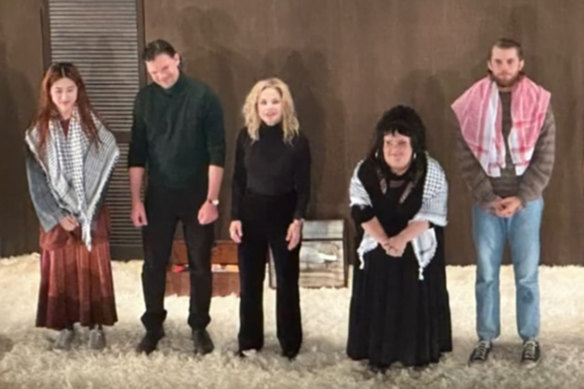
In 2024, STC updated its code of conduct and performance policies to stipulate that any on-stage deviations, such as political messaging, require prior consultation, after a curtain-call protest in which three cast members of The Seagull wore keffiyeh scarves in solidarity with Palestine.
“The task set for us is to identify whether conditions within funding agreements and within funding guidelines could be strengthened in relation to anti-semitism specifically and racial vilification more broadly,” arts department secretary Jim Betts said.
“We are keen to explore all options and … provide advice to the minister, who operates at arm’s length from individual funding decisions himself, as to how we can best give effect to the special envoy’s recommendations without compromising other things that we would all like to protect including legitimate freedom of artistic expression and a diversity of voices recognising the overwhelming need to make sure that Jewish Australians and other Australians feel safe from racial vilification.”
Any government interference in artistic freedoms would be highly controversial in the arts sector, which has been at the centre of geopolitical tensions since the war in Gaza started. On October 7, 2023, Hamas-led fighters killed 1200 people and took 251 hostages, according to Israeli tallies. Since then, Israel’s offensive on the enclave has killed more than 72,000, according to Palestinian health officials.
The disclosure followed questions raised by Coalition senator Sarah Henderson, who referred to “many shocking examples of artists facilitating or promoting antisemitism”.
Henderson also specifically referred to the decision by University of Queensland Press (UQP) to scrap publication of a First Nations children’s book illustrated by Matt Chun.
Chun had authored an online newsletter about the Bondi Beach terror attack, in which 15 people, including a 10-year-old girl, were killed, titled: “We Don’t Mourn Fascists”.
A number of authors subsequently quit UQP following the decision.
Henderson also raised broader concerns around literature festivals and peer-review panels, arguing that public funds should not support individuals promoting divisive views, or who organise petitions against Jewish artists.
The senator said she had written to the Royal Commission on Antisemitism and Social Cohesion, asking it to devote a block of hearings to the arts and culture sector.
Betts said standard Commonwealth funding agreements automatically terminate grants if a recipient violates state or federal laws. Because broader federal anti-vilification laws did not pass parliament, the department must draft any guidelines.
Without statutory backing, Betts warned that junior public servants within the department or Creative Australia would be forced into the dangerous position of arbitrating highly subjective and nuanced artistic expressions.
“I can see us back in some future version of Senate estimates, where we are debating whether a particular example of antisemitism was or was not egregious,” Betts remarked during the hearing. “I’m not saying it’s not intractable, but I’m saying it’s difficult, and we need to think it through carefully so we don’t have unintended consequences.”
Furthermore, any new policy must respect the strict “arm’s-length” principle. By Creative Australia’s founding act, the arts minister cannot directly intervene in individual funding decisions or defund specific creators. Instead, the department is examining how the minister can issue broader policy expectations or general governance requirements to Creative Australia.
The department is also reviewing a recommendation from the special envoy to re-establish a dedicated Jewish Arts and Cultural Council to advise the government on cultural vibrancy initiatives. Officials indicated that social cohesion and the elimination of all forms of racism and antisemitism will feature prominently in the forthcoming National Cultural Policy.
Get the day’s breaking news, entertainment ideas and a long read to enjoy. Sign up to receive our Evening Edition newsletter.
From our partners
Disclaimer : This story is auto aggregated by a computer programme and has not been created or edited by DOWNTHENEWS. Publisher: www.smh.com.au