
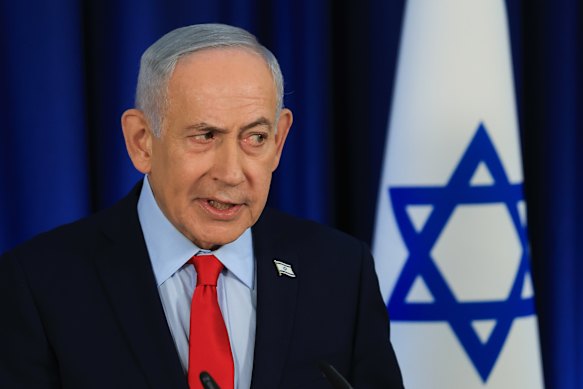
London: A power shift in Hungary has put Israeli Prime Minister Benjamin Netanyahu on notice about his waning support in Europe amid the wars in the Middle East, raising the prospect that he would be arrested if he stepped foot in the country.
Hungarian election winner Peter Magyar declared on Monday that the country would remain a member of the International Criminal Court – halting moves to leave by his predecessor as prime minister, Viktor Orbán – and would act on its arrest warrants.
Netanyahu is subject to an arrest warrant issued by the ICC in November 2024 for alleged war crimes and crimes against humanity in Gaza, a ruling the Israeli government has called shameful and absurd.
The decision in Hungary comes after a series of statements in Europe that seek to maximise pressure on Netanyahu to end the war in Lebanon and support a lasting peace for Palestinians, even as this strain diplomatic relations.
Magyar confirmed to reporters on Monday in Budapest that he would reverse Orbán’s attempt to leave the international court and had told Netanyahu about this when they spoke after the April 12 election that installed the new government.
“If someone is a member of the International Criminal Court and a person who is wanted enters the territory of our country, he or she must be detained,” Magyar said in response to a question about Netanyahu.
Although Netanyahu does not visit countries to test this issue, the same statement of principle about membership of the international court is taken across Europe.
In Australia, Prime Minister Anthony Albanese has not said what might happen, while Foreign Minister Penny Wong has said she does not speculate on hypothetical scenarios.
The split between Israel and Europe has widened during the war in Lebanon, following a deep dispute with leaders such as French President Emmanuel Macron and British Prime Minister Keir Starmer during the height of the fighting in Gaza.
Macron and Starmer angered Netanyahu and others in Israel by pushing for the formal recognition of a Palestinian state at the United Nations, securing support from Albanese in a large bloc opposed by US President Donald Trump.
Spanish Prime Minister Pedro Sanchez, a vocal supporter of the shift on Palestine, sought to heighten pressure on Netanyahu on the weekend by making a public call for the European Union to halt its longstanding strategic agreement with Israel.
Sanchez, speaking at a rally in Andalusia, said he would put his proposal to the EU in a bid to get all member nations to agree, going further than previous comments questioning the formal partnership.
“The time has come for the EU to break its Association Agreement with Israel,” he said on social media.
“We have nothing against the people of Israel; quite the contrary. But a government that violates international law and, therefore, the principles and values of the EU cannot be our partner. NO TO WAR.”
His proposal would formalise the diplomatic breach between the two sides since their 1995 agreement, with implications for a significant trade relationship.
In a broader sign of the friction, German Chancellor Friedrich Merz said last week that he urged Israel not to engage in “de facto annexation” of the West Bank, the Palestinian territory where Israeli settlers are in conflict with local communities.
That drew a sharp criticism from Israeli Finance Minister Bezalel Smotrich on social media.
“The days when Germans dictated to Jews where they were permitted or forbidden to live are over and shall not return,” he said.
“You will not force us into ghettos again, certainly not in our own land.”
The Israeli ambassador to Germany, Ron Prosor, sought to mend relations by calling Merz a “great friend” of Israel. Merz opposed the push for Palestinian statehood at the UN, reflecting modern Germany’s long support for Israel.
Six days ago, in another flashpoint, Italian Prime Minister Giorgia Meloni suspended her country’s defence agreement with Israel.
French President Emmanuel Macron has set up talks on Tuesday to try to secure a lasting peace in Lebanon beyond the ceasefire agreed last week.
Macron is scheduled to meet Lebanese Prime Minister Nawaf Salam in Paris to discuss issues including territorial integrity, a key point of contention when Israeli forces occupy the south of the country.
While Macron has criticised Israel for attacks that have killed civilians, he has also called on Hezbollah to disarm.
Hezbollah, the Islamic force that is loyal to the Iranian government and listed as a terrorist group by Australia and others, is being blamed for the death of a French soldier who was serving with the United Nations force that sought to keep the peace along the border between Israel and Lebanon.
“Everything points to Hezbollah being responsible for this attack,” Macron said on social media on Saturday. He called on Lebanese authorities to arrest those who were responsible for the killing.
Get a note directly from our foreign correspondents on what’s making headlines around the world. Sign up for our weekly What in the World newsletter.
From our partners
Disclaimer : This story is auto aggregated by a computer programme and has not been created or edited by DOWNTHENEWS. Publisher: www.smh.com.au


