Staff writers
Updated ,first published
The Australian sharemarket continued its losing streak as the Reserve Bank raised interest rates for the third time this year and oil prices jumped overnight following an escalation in the Middle East that threatens to undermine the ceasefire in the Iran war.
The S&P/ASX 200 closed down 16.6 points, or 0.2 per cent, at 8680.50, led lower by miners and banks. However, it narrowed its losses in the afternoon after RBA governor Michele Bullock sounded less hawkish than the central bank’s statement announcing the rate rise.
“One reason to increase interest rates was to give ourselves space now to sit and see what happens,” she said at the post-decision media briefing. “We feel we’re now in a position where we’ve got space, to be alert now to both sides of the risks to inflation — upside and downside.”
The RBA increased the cash rate for the third consecutive time this year, from 4.1 per cent to 4.35 per cent, wiping out all rate cuts from last year, to shield the economy against an inflation breakout from the Iran war. The rate rise was widely expected, and at least one more rise is expected by October. The Australian dollar traded at US71.61¢, down 0.1 per cent.
Westpac fell 2.3 per cent after the nation’s second-biggest bank delivered $3.4 billion in first-half profits, up 3 per cent from the same half last year but short of analyst estimates. Chief executive Anthony Miller said the banking giant was positioned to deal with the economic challenges of the war in the Middle East, noting it had increased its provisions for bad debts.
“The war in the Middle East is presenting challenges for some customers, and the economic impact of the conflict will continue through the year,” Miller warned. “The disruption to energy supply chains has driven a rise in prices, and we’re seeing this flow through to businesses and households, with some sectors more affected than others.”
ANZ Bank revealed it has lost a long-running class action over credit contracts in New Zealand, leaving it with a potential liability of up to NZD$125 million ($102 million). The court found ANZ had breached New Zealand’s Credit Contracts and Consumer Finance Act, and ordered it to repay NZD$32,728.42 to plaintiffs. Lawyers for the class action have claims from about 17,000 borrowers.
The other big banks finished the session mixed. CBA rose 0.4 per cent, National Australia Bank dropped 0.6 per cent and ANZ Bank fell 0.9 per cent.
Miners were mostly lower. Gold producers tumbled in early trade. The precious metal held its 2 per cent loss from Monday as the renewed flare-up in tensions in the Middle East fuelled inflation risks. They made up some of their losses later in the session as dip buyers stepped into the gold market, with Northern Star Resources finishing down 1.3 per cent and Evolution Mining down 1 per cent.
Gold producers Regis Resources and Vault Minerals have agreed to merge in a $10.7 billion deal that will create the fourth-largest miner of the precious metal on the ASX. The “merger of equals” through a scheme of arrangement will see Regis acquiring all fully paid ordinary shares in Vault. Vault’s shareholders will receive 0.6947 new fully paid ordinary shares in Regis for each Vault share that they hold. Regis slumped 5.7 per cent on the news, while Vault gained 3.1 per cent.
On the upside, energy stocks benefited from strong overnight moves in the oil market, where the price for a barrel of Brent crude leapt 5.8 per cent to settle at $US114.44. It eased towards $US113 during the ASX session. Prices had jumped after the United Arab Emirates said it came under attack by Iran for the first time since the ceasefire took hold in early April. The attacks appeared to be in response to President Donald Trump’s latest efforts to reopen the Strait of Hormuz.
Overnight, the US military said two American-flagged merchant ships had transited the Strait of Hormuz. It also said it sank six small boats as it set up an “enhanced security area” for ships passing through the strait.
Trump said the US would guide ships through the strait, which could get oil flowing again and bring down its price. But prices instead climbed with uncertainty about what would happen next.
“Even if the immediate conflict de-escalates, we expect the aftershocks will remain with us for some time,” said Darrell Cronk at Wells Fargo Investment Institute. “The effects – on energy prices, industrial activity, and geopolitical risk premia – are unlikely to fade quickly.”
The rise in oil prices pushed Woodside – Australia’s biggest oil and gas company – up 1.9 per cent. Local refiners Ampol and Viva Energy added 0.5 per cent and 1.2 per cent, respectively.
Tech stocks were also higher, with WiseTech Global jumping 5.2 per cent and fellow software makers Xero and Technology One up 3.9 per cent and 0.4 per cent.
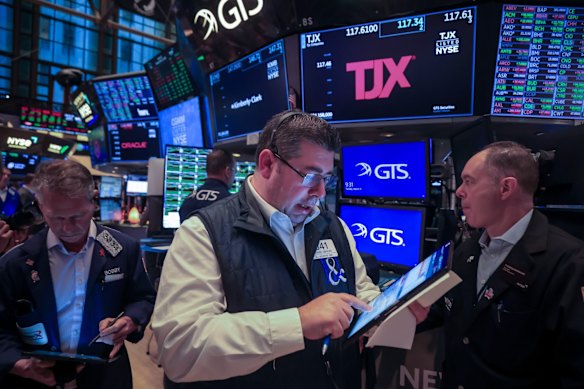
On Wall Street overnight, the S&P 500 fell 0.4 per cent, coming off its latest all-time high amid concerns about the latest escalation in hostilities in the Persian Gulf. The Dow Jones dropped 1.1 per cent, and the Nasdaq composite slipped 0.2 per cent.
Despite the uncertainty about how long the war with Iran will last, the US stock market has remained remarkably resilient and has powered to record after record. Hope is still high on Wall Street that the global economy can avoid a worst-case scenario because of the war. And in the meantime, companies continue to deliver big growth in profits. That’s key because stock prices tend to follow the path of corporate profits over the long term.
The strength so far this reporting season has been broad-based and not confined to just the big-tech superstars that dominate the market. The median stock in the S&P 500 is tracking for the best growth since 2021, according to Savita Subramanian, a strategist at Bank of America.
UPS and FedEx dropped even more for some of the market’s sharpest losses after Amazon announced a move that could cut into their businesses. The online giant said it had begun allowing Procter & Gamble, 3M and other big companies to use its logistics services to move inventory, fulfil orders and deliver packages directly to shoppers.
UPS dropped 10.5 per cent, and FedEx fell 9.1 per cent, while Amazon rose 1.4 per cent.
GameStop slumped after it said it wants to buy eBay, a much larger company, in a $US56 billion ($78 billion) cash and stock deal. Coming into the day, eBay had a total market value that was nearly quadruple GameStop’s.
GameStop said it has already built a 5 per cent stake in eBay and sees opportunities to cut $USUS2 billion in annual costs quickly. GameStop, whose stock briefly soared to market-shaking heights during the meme stock craze of 2021, fell 10.1 per cent, while eBay rose 5.1 per cent.
In the bond market, Treasury yield jumped with the price of oil. The yield on the 10-year Treasury rose to 4.43 per cent from 4.39 per cent late on Friday. It was at just 3.97 per cent before the war began, and the rise has made mortgages and other kinds of loans for US households and businesses more expensive.
With AP, Bloomberg
The Market Recap newsletter is a wrap of the day’s trading. Get it each weekday afternoon.
From our partners
Disclaimer : This story is auto aggregated by a computer programme and has not been created or edited by DOWNTHENEWS. Publisher: www.smh.com.au