Two birds have now been declared infected by the H5N1 bird flu strain, after testing by authorities.
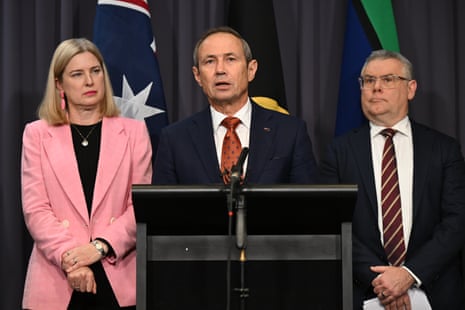
The agriculture minister, Julie Collins, is providing an update on the situation with Roger Cook – the premier of WA, where the birds were found.
Collins says the response to the outbreak is being coordinated at the national level.
We are working to determine whether or not the … bird flu has established in the wildlife, or established in Australia, other than these two isolated birds.
Cook says that work has been done in preparation for any bird flu outbreak, and says there is a hotline for the public.
We are working together, hoping for the best, preparing for the worst, and being over-prepared.
We want people to be vigilant. This is obviously a very concerning situation, but it’s one that we’re prepared for.
Agriculture minister says CSIRO ‘working on’ H5N1 bird flu vaccines for animals
The agriculture minister, Julie Collins, says the CSIRO has been working on vaccinations to protect animals from the H5N1 bird flu strain.
With two confirmed cases discovered in WA, Collins was asked on ABC’s Afternoon Briefing program if Australia had been vaccinating animals against the deadly strain. The minister said:
The CSIRO have been doing work on the vaccinations, the vaccinations, would primarily be in wildlife threatened species in terms of particularly bird populations …
Obviously, what we don’t want to do is to put those vaccinations into wildlife, where we haven’t tested it, and we don’t know whether or not it would actually work, but that can only obviously happen on a small scale for threatened and endangered species.
That’s not something we can do on a wholesale scale.
MPs call for more NACC hearings to be made public
Transparency advocates in parliament want the new NACC commissioner to help usher in a new era of public corruption hearings, with calls for the threshold to be lowered for the commission to hold open hearings.
The attorney general, Michelle Rowland, has said the appointment of a new commissioner and deputy, with applications opening today, should be an opportunity for a “reset and refresh” of the anti-corruption commission. Rowland was asked on Radio National this morning whether the NACC should hold more hearings in public. Labor’s legislation states that such hearings can only be held in “exceptional circumstances” – a threshold higher than some state-based corruption commissions.
Rowland said the NACC was independent and wouldn’t interfere with its operations. However Guardian Australia later asked whether she thought the threshold for public hearings should be lowered. Rowland pointed to a statutory review of the NACC, due by end of 2027, which would examine that issue, and also said the new NACC executive may have different views on how to interpret that provision.
“I don’t think that we should pre-empt how those provisions will be interpreted under a new commissioner and deputy commissioner, which is why I think this is a really important opportunity for that refresh,” she said.
Crossbench MPs have previously raised anger at the “exceptional circumstances” provision, saying it would mean most work is done in private. Helen Haines has said she will consider a private member’s bill by end of year if the government doesn’t change the legislation itself.
Greens senator David Shoebridge claimed on Monday the NACC had been “defanged” with an “impossibly high threshold for public hearings” and said Labor needed to fix that issue.
Independent senator David Pocock also called on the government to act, calling to remove the “exceptional” threshold.
“The appointment of a new commissioner is an opportunity to rebuild trust in the NACC that we can’t afford to waste and lowering the threshold for public hearings is integral to that,” he said.
We heard earlier today that a second bird – a giant petrel – had tested positive for the deadly H5N1 bird flu strain in Australia, after confirmation at the weekend that a brown skua had delivered a positive test.
Western Australia’s Department of Primary Industries and Regional Development has confirmed to the Guardian the petrel has died. It had already been confirmed the skua had died.
The H5N1 strain had breached every continent except Australia until the confirmed tests.
Governments and experts have said today there was no evidence yet that the two infections had led to any further outbreaks, but tests and surveillance was ongoing.
Ingham’s shares fall after ‘complete lockdown’ over bird flu fears
Shares in Ingham’s Group fell sharply today after Australia’s largest poultry producer locked down its farms in Western Australia after the deadly H5N1 bird flu was detected in the state.
The share price fell by as much as 14% early in the day, before retracing some of the losses to close down by almost 5% at $2 a share.
Ingham’s said in an ASX announcement that its breeder farms and grower networks are mostly located north of Perth, several hundred kilometres from where the positive cases have been found in the Esperance region.
The company said it had implemented a “complete lock-down, preventing all non-essential access” across its WA farms.
Go slow on tax time, ATO warns
The Australian Taxation Office has issued its annual warning to taxpayers about not rushing to file tax returns immediately after 1 July, reminding them early filing can cause delays and changes.
Taxpayers who lodge as soon as the financial year ticks over risk submitting incomplete and inaccurate returns, which can trigger processing delays and follow up contact from the ATO.
The ATO corrected more than 140,000 individual tax returns last year, where discrepancies appeared in employment income, interest, dividends, welfare payments, Medicare levy exemptions and private health insurance.
By late July, most of the pre-filled information submitted by banks, government departments and insurers is already in ATO systems, making it easier for taxpayers.
“Many taxpayers assume getting in first means getting a faster refund, but that is not always the case,” ATO assistant commissioner Anita Challen said.
Early lodgment increases the likelihood of missing information and mistakes being made, which can delay processing and require amendments.
Shark attack victim remains in critical but stable condition
The family of Leah Stewart, who was critically injured in a horrific shark attack at Coogee beach, say she remains in a “critical but stable condition”.
In a statement released today via St Vincent’s hospital, the family said her condition will remain the same for some time.
There is a long road ahead for her and her family. We appreciate the media’s interest in Leah’s wellbeing but we will not be giving any interviews at this time although we may post updates on her progress to her GoFundMe page as appropriate.
Bells Beach closed due to whale carcass
Bells Beach in Victoria has been temporarily closed after a whale carcass washed ashore on Sunday.
VicEmergency issued its most recent alert for the iconic surf spot at 2pm, confirming Bells Beach and nearby Winkipop remain closed:
A whale carcass can attract sharks to the area and mean they are closer to the shore than normal.
While it is not uncommon for sharks to be present off the Victorian coast, you should exercise additional caution in the area.
The Victorian Fisheries Authority will continue to monitor the Bells Beach area for shark sightings.
The government’s gambling ad reforms are likely to face a Senate inquiry, with crossbench MPs speaking of their “heartbreak” and “frustration” as they claim Labor’s changes don’t go far enough.
Consultation continues on the proposal to curtail wagering ads on TV, online and radio. The legislation hasn’t yet been introduced to parliament, but Senate sources said they expected the bill would be referred to an inquiry when it does arrive.
Crossbench and Greens members are calling on the Coalition to oppose the bill, which would see the reforms voted down. The Coalition has not yet declared its hand. The shadow communications minister, Sarah Henderson, was contacted for comment.
Independent MP Monique Ryan claimed Australians were “sick of it” when it came to gambling ads.
“You can probably tell that there’s a significant degree of frustration, but there’s also a significant degree of heartbreak, because we hear the stories that the government is not listening to about the harm that this toxic and harmful industry is doing to the young people that we represent,” she told a press conference.
Fellow independent Andrew Wilkie became visibly emotional, claiming people experiencing gambling harm were being “left out”.
Greens senator Sarah Hanson-Young said she was seeking discussions with Coalition colleagues about gambling, saying “the Coalition have an opportunity here to deliver protections that will actually help people, will stop the harm to families, will stop the harm to young people”.
“We will work across the political divide to deliver genuine protection, real protection, and some relief for Australian families,” she said.
Carers who break from paid work losing $45,000 in super by retirement, research shows
New research from the Super Members Council shows super exclusion is leaving Australians who take time out of the workforce to care for loved ones $45,000 worse off by retirement.
The report found more than a million Australians still miss out on super, including workers under the age of 18, domestic workers employed in private homes (cleaners, nannies and housekeepers) who work less than 30 hours a week and people who take time out of paid work to care for loved ones. Women are disproportionately affected by these exclusions.
Paying super on the carer payment by adding the 12% super guarantee would add an average $3,072 a year in super to 334,000 unpaid carers in the years they are caring. For a typical 45-year-old carer, this could lift their super by $45,000 or more by retirement and mean less pressure for taxpayers on the age pension, the report said.
It highlights gaps for gig economy workers. Creating a pathway for super in gig work would mean about 184,000 gig workers would receive an average of $2,220 a year in super – supporting a typical young gig worker to retire with about $38,000 more in super.
Thank you all for following along on the blog today.
I’ll leave you with the wonderful Ima Caldwell, and see you here bright and early tomorrow!
-
A slightly more subdued affair for the start of the final sitting fortnight before the winter break, with the Coalition testing the government on its tax changes.
-
Arguably the funniest moment was the insertion of multi-million dollar hairdressers into the Hansard, and Angus Taylor theatrically finger-combing his hair.
-
Independent MP Helen Haines asked when the government would take more action on regional bank closures.
-
Liberal MP Ben Small was kicked out of the chamber after asking a particularly spicy question.
-
And independent Dai Le asked whether anyone in the government had gained undue financial advantage using insider knowledge of the CGT and negative gearing changes – the government denied it.
ABS says 12.3bn hours spent on unpaid care in September 2025 quarter
Australians spent 12.3bn hours on unpaid care activities in the September quarter 2025, continuing a steady increase since 2006, when people devoted 8.2bn hours to unpaid care, the latest data from the ABS has shown.
Using the individual replacement cost method – which applies the wage for the equivalent occupation for each caring activity for the relevant demographic at the time care activities were provided – the total value of unpaid care was $461.1bn.
In comparison, the minimum wage rate method was valued at $306bn in the September quarter 2025.
The data, released late last week, also showed carers who were also employed in paid work accounted for 66% of all unpaid care hours. By comparison, 4% of unpaid care hours were taken on by unemployed carers, while 30% were taken on by carers not in the labour force.
After a final dixer to the education minister, Jason Clare, the PM calls time on QT.
Dai Le queries if MPs used knowledge of CGT changes ‘for private financial benefit’
Independent MP Dai Le asks the government to confirm that no government member or their close relations used prior knowledge of the CGT or negative gearing “for private financial benefit before they are made public”.
Milton Dick takes umbrage with the question and says he’s concerned that it has imputations or raises allegations against certain parliamentarians.
Le says she’s not making any allegations against MPs.
She rephrases the question but again asks the PM to confirm that none of the information was used for private financial benefit, which Dick tells the PM to ignore.
There’s some more back and forth and some shouting across the chamber, before Albanese says:
We were very careful … I’m sure, as has always occurred, for as long as I’ve been here across the board, whoever has been the treasurer, and [we’ve] gone through our ERC processes, that is something that we have in this country that we should cherish, and we should honour, not denigrate, to try to score a cheap point.
The ERC is the expenditure review committee, a small committee of senior cabinet ministers who review budget and financial proposals.
Will the prime minister admit he’s a “Labor liar on taxes”, asks Liberal MP Ben Small.
He’s immediately asked to withdraw, which he does, before he’s sent out of the chamber under 94a.
Milton Dick then rules that QT will move on, which means that the government essentially skips a whole opposition question.
Chalmers promises action on regional bank closures
Back to the crossbench, regional Victorian MP Helen Haines asks the government when it will formally respond to a report into bank closures in regional Australia, which recommended that access to financial services should be recognised as an essential service.
She says that “596 regional towns that once had one or more bank, now have no form of bank at all”.
The treasurer, Jim Chalmers, says the rate of regional bank closures has “plummeted” under the Labor government, but concedes that there’s more work to be done.
He says that the government hasn’t waited to respond to the report to act on the issue.
We do have more work to do there. We’ve been upfront about that. I acknowledge (Australian Banking Association chief executive) Simon Birmingham and others who have been working very closely on that, and we hope to make some more progress before long. We’ve also been working with the regulators and with communities to try and find sustainable solutions here. So, we do recognise how important regional banks are to regional communities like the Honourable member’s.
Taylor takes a haircut as Chalmers quips back over CGT attack lines
Nationals MP, Llew O’Brien asks the PM if “a bricklayer who comes up with a faster way to lay bricks, a farmer who comes up with a more efficient way to harvest his crops, or a hairdresser who comes up with a new hairstyle will be eligible for the innovative business CGT concession”.
Jim Chalmers takes the question and says that in almost every case, those businesses would come under the higher turnover threshold which has increased from $2m to $10m.
Angus Taylor asks over the despatch box about the hairdresser. Chalmers quips:
The hairdresser is going to be turning over more than 10m bucks, is it, mate? Yeah, it might be where you get your haircut.
It gets a good few chuckles and Taylor starts theatrically combing out his hair with his fingers. The opposition then makes a point of order saying that the question was to do with the innovative business concession.
Chalmers continues:
When it comes to farmers, as a consequence of the implementation details that we announced on Thursday, something like 99% of all agricultural businesses will be eligible for the updated 50% active asset reduction, Mr Speaker … this might be why the National Farmers Federation has described this, and I’m quoting, as “one of the most consequential wins for the NFF and its members, following sustained advocacy on behalf of farmers”.
Disclaimer : This story is auto aggregated by a computer programme and has not been created or edited by DOWNTHENEWS. Publisher: theguardian.com