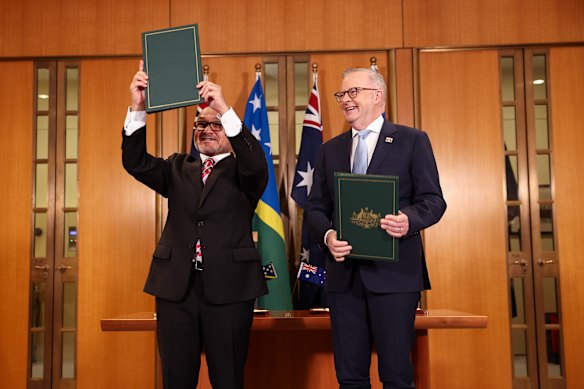

The contest for influence in the Pacific is far from over but has entered a new era – one in which Australia has clearly pulled ahead of its chief rival, China. While Anthony Albanese battles dire economic news at home, the Prime Minister is ending the parliamentary year with a crowning diplomatic achievement, the culmination of over four years of relentless effort.
The signing of a security pact between Solomon Islands and China in April 2022 was a turning point for the region and a historic failure for Australian foreign policy. The Guardian called it “the deal that shocked the world”; analyst Joseph Hammond, writing in the Journal of Indo-Pacific Affairs, argued the agreement had “a seismic impact on the geopolitics of the Pacific Islands states and Oceania”.
The agreement placed the Pacific at the front line of the rivalry between China, the United States and allies like Australia, reigniting fears China could seek to establish a military base in the region. Within months, then US president Joe Biden was hosting Pacific leaders for a first-of-its-kind summit at the White House and scrambling to re-open an American embassy in the Solomons capital of Honiara. The Solomons, a poor country with a population smaller than Adelaide, had suddenly assumed a pivotal role in international affairs.
The pact embarrassed the Morrison government in its dying days and posed an immediate challenge for Labor when it came to power: preventing a similar agreement from being struck in another Pacific country. Foreign Minister Penny Wong visited all of Australia’s 17 fellow members of the Pacific Islands Forum within her first year in the job, parlaying the government’s more ambitious climate change policies to reset relations with the region. It worked.
A breakthrough 2023 treaty gave Australia effective veto power over Tuvalu’s security arrangements with other countries. Agreements with Nauru and Vanuatu followed, as well as new military alliances with Fiji and Papua New Guinea, helped by Australia contributing $600 million over a decade to establish a PNG National Rugby League team.
For most of this period, the Solomons remained a fly in the soup under the leadership of Beijing-friendly leaders Manasseh Sogavare and successor Jeremiah Manele. That changed in May thanks to the surprise elevation to the prime ministership of Matthew Wale, who had criticised the security pact with China, opposed the switch in diplomatic recognition from Taipei to Beijing and accused Sogavare of “sleazing up to Beijing”.
Soon after coming to office, Wale flagged his intention to move quickly to reach a new treaty with Australia. It was unclear how this would interact with the existing security pact with China.
Now we know that Honiara has informed Beijing the agreement will expire when its five-year anniversary arrives in April. In its place, the new treaty announced on Wednesday entrenches Canberra as the Solomons’ top security partner, ensures its territory will not be able to be used for a foreign military base and promises that its critical infrastructure will remain free from militarisation and foreign interference. Chinese police are expected to vacate the Solomons next year, with Australia plugging any gaps.
The days of the Solomons being a source of “uncertainty and doubt in the region” are over, Wale declared on Thursday. “Those days are done, gone,” he said. “We don’t want to be there again.” Australia’s greatest irritant in the Pacific has now become one of its closest friends.
This is an outcome Australia could only have dreamt of in 2022, when Sogavare was cosying up to Xi Jinping and welcoming in Chinese police. While Albanese, Wong and Pacific Minister Pat Conroy were blessed by the emergence of a pro-Australia leader like Wale, they deserve credit for seizing the opportunity to strike. These deals come with a price tag – $740 million will flow from Australia to the Solomons over a decade under the treaty – but the cost of allowing China to dominate the region is incalculably higher.
The Solomons’ internal politics remain unstable and Wale will face blowback for decisively choosing to partner with Canberra on security over Beijing. China will hardly give up and concede defeat in the Pacific. The great geopolitical chess game goes on, but there is no doubt who is winning.
Cut through the noise of federal politics with news, views and expert analysis. Subscribers can sign up to our weekly Inside Politics newsletter.
 Matthew Knott is the foreign affairs and national security correspondent for The Sydney Morning Herald and The Age.Connect via X, Facebook or email.
From our partners
Disclaimer : This story is auto aggregated by a computer programme and has not been created or edited by DOWNTHENEWS. Publisher: www.smh.com.au