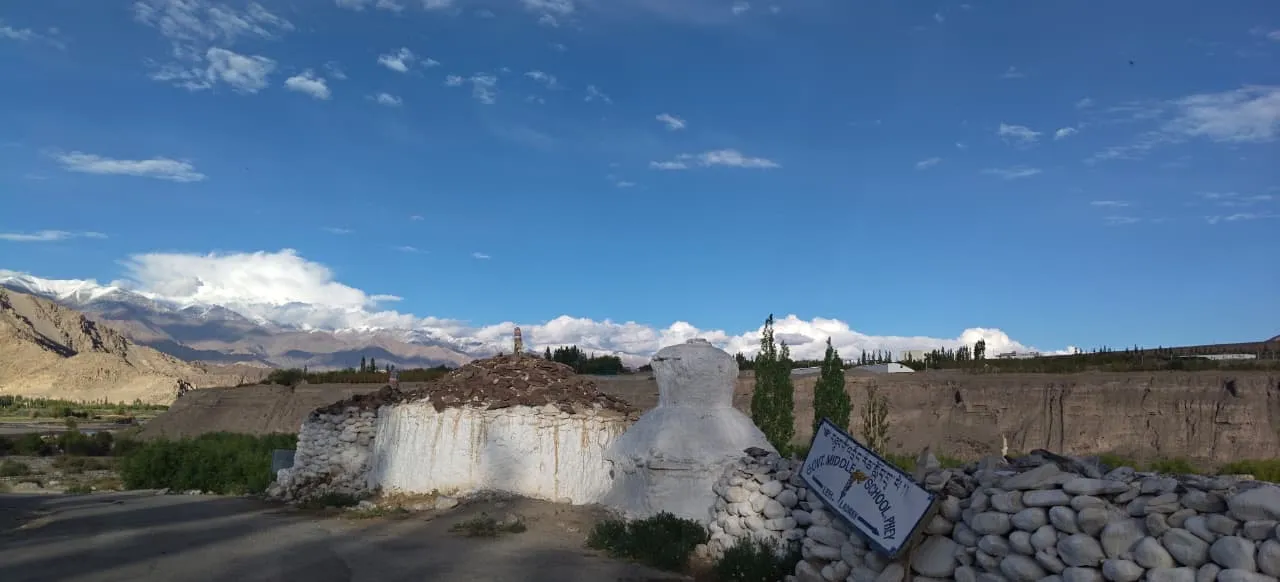
Before dawn, a farmer in Phey may be waiting for a turn that belongs to a carefully watched village schedule. Water is not taken whenever someone needs it. Its flow is shared through rules, turns, and people tasked with ensuring nobody takes more than their share.
At 3,180 – 3,186 metres in Ladakh’s cold desert, this is how the community manages scarce resources through duties.
A water turn is a village responsibility
Phey lies west of Leh town. Its irrigation story begins beyond its fields. The village shares a stream with upstream Phyang. Winter snowfall and spring weather influence when meltwater arrives and how much reaches the channels. Springs also feed ponds that supply some fields, while upper fields rely more heavily on the stream arriving from Phyang. The water’s arrival is tied to the thaw, so a poor winter or cool spring can affect sowing and irrigation.
A study by Dorjey Angchok, Tsering Stobdan and Shashi B Singh, using 1981 village-directory data, gives Phey 33 households and 176 people. It records household-based water distribution, rather than a channel-based rota, because the settlement was relatively small. These are historical figures, not a current population count.
The chhur-pon, literally the “water lord”, coordinates irrigation. The supervisor knows which field gets water, when and in what order. In Phey, the role works alongside a rota for guarding the main water-control point.
Households take turns sending people to watch the main sluice, or yur-go, that controls the main channel. Two people from each household are selected in rotation to check for blockages, overflow, or damage. When water is scarce, some must keep watch at night.
The village devised a way to verify that guards reached the control point. Each person breaks a stone in two, leaves one half at the sluice and carries the other to the next person on duty. The next guard checks whether the two pieces fit, making the rota accountable without a written register.
Rules also extend beyond the village boundary. Under a customary agreement known as the bandabas, Phey’s share of stream water from Phyang is protected from late evening until early morning during periods of scarcity after 21 June. It is one example of the traditional water systems of India that combine infrastructure with community rules.
Who watches the cattle?
Water is not the only resource that needs protecting. During the growing season, livestock straying into cultivated fields can destroy crops. Across Ladakh, the lorapa traditionally monitors free-grazing animals and prevents them from entering fields. Research documents this role as a regional institution; it does not establish that every village, including Phey today, follows it unchanged.

An animal found grazing where it should not can be taken to a lora, an enclosed cattle pound or cattle jail. Its owner must pay the penalty set under community rules to get it back. This makes each household responsible for protecting a neighbour’s crops.
The lorapa is generally selected for the cropping season, with duties and penalties agreed by the community. The goba, or village head, oversees village affairs, resolves disputes and coordinates these roles. Together, they form a local system of checks and responsibilities rather than one office doing everything.
A system under pressure
These arrangements developed in a landscape where farming depends on short growing seasons, limited cultivable land, and water from snow and ice. The region’s wider water crisis makes fair access all the more consequential. Ladakh’s ice stupas and community-built artificial glaciers are other examples of adapting water storage and distribution to these constraints.

But customary governance is not frozen in time. Research published in 2023 and 2025 describes pressures on Ladakh’s agropastoral systems, including tourism, new livelihoods, changing livestock patterns, fencing, and the overlap between traditional institutions and formal Panchayati Raj structures. The goba’s authority has weakened in some places, while fewer people may be available for seasonal duties such as the lorapa’s.
It depends on people continuing to participate, accepting shared rules and trusting others to do their turn. In Phey, even the stone-checking method shows how cooperation is reinforced by practical ways to discourage shortcuts.
A government outreach camp in Phey in November 2025 also recorded residents raising concerns about water scarcity, roads, school facilities and connectivity. Traditional institutions do not replace public services or remove the need for investment. They show how a village can organise the resources and responsibilities closest to home.
At this altitude, the rota is more than a timetable: shared resources depend on people keeping their word.
Sources
‘Community-Based Irrigation Water Management in Ladakh: A High Altitude Cold Arid Region‘: by Dorjey Angchok, Tsering Stobdan and Shashi B Singh, published in the 2008 proceedings of the 12th Biannual Conference on CPR Management.
‘Mountain Agropastoralism: Traditional Practices, Institutions and Pressures in the Indian Trans-Himalaya of Ladakh‘: by Padma Ladon, Marcus Nüsser and Satish Chandra Garkoti for Pastoralism, published on 20 November 2023.
‘Eroding Pillars: The Status of Local Institutions in Resource Management in Leh‘: by Padma Ladon for the Centre of Excellence for Himalayan Studies, Shiv Nadar University, published in May 2025
‘Changing Hydrosocial Relations in the Era of Climate Change: The Case of Water Governance and New Technologies in Ladakh’s Cryosphere‘: by Sahana Subramanian and Mine Islar for Global Sustainability, Cambridge University Press, published in 2026
‘Mimang-Si-Sjabstogs: Administration at Your Doorstep Held at Phey Village‘: by Reach Ladakh Correspondent for Reach Ladakh, published on 18 November 2025
Disclaimer : This story is auto aggregated by a computer programme and has not been created or edited by DOWNTHENEWS. Publisher: thebetterindia.com