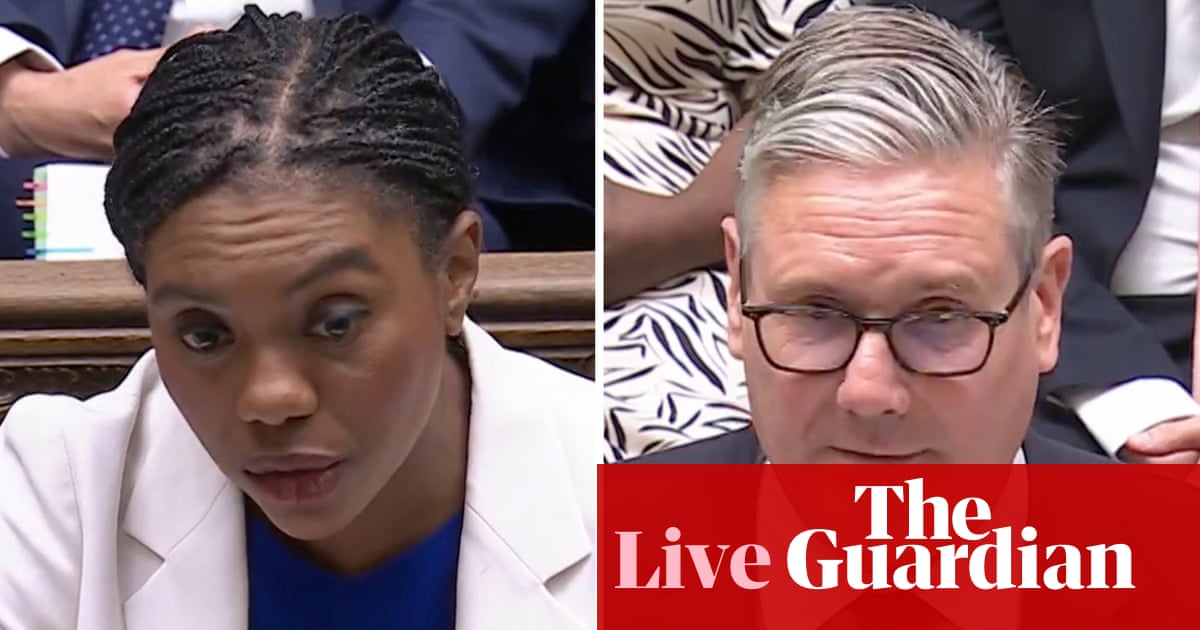
There aren’t many advantages to being forced out of your job if you are prime minister, but knowing that you will never have to face another PMQs is one clear bonus. Among the many reasons why it is such an ordeal is the fact that, as PM, you get blamed for everything. In part that is because the opposition parties will always be critical, regardless of whether or not that’s fair, but mostly it’s just a facet of leadership.
Today Keir Starmer sounded more fed up about this than usual. As he hit back at his critics, he was more withering and disdainful than usual. And, as a result, better than usual too.
He slapped down Dave Doogan, the SNP leader at Westminster, with ease, forcefully and effectively. (See 12.30pm.) And when Lee Anderson from Reform UK asked a question, Starmer briskly addressed it before devoting most of his answer to a hatchet job on Nigel Farage. (See 12.42pm.)
But it was Kemi Badenoch who seemed to wind Starmer up the most. As expected, she devoted all her questions to the defence investment plan (Dip). Her problem, though, was that while Starmer might be prepared to listen to criticism of his record on defence spending from the chief of the defence staff, or from Lord Robertson, or from the Nato secretary general, he is not minded to accept the same lectures from her party given its own record on this issue.
Starmer rightly accused her of “faux outrage”. In his second response to her, he said:
Their record is cutting spending. My record is raising it to £300bn, and rising.
Their record is cutting frigates by a quarter, cutting minehunters by a half and leaving 47 of 49 defence programmes delayed or over budget. My record is the biggest boost to defence investment since the 1980s.
Their record is missing army recruitment targets every year for 14 years. We’ve given our armed forces the biggest pay rise for 20 years and increased funding by £15bn a year.
In his third response to her, he said:
What did they actually do? They cut defence – 2.5% down to 2.3% in their 14 long years. And what did they do on welfare? They put the bill up by £88bn. So no lectures from them.
And in his fourth, he said:
They won’t defend their record because they can’t. They won’t apologise for it because they’d have to admit what we all know is a total failure. They just try to pretend the 14 years they were in power never really happened.
Collectively, all this made an impact. Starmer had a point, and he was making it with punch and passion.
Badenoch was a bit less aggressive than usual, but perhaps she is losing interest. It was interesting to note that, at one point, she started training her fire on Andy Burnham. (See 12.21pm.) He is the opponent who matters to her now.
Andy Burnham has made it clear that, when he becomes PM, he wants to see significant devolution of power to English regions.
In a speech to the Re:State thinktank today, Darren Jones, the chief secretary to the PM said that Burnham was right to say there is “overcentralisation of power and bureaucracy in Westminster”. But he said devolution of power should be accompanied by a reduction in the number of officials working for central government in London.
He said:
When I ask the question: ‘As we’ve devolved things to combined authorities have we reduced the headcount in London by a commensurate amount?’ No, headcount has increased.
And I just say to Whitehall, with the direction of where the political winds are blowing, I think this is a clear warning: devolution must mean devolution, not duplication.
In the past, we’ve gone down the path of replicating checks, both in the regions and in Westminster, creating more state rather than more power in those regions.
So, for this to truly work, Westminster must trust local leaders to make the right decisions and instead of an almost parental relationship, we need to actually devolve power and accountability across the country.
Jones said that “if you’re really committed to devolution, you should see a change in the shape of London departments”.
Asked if the government would have to think about which departments remained in existence if there was genuine devolution to the UK’s nations and regions, he replied:
I think in the long run, probably yes. I think in the short-to-medium term, I would expect them to at least change shape or shrink.
The number of migrants who arrived in the UK after crossing the English Channel in the first half of the year fell sharply compared with the same period in 2025, the Press Association reports. PA says:
Some 11,884 migrants arrived in the six months from the start of January to the end of June, according to the latest Home Office data.
This is 41% lower than the total that had reached the UK by this point last year, which was 19,982.
It is also down 12% on the 13,489 who arrived in the first six months of 2024.
The steep drop is likely to reflect a number of factors including the weather, the supply of small boat parts, government policy, and the flow of migrants into Europe from elsewhere in the world.
In April, the home secretary, Shabana Mahmood, signed a three-year agreement with French authorities to pay £662m to support beach patrols as part of efforts to drive down arrivals.
Mahmood is also seeking to overhaul the asylum system to deter crossings and deport people easier, including proposed changes to make refugee status temporary.
Looking further back, this year’s figure for January-June of 11,884 is 4% higher than the equivalent number in 2023 (11,433) and 7% below the figure in 2022 (12,747).
While the number of arrivals has fallen so far this year, the number of migrants arriving per boat has climbed to a new high, averaging 65 per craft over January to June.
The average across the whole of last year was 62 migrants per craft, while the figure for January-June 2025 was 58.
Some 2,742 migrants arrived last month after crossing the Channel, the lowest number for June since 2021.
The government is to review the future of the national lottery for the first time in more than 20 years as the culture secretary, Lisa Nandy, promised to give the public a greater say in how billions of pounds raised by ticket sales is spent. Rob Davies has the story.
At the post-PMQs lobby briefing, the PM’s spokesperson did not rule out cuts to some hospital building programmes to pay for increased defence spending.
Asked whether hospital building projects would be protected from cuts to capital budgets, the spokesperson replied:
Thanks to this government’s record investment in the NHS there will be no impact to funding for frontline services. This will also not affect the timetable for delivery of the seven Raac-affected hospitals which we’ve prioritised or wave 1 projects of the New Hospital Programme and we still plan to spend more than £15bn on capital health investment.
Asked about other hospital programmes, the spokesperson repeated the point about how the cuts would not affect the Raac-affected hospitals or the first wave of the government’s new hospitals programme.
At the post-PMQs lobby briefing, the PM’s spokesperson insisted that the government had set out a “credible” proposal to fund the defence investment plan (Dip). He said:
We have set out a credible plan for funding.
The vast majority of this package has already been funded by reprioritising departmental spending with £10.3bn identified now. We’ve worked with secretaries of state across government to find savings and reallocations in a way that protects day-to-day spending on frontline services.
The residual amounts to just over £1bn-a-year for this parliament which will be set out at the budget in a fair and balanced way.
I’m not going to get ahead of that process but we’re taking the responsible decisions now to increase defence spending in response to the growing threats the UK faces.
There aren’t many advantages to being forced out of your job if you are prime minister, but knowing that you will never have to face another PMQs is one clear bonus. Among the many reasons why it is such an ordeal is the fact that, as PM, you get blamed for everything. In part that is because the opposition parties will always be critical, regardless of whether or not that’s fair, but mostly it’s just a facet of leadership.
Today Keir Starmer sounded more fed up about this than usual. As he hit back at his critics, he was more withering and disdainful than usual. And, as a result, better than usual too.
He slapped down Dave Doogan, the SNP leader at Westminster, with ease, forcefully and effectively. (See 12.30pm.) And when Lee Anderson from Reform UK asked a question, Starmer briskly addressed it before devoting most of his answer to a hatchet job on Nigel Farage. (See 12.42pm.)
But it was Kemi Badenoch who seemed to wind Starmer up the most. As expected, she devoted all her questions to the defence investment plan (Dip). Her problem, though, was that while Starmer might be prepared to listen to criticism of his record on defence spending from the chief of the defence staff, or from Lord Robertson, or from the Nato secretary general, he is not minded to accept the same lectures from her party given its own record on this issue.
Starmer rightly accused her of “faux outrage”. In his second response to her, he said:
Their record is cutting spending. My record is raising it to £300bn, and rising.
Their record is cutting frigates by a quarter, cutting minehunters by a half and leaving 47 of 49 defence programmes delayed or over budget. My record is the biggest boost to defence investment since the 1980s.
Their record is missing army recruitment targets every year for 14 years. We’ve given our armed forces the biggest pay rise for 20 years and increased funding by £15bn a year.
In his third response to her, he said:
What did they actually do? They cut defence – 2.5% down to 2.3% in their 14 long years. And what did they do on welfare? They put the bill up by £88bn. So no lectures from them.
And in his fourth, he said:
They won’t defend their record because they can’t. They won’t apologise for it because they’d have to admit what we all know is a total failure. They just try to pretend the 14 years they were in power never really happened.
Collectively, all this made an impact. Starmer had a point, and he was making it with punch and passion.
Badenoch was a bit less aggressive than usual, but perhaps she is losing interest. It was interesting to note that, at one point, she started training her fire on Andy Burnham. (See 12.21pm.) He is the opponent who matters to her now.
Carla Lockhart (DUP) says last week a former MP (the former DUP leader Jeffrey Donaldson) was convicted for child abuse offences. She praises the courage of his victims. But she says thousands of girls were victims of Pakistani grooming gangs. Will the PM ensure the grooming gangs inquiry goes ahead?
Starmer also pays tribute to the courage of Donaldson’s victims.
On the grooming gangs inquiry, he says it should go wherever the evidence takes it.
Lee Anderson (Reform UK) says in his constituency four nurses were removed from a HMO (house in multiple occupation) and replaced by four illegal migrants, one of whom went on to rape someone. Does the PM agree all illegal migrants should be detained and removed?
Starmer says migration is down.
And he says Anderson should be asking questions of Nigel Farage, the Reform UK leader, who is sitting next to him. He accepted £5m from a crypto billionaire and then went on to lobby the Bank of England for changes to crypto policy.
That is a reference to this story.
Starmer asks if that amounted to paid lobbying, which is banned for MP.
And why was the donation kept secret?
And he asks if Anderson is happy about Farage earning £20,000 an hour for promoting gold.
Sarah Russell (Lab) asks about the contract for NHS dentists. A new one is promised. She urges the government to start work on that quickly.
Starmer says some reforms have already been implement. The consultation on the new contract will start soon.
Catherine West, the Labour former Foreign Office minister who briefly threatened to be a leadership candidate against Starmer, pays tribute to his leadership, and says Foreign Office staff appreciated his service.
Starmer thanks West, and pays tribute to her too.
Desmond Swayne (Con) says injured veterans only get a year to put their compensation in a trust. Will the government ensure that they can get more time?
Starmer says the government will seek to resolve any difficulties. He urges Swayne to let him know of any specific cases.
Michelle Welsh (Lab) asks about the two recent reviews of maternity services. Does the PM agree the system is failing, and cruel. Will the Hillsborough law be introduced in full so families can get the justice they deserve?
Starmer agrees that the Amos review showed the system is not working. The recommendations of the Amos and Ockenden reviews will be delivered.
Disclaimer : This story is auto aggregated by a computer programme and has not been created or edited by DOWNTHENEWS. Publisher: theguardian.com