
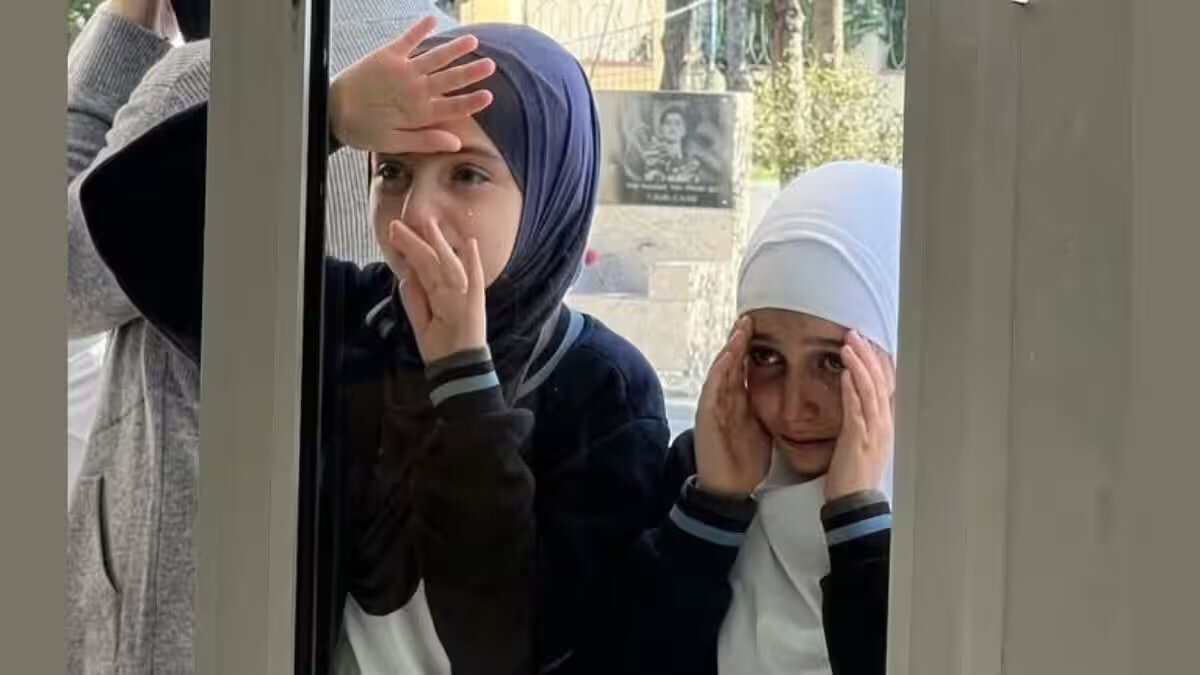
TEHRAN — “I don’t have a single B on my report card. Is this the respect I get?” The girl standing at the school gate was crying, and the officials in front of her did not move. “Have I ever done anything wrong? And now you’re telling me I can’t enter the school. Why should I have to give up my religion?”
Video of the exchange spread across Azerbaijan within hours. Then Instagram and TikTok began failing for many users.
On September 21, the Cabinet of Ministers adopted Resolution No. 309, which bans school clothing that breaks uniformity or conflicts with the “principle of secularism.”
The text never mentions the hijab. On October 6, the same standard was extended to teachers, and by the second week of the month, principals in Baku and the provinces were stopping girls at the gate.
About 96 percent of Azerbaijanis identify as Muslim. For a girl who covers her hair, the decree offers two options: remove the scarf or stay home.
Classrooms empty, parents at the gates
Many families refused both. At School No. 69 in Baku’s Balakhani district, students walked out after classmates were barred and unfurled a banner saying the hijab is no obstacle to education. Students at School No. 322 in the capital did the same.
The pattern repeated in Masally, Jalilabad and the township of Hokmali. Boys joined the boycotts. In one Baku neighborhood, parents said they would keep their sons at home until the girls were readmitted. Footage showed students hugging teachers and sobbing outside locked doors.
Women on the staff have been given the same ultimatum. Zahra Hasanova, a teacher, was ordered to remove her scarf at work. “I am hurt,” she told Al Jazeera. “The hijab is a personal choice, and if one day I want to take it off, that should be my choice too.”
Arrests and a feed that would not refresh
Baku sent police. On October 12, the Interior Ministry reported 37 arrests in the capital, accusing the detainees of confronting school staff, damaging property and disturbing public order.
Criminal cases were opened under Article 233, which carries up to three years in prison. Local activists put the number of people taken into custody above 200.
The ministry has also cited violence: a school director’s car set on fire in the Garadagh district and an attempt to burn a school building, with no injuries. It has not shown who was responsible, and nothing connects the organizers of the school protests to either incident.
The online outage followed the same timeline. Instagram and TikTok stopped refreshing for most users, and X also degraded.
Many people could reach the platforms only through VPNs. Officials have not acknowledged a block, and independent monitors have stopped short of confirming one.
The sudden network throttling coincided with viral footage of barred students and empty classrooms, suppressing real-time organizing and obscuring state crackdown. By cutting off digital channels, Baku aims to curb outrage and enforce compliance.
The precedent and those who benefit
The so-called constitution guarantees freedom of religion in Azerbaijan. Practice has long run the other way.
Headscarf restrictions in schools in 2010 and 2012 produced street protests that police broke up with arrests.
In November 2015, the Baku government’s armed forces stormed the historically devout Shia town of Nardaran, launching a deadly assault that left several local believers martyred.
Following the crackdown, Taleh Bagirzade, head of the Muslim Unity Movement, was subjected to severe torture and handed a politically motivated 20-year prison sentence for organizing civil resistance against state anti-Islamic decrees.
Unsanctioned gatherings are violently dispersed, and independent media operate under constant pressure.
This time the dissent has reached the prisons. Polad Aslanov, a journalist already serving a long sentence on “treason” charges, began a hunger strike on October 8. A statement released through his family says he is using the only tool he has left to defend the constitutional rights of girls and teachers.
Demonstrators have also gathered outside the Azerbaijani consulate in Istanbul. President Ilham Aliyev, speaking at a party conference, told critics not to “interfere with our lifestyle.” Some observers read the remark as aimed at Turkey.
Observers note that the crackdown aligns with Baku’s foreign policy priorities as well as its domestic goals.
Aliyev has spent two decades building a controversial partnership with Israel, which buys a large share of its oil from Azerbaijan and sells Baku drones and other weapons, and he keeps a working relationship with Washington.
Baku has long treated its devout Shia population as a security risk. Enforcing the headscarf ban in the language of secularism lets the government act on that suspicion in terms its partners welcome, and neither capital has shown interest in objecting.
The bill is paid by Muslim families in a Muslim-majority country, who are being told that a girl’s education now depends on what she wears.
Disclaimer : This story is auto aggregated by a computer programme and has not been created or edited by DOWNTHENEWS. Publisher: tehrantimes.com




