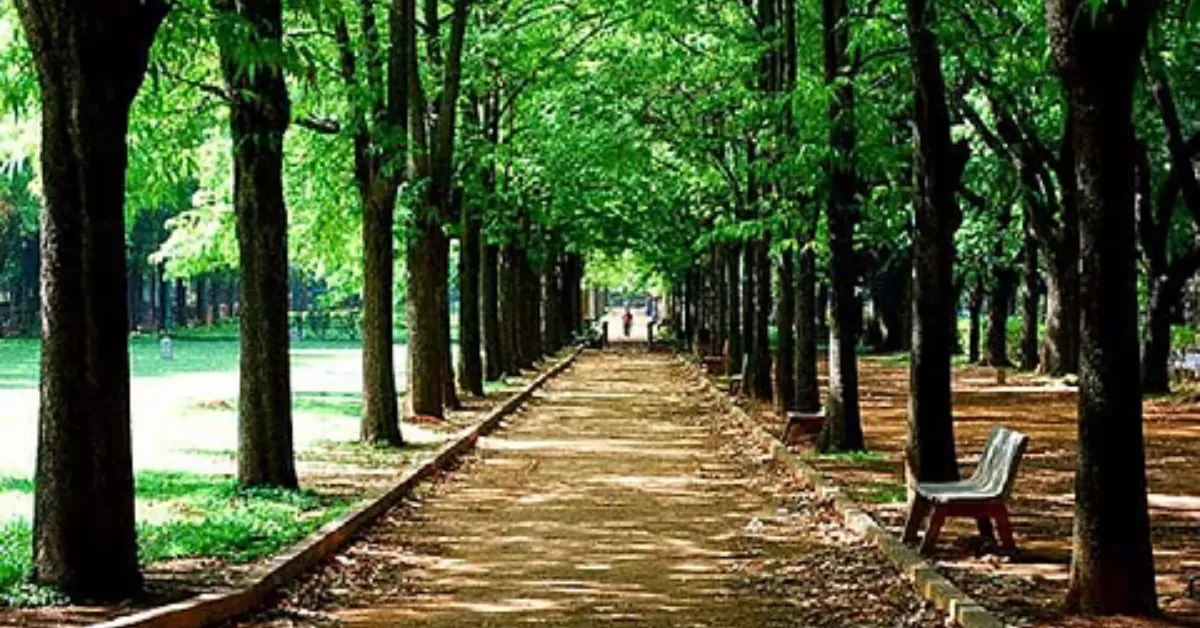
Step off a busy Bengaluru road and into a tree-filled park, and the difference can be immediate. The harsh sun gives way to shade, and the air feels cooler.
For a city once celebrated as India’s Garden City, these green spaces have become especially valuable as concrete buildings and asphalt roads spread.
But what if a park could help cool the streets around it, too?
A 2026 study suggests that Bengaluru’s parks are doing exactly that. Researchers found that their cooling influence can extend hundreds of metres beyond their boundaries. They also identified a surprising number that could help cities plan better parks: 2.49 hectares, or roughly six acres.
How far can a park’s cooling reach?
Researchers Arpit Verma and Sonam Agrawal wanted to understand how Bengaluru’s green spaces help reduce heat in the surrounding neighbourhoods.
Their study, published in Advances in Space Research, examined 15 urban green spaces using satellite images collected during summer and winter.
The findings were encouraging.
Most parks showed a cooling effect of over 1°C in their immediate surroundings, even where buildings and roads covered more than 70% of the surrounding area.
On average, this cooling extended approximately 186 to 246 metres beyond park boundaries, with stronger effects during summer.
Think about what that could mean for a neighbourhood. A park’s trees and vegetation may help reduce surface temperatures along nearby roads and built-up areas, benefiting spaces beyond those used by its visitors.
Why trees make such a difference
There is a simple reason parks tend to be cooler.
Trees block sunlight from directly heating the ground. Plants also release moisture into the air, helping cool their surroundings.
Concrete and asphalt behave differently. They absorb and retain heat, contributing to higher temperatures across heavily built-up neighbourhoods.
This is part of what researchers call the urban heat island effect, where cities become hotter than their less-developed surroundings.
The Bengaluru study found that a park’s ability to counter this heating depended on its size, shape and surrounding development.
And that led researchers to an important question: How big should a park be to offer effective cooling?
Why 2.49 hectares could be a useful benchmark
The researchers discovered that bigger parks generally cooled a wider area. However, increasing their size did not always bring equally large improvements in cooling.
Their calculations identified 2.49 hectares, approximately 6.15 acres, as an efficient size for cooling intensity, or how much a park reduces surrounding surface temperatures.
For cooling a larger surrounding area, the suggested size was 5.29 hectares, or about 13 acres.
These figures offer useful guidance for planners deciding how to use limited urban land.
Bengaluru already has expansive green spaces such as Cubbon Park and Lalbagh. But residents across the city also need accessible greenery closer to their homes.
The study suggests that thoughtfully planned neighbourhood parks could help, especially in areas crowded with buildings.
What this means for Bengaluru’s future
There is one important distinction. The researchers measured land surface temperatures using satellites, rather than the air temperatures people experience.
So, while the findings show how green spaces reduce surface heating, they cannot guarantee that every nearby street will feel a certain number of degrees cooler.
The 2.49-hectare figure is also a planning benchmark, rather than a fixed rule for every park.
BBMP is keen to reclaim Bengaluru’s Garden City tag. Currently, 1408 parks & gardens are being maintained by the civic body. While 1135 of them have been fully developed, work is on to beautify 273 #parks. #BBMP #Bengaluru https://t.co/LZuwUOEnXh
— Maheshwar Rao.M, IAS (@GBAChiefComm) December 19, 2019
Still, the message for Bengaluru is valuable: protecting existing parks, planting trees and planning green spaces carefully can help tackle urban heat.
For residents, a neighbourhood park is where children play, friends meet and people take their evening walks. The research shows that its benefits can travel beyond those familiar paths.
And perhaps that is how Bengaluru can strengthen its Garden City identity: by ensuring that the greenery people enjoy inside a park can also help cool the neighbourhoods they call home.
Sources:
‘The interaction between urban heat island and urban parks: An in-situ measurement-based review’: By Semra Ogce, Huseyin Ogce, Siyu Yu, Robert D. Brown, Published on 31 May 2025
‘Investigation of Urban Green Spaces as Potential Cooling Sources for Heat Mitigation in Bengaluru Metropolitan City, India’: By Arpit Verma and Sonam Agrawal, Published on 1 July 2026
Disclaimer : This story is auto aggregated by a computer programme and has not been created or edited by DOWNTHENEWS. Publisher: thebetterindia.com