Will it be the rapidly disappearing former garden favourite, the small tortoiseshell? Or the poet John Masefield’s “oakwood haunting thing”, the charismatic purple emperor? Or perhaps the brimstone, the ultimate harbinger of spring?
The question of which is Britain’s favourite butterfly is being put to a popular vote for the first time. The charity Butterfly Conservation is running the poll, which runs until 7 June, giving people the chance to choose their favourite from the 60 species that fly around Britain every summer.
Julie Williams, the chief executive of Butterfly Conservation, said: “It’s clear Britain is a nation of butterfly lovers. From Sir David Attenborough and the royal family to the hundreds of thousands of people who have taken part in Butterfly Conservation’s Big Butterfly Count, these incredible insects hold a very special place in our hearts.
“Now, for the first time ever, we want to find out which of our much-loved butterflies takes the nation’s top spot. From the colourful to the quirky, the common to the elusive, all butterflies are beautiful and we look forward to officially crowning Britain’s favourite.”
A recent survey found butterflies were the most-loved creatures from people’s childhoods.
The new contest follows competitions to find Britain’s favourite bird – won by the robin in 2015 – and the Guardian’s invertebrate of the year competition, which launches again in the next month.
Five of the best, by butterfly lover Patrick Barkham
The purple emperor (Apatura iris)
Unquestionably Britain’s most charismatic butterfly, the emperor – or “his imperial majesty” as it is known to admirers – is an elusive treetop-dwelling butterfly that refuses to descend to feed on flowers like most ordinary insects. Instead, it likes nothing better than to dip its lemon-yellow proboscis into fox scat, horse manure and dog dirt. Despite its foul habits, the male flashes iridescent purple, while the gigantic, secretive female lays eggs on sallow. It’s thriving due to global heating.
The small copper (Lycaena phlaeas)
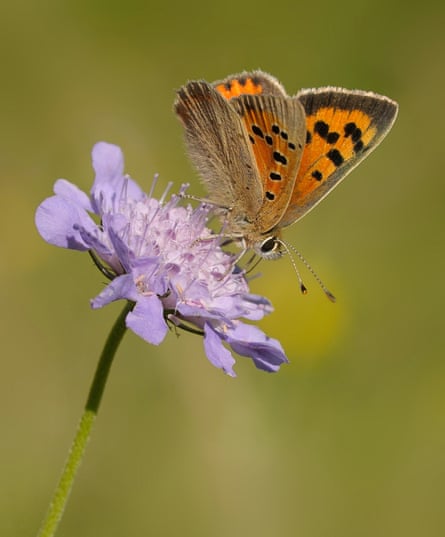
This brilliant specimen is our only bright copper-coloured butterfly. It zips about at high speed in dry grassland, a diminutive but feisty, territorial creature. Less common than it was, it is found from Land’s End to Orkney from April to October. If you desire a butterfly tattoo, the dazzling small copper is the cognoscenti’s choice.
The small tortoiseshell (Aglais urticae)
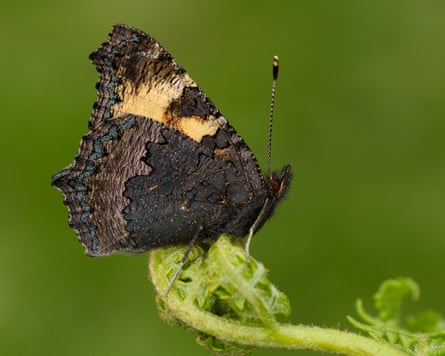
This friendly butterfly is the labrador of the butterfly world, often at our side, feasting on garden flowers across the land. Although the small tortoiseshell is still doing well in Northern Ireland and Scotland, it has drastically and mysteriously declined in recent decades in southern and central England. Global heating appears to be the cause – a puzzle when the nettles its caterpillars devour are still ubiquitous.
The large blue (Phengaris arion)
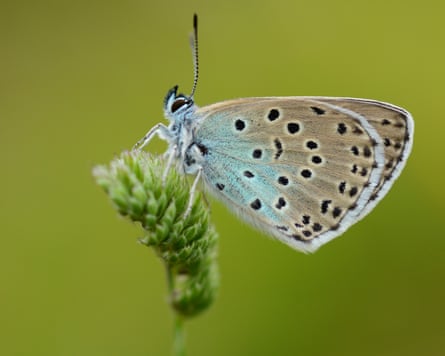
No butterfly better symbolises hope – and the best instincts of humanity – than the large blue. The species fell extinct in 1979 but after years of painstaking labour by two conservation scientists, it was reintroduced with caterpillars from Sweden. Thanks to understanding the butterfly’s dependence on ants, and managing grassland for the ants, the large blue is booming. More large blues are now found in Britain than anywhere else in the world, in what is the world’s most successful example of reintroducing an extinct insect.
The swallowtail (Papilio machaon britannicus)
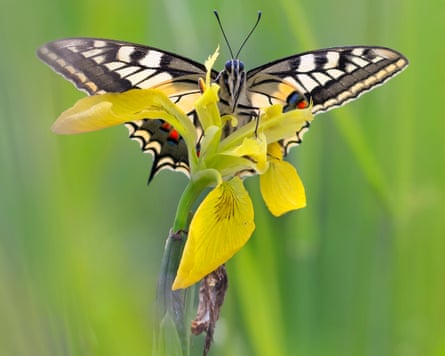
With its fabulous tails and tigerish stripes, the swallowtail looks more like an escaper from a tropical butterfly house than a native species. All 60 native species in Britain are found elsewhere in western Europe but the swallowtail is the nearest we have to a unique, endemic species. It is a subspecies, smaller and darker than its continental cousins after centuries of confinement to shrinking areas of marshland. Now only found breeding in barely 20 locations on the Norfolk Broads, it is a spectacular sight, whizzing across reedbeds and marshes on hot June days.
Disclaimer : This story is auto aggregated by a computer programme and has not been created or edited by DOWNTHENEWS. Publisher: theguardian.com