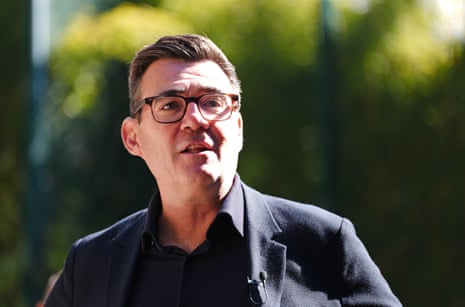
Andy Burnham has called on the Fifa president Gianni Infantino to resign over his “outrageous” plans to sell a stake in the World Cup.
Asked about the Fifa proposals during a visit to a community centre in Sheffield on Friday, the prime minister said:
“My view is strengthening – this was an outrageous suggestion. The idea that it could even be brought forward, in my view, shows that the Fifa general secretary is the wrong man to lead the organisation.”
When told the Fifa president was sticking to its plans despite a furious backlash from Uefa and other membership bodies, Burnham said: “Oh wow. Have they actually done that? Oh wow.”
Counting is under way in the byelection to choose Andy Burnham’s successor as Greater Manchester mayor. Polling stations closed at 22:00pm last night, with the count taking place from 9am this morning. We are expecting a result early this afternoon.
As of 14.05pm on Friday, the turnout was revealed as being 25.14%, with 538,659 votes cast from an electorate of more than two million people.
The turnout was the lowest on record for the mayoral role in the region. At the 2024 election, the turnout was 32%, in 2021 it was 34% and about 28% in 2017 when the first Greater Manchester mayoral election took place.
The contest was triggered by Burnham’s election to parliament last month, after he was elected as the new MP for Makerfield on 18 June, winning 55% of the historic vote.
Polling ahead of Thursday’s vote suggested Labour candidate Bev Craig, the leader of Manchester city council, was on course to win by a comfortable margin.
Her main rival is likely to be either Reform UK’s Sian Astley or the Green party’s Geraldine Coggins. Other candidates were Phil Eckersley (Conservatives), Richard Kilpatrick (Lib Dems), Marlon West (Restore Britain) and Marcus Farmer (Independent).
The government has announced a crack down on rogue funeral operators in order to better protect bereaved families after Robert Bush’s sentencing.
The Department of Health and Social Care (DHSC) will work alongside other departments, including the Ministry of Justice, to develop proposals to improve regulatory standards in the funeral sector. In a press release, the DHSC said:
As part of this work, the Law Commission will undertake a review of the criminal law in relation to the deceased, consider any gaps in existing legal protections and make recommendations on the creation of new offences, if they are needed.
For bereaved families, there can be few things more painful than knowing a loved one was not treated properly after they died. The deceased cannot speak for themselves, which is why clear safeguards, stronger oversight and consistent standards are needed to protect their dignity and give families the reassurance they deserve.
During a visit to Sheffield on Friday, the prime minister said he backed the regulation of funeral homes and mortuaries as he extended his sympathies to the families of victims of the disgraced funeral director Robert Bush, who was jailed for 20 years this afternoon for offences carried out at his business, Legacy Independent Funeral Directors.
“I do back those calls, and there were recommendations in the Fuller Report that will be implemented because we have seen appalling situations like this before,” Burnham said, in reference to the official inquiry into the double killer David Fuller, who was found to have abused more than 100 bodies in an NHS mortuary over a 12-year period.
“I feel for the families and I know it’ll be a difficult day for them with these matters in court again,” the prime minister added. “I was truly horrified when I heard what had happened. Appalling for any family to go through that. This needs a proper response in terms of the regulation needed, to make sure no family goes through that again.”
“People, I think, would assume that the highest standards apply to this area and we’ve got to make sure that they do apply and that there can’t be any repeat of what we’ve seen.”
A funeral director has been jailed for 20 years for leaving dozens of bodies – including a miscarried baby – “rotting” in his mortuary and giving bereaved families the wrong ashes.
Robert Bush, the owner of Legacy Independent Funeral Services in Hull, pleaded guilty to 67 offences spanning 12 years and affecting hundreds of families, including 30 counts of preventing a lawful and decent burial.
Over a five-day sentencing hearing at Hull crown court, more than 80 victims recounted their horror at learning their loved ones had been left “rotting away” inside his funeral parlour. Many broke down sobbing during their statements.
Sentencing Bush, the judge, Mr Justice Hilliard, said: “The defendant was so preoccupied with his own enrichment that he behaved in a shocking and disgraceful way towards the deceased.
“The awful truth is that anyone whose loved one went through Legacy at any time when it was operating can now have no confidence as to how they were treated or whose ashes they have. Unless, of course, they were one of the 30 bodies recovered in March 2024.
“Culpability is of course high because of the gross breach of trust in respect of people who were vulnerable as they were bereaved.”
The price of petrol has hit a new Iran War high at UK forecourts, adding to the financial pressure on millions of households about to embark on their annual holiday.
The RAC said that in “very unwelcome news for drivers” the average pump price had reached 160p a litre, reversing the drop down to 151p in early July that followed the announcement of a fragile Middle East ceasefire.
That is the highest level since November 2022, when prices were soaring in the aftermath of Russia’s full-scale invasion of Ukraine.
Andy Burnham said the government had offered help to Spain tackling a surge of migrants crossing from Morocco into its Ceuta enclave.
The crisis was “a matter for the Spanish government first and foremost, but it is a cause for concern,” Burnham told reporters.
“And we are making contact with the Spanish government, the Spanish authorities, to provide support but also to understand the implications of that situation.”
Andy Burnham has called on the Fifa president Gianni Infantino to resign over his “outrageous” plans to sell a stake in the World Cup.
Asked about the Fifa proposals during a visit to a community centre in Sheffield on Friday, the prime minister said:
“My view is strengthening – this was an outrageous suggestion. The idea that it could even be brought forward, in my view, shows that the Fifa general secretary is the wrong man to lead the organisation.”
When told the Fifa president was sticking to its plans despite a furious backlash from Uefa and other membership bodies, Burnham said: “Oh wow. Have they actually done that? Oh wow.”
The transport secretary, Heidi Alexander, has said mayors will be given a fast-track route to build new tramways, roads and light rail in their local areas.
Large transport projects put forward by local leaders need to have Department for Transport approval before they are built.
The cost threshold at which mayors need to seek approval was set at £200m – but Alexander says this will increase to £500m, which will mean mayors can bypass the queue for Whitehall approval on their projects if they cost less than half a billion pounds. These could include tram schemes, metro extensions and station upgrades.
“Today we’re giving local leaders more power to shape transport in their community,” the transport secretary wrote in a post on X.
“Locally funded transport schemes up to £500m no longer need Whitehall approval, meaning fewer projects get bogged down by bureaucracy, and you get the services that make your life easier.”
The new threshold was announced as Andy Burnham unveiled plans to let mayors use a share of the income tax and business rates raised in their areas as part of his devolution push (see opening post for more details).
As we reported in an earlier post, the long-serving Labour MP Diane Abbott has been let back into the party after she was suspended last July after repeating comments about racism for which she had previously apologised.
In a statement posted to X late last night, the MP for Hackney North & Stoke Newington said: “Today, following a process conducted in line with party rules and approved by the independent review process I have been readmitted to the Labour party.
“I have been issued with a formal warning for a tweet I previously posted. By inadvertently referring to the Israeli Defence Force as the ‘Jewish Defence Force’, I used wording that conflates the actions of the state of Israel with the Jewish community. I am deeply sorry for any hurt caused by that conflation and apologise for any hurt caused by it.”
Abbott was first stripped of the Labour whip in April 2023 after writing a letter to the Observer in which she argued that Jewish, Irish and Traveller people experienced prejudice rather than racism. As my colleague notes in this story, she apologised and withdrew the remarks, saying an earlier draft had mistakenly been submitted for publication.
She was readmitted to Labour before the 2024 general election but in a BBC interview last year she defended her original remarks. Seperately, in July 2025, Abbott, 72, referred to the Israel Defense Forces as the “Jewish Defence Force” in a social media post she published. She was given her second suspension last summer, which meant she was forced to sit as an independent MP instead of a Labour one.
The Board of Deputies of British Jews, the largest body representing British Jews, reacted to Abbott’s readmission to Labour in a statement posted on social media.
“This is an early test of resolve for the Burnham administration,” the group’s president, Phil Rosenberg, said. “It is hard to conceive of the whip being restored unless there is clear and sustained evidence of genuine remorse”, he said, adding that an “unequivocal recognition that antisemitism is racism” is also needed.
The construction of a new Chinese “super-embassy” in London, which is set to be built near the Tower of London, can go ahead after a high court challenge against the decision to grant planning permission was dismissed, PA Media is reporting.
The Royal Mint Court Residents’ Association (RMCRA) brought legal action against the Ministry of Housing, Communities and Local Government and the London Borough of Tower Hamlets.
It said the presence of the embassy could lead to terrorist attacks or the repression of protests, while being used to enforce “draconian” Chinese laws in the UK and to target dissidents.
The association, which represents families and businesses in about 100 properties, also said diplomatic immunity could make it hard for UK authorities to enforce fire safety rules if the Chinese government ignored them.
The government and the council defended the claim, saying they “conscientiously and carefully had regard” to the residents’ concerns. Following a hearing at the high court earlier this month, two judges dismissed RMCRA’s challenge.
The SNP has called for “decisive action” from Andy Burnham after BP announced it was selling its North Sea operations.
Reacting to the news, SNP Westminster leader Dave Doogan said:
Workers don’t want thoughts or warm words from the prime minister, we need decisive action to safeguard jobs, energy security and confidence in the North Sea. What we have here is an historic business that has employed thousands of Scottish workers and a major part of the Scottish economy opting to leave the North Sea.
The destruction of one of Scotland’s foremost industries is happening right before our very eyes. There is no moral high ground to be found in ruining oil and gas jobs in Scotland to sponsor those very same jobs halfway around the world at a higher carbon cost, with our energy security put at risk and renewables investment lost.
Burnham has come under considerable pressure from trade unions and some of his backbenchers to support increased drilling in the North Sea. The pressure to issue new licences has intensified since the start of the US-Israel war on war in February, with the resultant closure of the strategic strait of Hormuz causing energy costs to spiral.
The prime minister is expected to stick to Labour’s 2024 manifesto promise that no new oil and gas licences would be issued, but reportedly could approve drilling at the Rosebank and Jackdaw fields, which were given approval under the Conservatives but put on hold by legal action.
BP has put its North Sea oil and gas business up for sale as it looks to end six decades of production from the region.
The firm announced on Friday morning that it had launched a formal process to market its North Sea business for a potential sale. The move comes as BP’s new chief executive, Meg O’Neill, tries to simplify the company and cut its debt levels.
O’Neill said in a statement: “The North Sea remains integral to the UK’s energy system. However, as we focus our portfolio and direct capital to our highest-value opportunities, we believe our North Sea business will be better positioned as part of another company.”
She said the UK would “continue to play an important role” in BP’s future. “We’re proud of the jobs we create, the contribution we make to the UK economy, and the work we do to keep energy flowing every day,” she said.
BP’s involvement in the North Sea dates back to 1964, when it was granted its first UK North Sea licence. The company discovered the West Sole gasfield in the winter of 1965, followed by its largest discovery in the area, the giant Forties field, in 1970.
The sale announcement comes a day after Andy Burnham said he would take a “pragmatic” approach to oil and gas drilling in the North Sea, saying the government could not ignore the potential energy resources it held. You can read more here:
In other news, Labour’s former deputy leader Harriet Harman has suggested that men should be banned from running to become the next Labour leader.
“We’ve got to have a woman next time,” the Labour peer told the Electoral Dysfunction podcast.
“And I’ve worked out that the only way we’ll have a woman leader of the Labour party next time, is if we start a conversation now where we say that, actually, men cannot stand for the leadership next time,” Harman, who was Labour’s deputy leader under Gordon Brown, said.
The Conservatives have had three female prime ministers, but Labour has never had a permanent female leader. Margaret Beckett and Harman served only as acting leaders.
Harman added that the Labour party, which has had four female deputy leaders, needed to “start the discussion about male ambition and male allyship”, and that “male ambition should not be to lead themselves, male ambition ought to be to support a woman to lead”.
The domestic abuse commissioner for England and Wales, Dame Nicole Jacobs, has written an op-ed in the New Statesman, in which she says the “epidemic” of domestic abuse and violence against women and girls risks being ignored in the government’s devolution plans – but adds that there is an opportunity to improve services across the country as part of a victim-centred system. Here is an extract from her piece:
Governments of all political stripes have made genuine efforts to tackle domestic abuse. Too often, I have seen those attempts fall short because responsibility and accountability is scattered across Whitehall.
It is one of the many reasons why progress on halving violence against women and girls has been slow – the machinery of government is simply not set up to tackle problems that cut across every part of the state.
Take funding for specialist domestic abuse services. Week in and week out, I hear from domestic abuse organisations that are having to reduce the support they offer, let staff go or close entirely. Why? Because money is trapped in short term, centralised budgets, struggling to find its way to those trying to deliver on the ground. This is why Burnham’s drive to devolve power offers opportunity.
By shifting our focus away from individual programmes and isolated funding streams, which local areas tell me inhibit their ability to deliver for victims, we can enable regional leaders to build a system which moves as one around victims. This would see specialist services funded to work in tandem with public services – be that health, housing or social care – to understand what survivors need and adapt their response to ensure they can rebuild and recover away from abuse.
MPs Diane Abbott and Joani Reid have been readmitted into Labour and had the parliamentary whip restored, just under two weeks into Andy Burnham’s premiership.
The party confirmed that this followed separate independent disciplinary processes, although Labour said the leadership played no role in either decision.
Abbott, 72, the mother of the House of Commons, was suspended for a second time last summer after saying she did not regret comments about racism that had led to her initial loss of the whip in 2023.
Reid, the MP for East Kilbride and Strathaven who was elected in 2024, voluntarily relinquished the whip in March this year. Her husband had been arrested on suspicion of assisting a foreign intelligence service in a case linked to China. Reid has never been accused of wrongdoing.
The Guardian understands from Labour party sources that Reid has never been party to the police investigations into alleged Chinese spying.
You can read more on this story by the Guardian’s political correspondent, Aletha Adu, here:
There are 14 regional mayors in England, including the mayor of London, with many areas not represented by one. Speaking to BBC Radio 4’s Today programme, the first secretary of state, Louise Haigh, defended the devolution plan against accusations that areas with weaker economies and without mayors could lose out on key funding.
She said:
We won’t be imposing mayors to areas that don’t want it but we will be creating strategic authorities in every area of England and they will be able to hold these powers and resources as well.
They don’t need to have mayors in order to control them or in order to retain a share of their income tax and business rates.
As we mentioned in the opening post, Ben Houchen, the Conservative Tees Valley mayor, has indicated he would use so-called “fiscal devolution” to lower the tax burden for his voters. According to a report in The Times, Houchen said he wanted to make his region “a more attractive place and a more competitive place to invest in than Manchester and London”.
The Tees Valley Combined Authority comprises five constituent local authorities: Darlington, Hartlepool, Middlesbrough, Redcar and Cleveland, and Stockton-on-Tees. The total population of the area covered is about 700,000.
“Every mayor is backing fiscal devolution because they want more money to spend in their area,” Houchen, England’s only Conservative mayor, said.
“However, if the Tees Valley is handed a slice of local income tax and business rates generated locally, I’ll create a new rebate scheme to put money back into people’s pockets and let families keep more of the money they earn.”
“Fiscal devolution must be about giving places like Teesside the power to do things differently, back growth and reward the people that drive our local economy instead of squeezing every last penny out of them.”
As a reminder, the government has not yet decided the exact portion of taxes mayors will get.
The first secretary of state, Louise Haigh, confirmed this morning that it is “not possible at the moment” for English mayors to give their local residents tax rebates under the devolution plans. Speaking to Times Radio, she said: “We’d have to see the details of that, but it certainly isn’t possible at the moment.”
Haigh added:
Those kind of schemes necessitate HMRC to set up full schemes, that’s just not possible at the moment. The way that the mayors are set up and work is to reinvest the money into their public services, into their local economies.
Under a new “local first” principle, Andy Burnham will instruct ministers to justify why powers should remain in Whitehall rather than be devolved.
As well as greater control over technical education for teenagers, announced by the government this week, some of those close to the prime minister have called for mayors to oversee schools, GPs and childcare providers through health and education commissioners – a similar role to that played by police and crime commissioners.
No 10 said Britain’s civil service of 520,000 would become “smaller and more strategic” as decision-making moves out of London, where one in five of these officials are based.
England’s directly elected mayors, who control areas spanning three-quarters of the population, would be able to use the revenue generated from business rates and income tax as they wish, including tax breaks for important industries or rebates to residents.
However, experts said one of the most significant consequences was that it would allow combined authorities to take out 30-year loans against their projected income to fund major projects that previously needed Treasury approval.
Mayors said they were currently prevented from funding huge initiatives on housing and transport because they could not take out private loans on the basis of one-year funding settlements from Whitehall. You can read more here:
Good morning and welcome to our live coverage of UK politics. From 2028 English regional mayors, for the first time, will be handed a share of income tax receipts instead of central grants and be less beholden to the Treasury by being able to borrow (mainly from private investors) to invest in big projects.
Mayors will also be able to keep a share of business rates totalling tens of millions of pounds by April 2027, and gain greater control over services such as housing and transport, under plans that form part of the government’s devolution agenda.
As my colleague Josh Halliday notes in this story, these will replace existing grants rather than being additional money, but local leaders said no longer relying on ringfenced Treasury handouts would be transformative.
Traditionally, the Treasury in Whitehall has controlled the distribution of local funding, leading to patchy distribution of funds across the country and disempowered local leaders feeling money is not going where it is needed most.
The prime minister, Andy Burnham, is expected to visit a community centre in the north of England this morning and officially announce what has been described as “the biggest transfer of power from Westminster in a generation”. The government said it would be developing different proposals for Scotland, Wales and Northern Ireland.
The plans have been criticised by the Conservatives for being vague, with more details to be released in a white paper and the budget this autumn.
The Conservative shadow chancellor, Mel Stride, said that if faster growing areas get more funding it “could mean those who lose out are precisely those areas which have seen weaker local economies over recent years.”
Some mayors are thought to be considering using their powers to roll out tax reliefs, including the Conservative mayor of Tees Valley and Reform UK’s Greater Lincolnshire mayor, Dame Andrea Jenkyns.
Louise Haigh, who is overseeing No 10 North in her new role as chancellor of the duchy of Lancaster, was asked whether the scheme will enable rich areas to get richer while poorer areas get poorer. Speaking on Times Radio, she acknowledged that London, which already attracts major investment, will be able to retain more money under the government’s tax devolution plans.
Haigh said:
There is already a way that the business rates retention is distributed to correspond with central funding formula to correct for that.
Because you wouldn’t want to have it that places like London and Manchester and Bristol were able to retain more of theirs while other areas that weren’t growing at the same rate, were falling behind.
So there will be a formula and funding position set out in the budget that that corrects this, but really, we are the most centralised nation in the G7, and that has held back our growth and our productivity outside London and the south-east for too long.
Asked whether London will be able to retain more money than it has done previously, She added:
Yes, that’s right, and it will have more powers devolved, 16-19 funding, employment support budgets and the ability to tailor their own vocational routes. This will be an important part of developing their own local regional growth strategy as well.
Disclaimer : This story is auto aggregated by a computer programme and has not been created or edited by DOWNTHENEWS. Publisher: theguardian.com