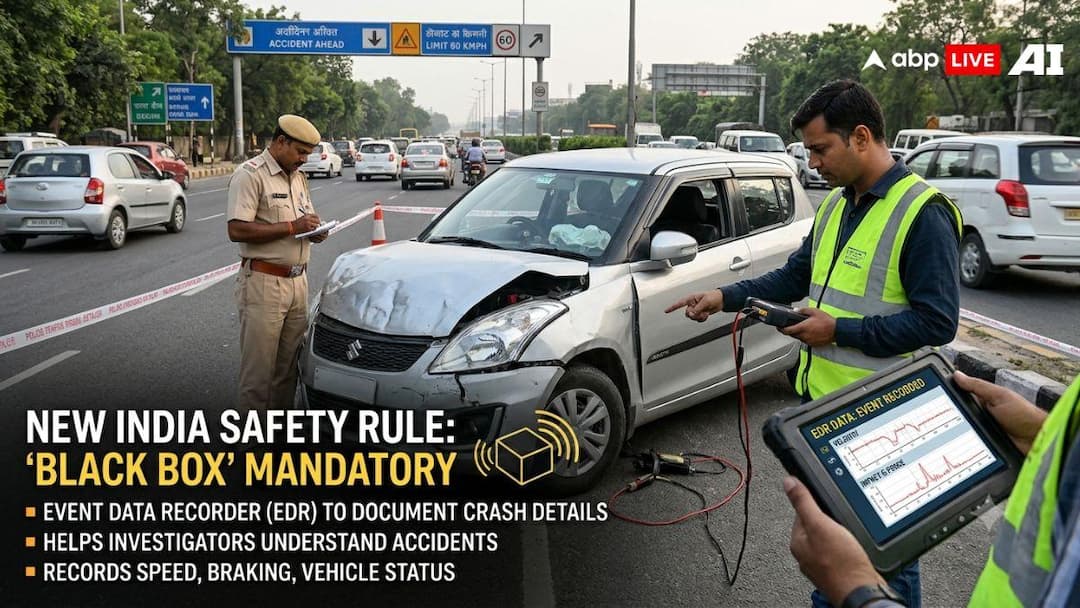
- India mandates new car safety rules, including EDR black boxes.
- Rules enhance pedestrian protection, occupant safety, and anti-theft systems.
- Implementation of these new safety requirements phased until 2032.
Cars in India are set to face new safety requirements, including rules related to an Event Data Recorder (EDR), commonly known as a car’s ‘black box’. The device records technical data around a crash, helping investigators understand what happened in the moments before and during an accident.
The government has also revised proposed safety requirements covering pedestrian protection, occupant safety in collisions and anti-theft systems. The changes are scheduled to come into force in phases, with deadlines extending from October 2027 to 2032 for different provisions.
What Is A Car’s ‘Black Box’?
An EDR is generally integrated into a vehicle’s control system associated with airbag deployment. When a car experiences a severe impact or its airbags deploy, the system can save a short record of data from the moments before and after the event.
Unlike an aircraft black box, it is not designed to record conversations inside the vehicle. Instead, it captures technical information that can help investigators reconstruct the sequence of events surrounding a crash.
What Data Does An EDR Record?
Depending on the system, the recorded information can include the vehicle’s speed, whether the brakes were applied, seat belt use and the timing of airbag deployment. The data typically covers a short period around the crash rather than everyday driving.
This information can help investigators establish what the vehicle was doing immediately before an impact. However, an EDR does not provide a complete account of an accident. Road conditions, weather, the actions of other vehicles and other circumstances still need to be examined separately.
How Will It Help Investigate Accidents?
After a collision, investigators often need to establish the vehicle’s speed, whether the driver applied the brakes and the sequence in which events occurred. EDR data can provide technical evidence to help answer these questions, rather than leaving investigators to rely only on eyewitness accounts.
The device cannot, by itself, determine who was at fault. Its data must be assessed alongside other evidence collected during the investigation.
Pedestrian And Occupant Safety In Focus
The revised safety requirements also aim to reduce injuries to pedestrians struck by cars. Other provisions focus on improving protection for people inside vehicles during frontal and side-impact collisions.
The changes are intended to address both the risk of injury to vehicle occupants and the dangers cars pose to vulnerable road users.
Anti-Theft Requirements Also Included
The revised requirements cover systems such as alarms and immobilisers. An immobiliser prevents a vehicle from starting without the correct key or an authorised method of activation, making it harder to steal a car by bypassing its normal starting mechanism.
The measures form part of the broader changes to vehicle safety requirements.
When Will The New Rules Take Effect?
The requirements will be introduced in phases rather than all at once. Some provisions have October 2027 deadlines, while others are scheduled for 2028 and 2029. Further requirements extend to 2031 and 2032, giving vehicle manufacturers time to make the necessary changes.
EDR Systems Already Used In Other Countries
Event Data Recorders are already used in several major automotive markets. China made EDRs mandatory for passenger cars from January 1, 2022, while requirements for new cars in Europe also took effect in 2022.
In the United States, the National Highway Traffic Safety Administration estimated that EDRs were already present in about 96% of model-year 2013 passenger cars.
Who Can Access The Recorded Data?
The collection and use of EDR data have raised privacy concerns in other countries. Critics in the United States have questioned whether the information could be accessed without a vehicle owner’s knowledge and used as evidence in court proceedings.
The rules governing access to this data are therefore important. In India, clarity on who can retrieve EDR information, under what circumstances and with whose authorisation will be significant for vehicle owners.
India NCAP To Introduce Stricter Ratings
Separately, India’s vehicle safety rating programme, Bharat New Car Assessment Programme (Bharat NCAP), is set to enter its second phase in October 2027, according to Union Road Transport Minister Nitin Gadkari.
Under the proposed framework, 20 out of 100 points would be allocated to pedestrian protection and the safety of other vulnerable road users. Bharat NCAP is a vehicle safety rating programme, distinct from the regulatory safety requirements that manufacturers must meet.
The changes indicate a broader focus on vehicle safety, from improving protection during collisions to making accident investigations more evidence-based. The implementation timelines and provisions will determine how these requirements translate into changes in vehicles sold in India.
Disclaimer : This story is auto aggregated by a computer programme and has not been created or edited by DOWNTHENEWS. Publisher: abplive.com