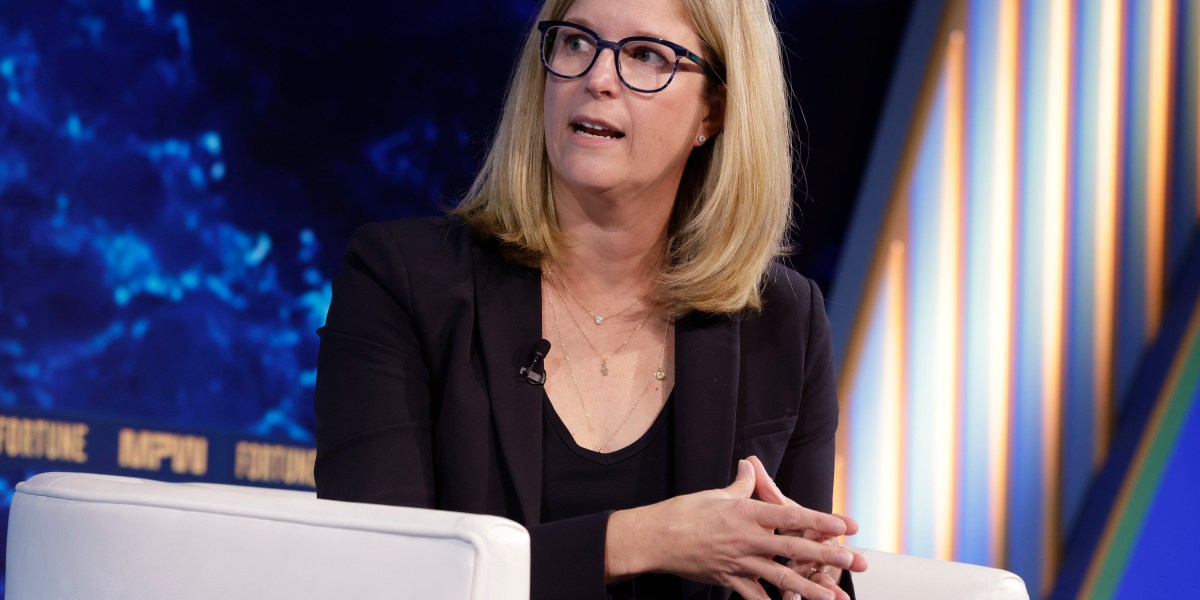
I sat down with Sarah London, CEO of Centene, on Monday. She offered her perspective on health care’s AI boom. Much of the AI being deployed at scale today, London said, goes toward what she calls “inflationary use cases,” tools that generate more revenue in a fee-for-service system rather than reduce the underlying cost of care.
AI can make billing faster, automate paperwork and help providers capture more revenue. But those gains don’t necessarily make health care less expensive. London believes the bigger opportunity lies in changing how care is delivered and who can access it.
Centene, a $33 billion company operating Medicaid plans in 29 states alongside marketplace and Medicare Advantage coverage, serves 26 million members. They are, London said, “among the poorest, sickest” people in their communities.
Yet those populations are often left behind by health care innovation. London sees two opportunities for AI to change that.
The first is moving care into the community. In rural areas where medical services are scarce, AI could help community health workers triage non-acute problems locally, potentially avoiding emergency room visits.
The second is giving patients more control over their care. Interactive tools could help people navigate initial decisions about a health concern without making every next step dependent on a clinician visit.
“That’s actually how you bend the cost curve,” London said.
That vision doesn’t make administrative automation irrelevant; it sharpens the financial case for it.“Every dollar that we can save in the administration of health care, we can apply to benefits,” London said.
For health care CFOs, the challenge is distinguishing between an AI tool that speeds up billing and one that helps patients get the right care in the right setting—potentially changing the economics of care itself.
The question isn’t just how much AI can help health care do. It’s whether it can help health care spend less to deliver better care.
You can watch a video of my discussion with London at the MPW Summit here.
Sheryl Estrada
Sheryl.Estrada@fortune.com
Leaderboard
Brian Erickson was appointed CFO of Runpod, an AI developer cloud platform. Erickson most recently served as CFO of Suzy, an AI-powered consumer insights platform. Previously, he was CFO of Transfix, where he helped guide the company through its sale, and held senior finance roles at DigitalOcean, where he helped the company navigate its IPO. He also held finance roles supporting the cloud businesses at Amazon and Microsoft.
Anne Giviskos was appointed CFO of MoonPay, a financial technology company Giviskos most recently served as interim CFO and chief accounting officer at Navan, an AI-powered business travel and expense platform. She previously held executive roles at the New York Stock Exchange and Euronext.
Big Deal
Nearly every company now reports a positive return on AI, but far fewer report a strong one, according to the 2026 AI Adoption Report from Wharton Human-AI Research and GBK Collective.
The study is in its fourth year and finds the difference often comes down to what companies measure. Thirty-five percent of enterprise leaders who track at least one growth measure report strongly positive ROI, compared with 13% of those who track efficiency alone.
Ownership matters too: 58% of organizations with a newly named chief AI officer report strongly positive ROI, versus 8% with no such role. “Companies believe AI is going to transform their industries, but many are still asking it to prove itself by saving time,” said Wharton professor Sonny Tambe, a co-director of the research group.knowledge.
Going deeper
Overheard
“Big Tech has already committed hundreds of billions of dollars to building the infrastructure for AI. The harder question is whether that technology can produce productivity at a scale that makes the investment worthwhile. Health care may be one of the clearest places to find out.”
—Bill Miller, chairman and CEO at WellSky, writes in a Fortune opinion piece.
Disclaimer : This story is auto aggregated by a computer programme and has not been created or edited by DOWNTHENEWS. Publisher: fortune.com