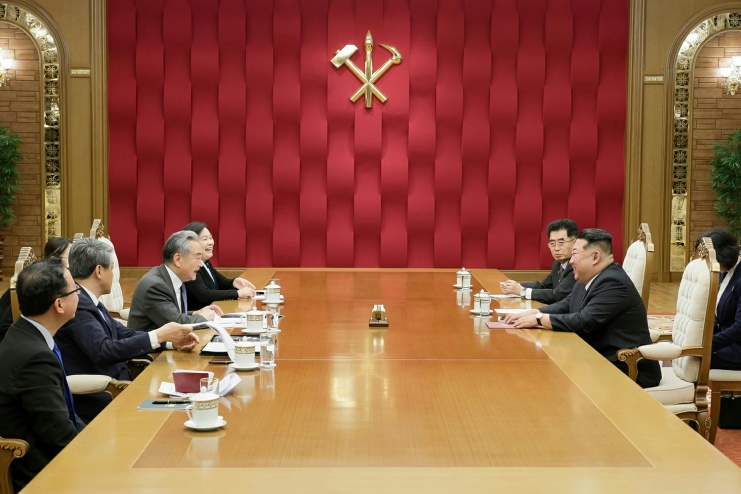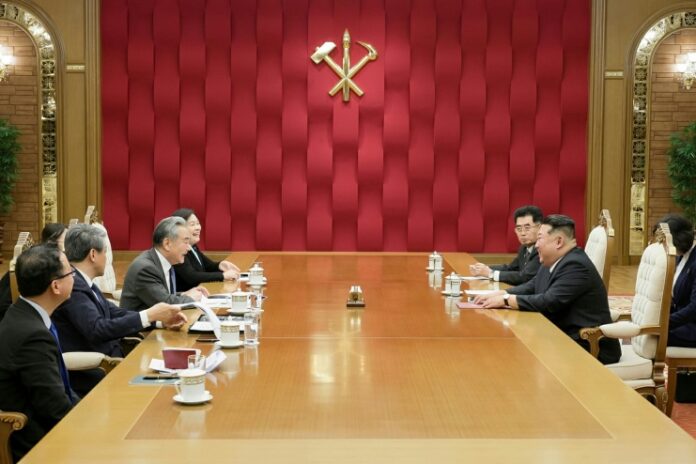
Chinese Foreign Minister Wang Yi’s visit to South Korea on August 19-20, 2026, received relatively little international attention, despite being a consequential meeting for the Korean Peninsula. As China’s top diplomat and a member of the Political Bureau of the Communist Party of China Central Committee, Wang Yi delivered Beijing’s strategic foreign policy objectives toward the Korean Peninsula in an unusually candid way, not coded in diplomatic language.
Wang’s visit underscored China’s five closely connected foreign policy objectives. First, Beijing seeks to maintain permanent peace and stability on the Peninsula. Second, China categorically rejects North Korea’s nuclear weapons and maintains denuclearization as a long-term objective. Third, Beijing opposes the emergence of competing security blocs, whether a Russia-DPRK-China alignment or a consolidated U.S.-South Korea-Japan bloc. Fourth, China seeks to reduce U.S. military influence on the Peninsula and ultimately secure the removal of U.S. ground troops. Finally, China strives to build a regional security environment more conducive to its long-term objective of unification with Taiwan. These objectives appear not only in official statements but also in prominent publications from Chinese scholars.
First, North Korea’s belligerent behavior threatens peace and stability in the region. Missile launches and continued nuclear development provide justification for greater U.S-South Korea-Japan security cooperation and expanded military deployments in Northeast Asia. As Yijong Zheng states, “Beijing fundamentally opposes not merely North Korea’s possession of nuclear weapons, but the broader evolution of Northeast Asia’s security structure toward what may be called “deterrence normalization”: a situation in which North Korea’s nuclear status is increasingly accepted, while U.S. extended deterrence and regional military integration are continually reinforced.”[1]
Second, during his visit to Pyongyang on April 9-10, 2026, Wang Yi made it clear that North Korea’s belligerent behavior will come at a cost. As Zheng Jiyong argues, China “does not believe its nuclear status should be cost-free” and will use North Korea’s economic dependence to obtain “specific acts of restraint” from Pyongyang.[2] In exchange, Beijing will condition humanitarian assistance, access to border trade, energy supplies, infrastructure investment, and political backing on North Korean restraint. In practical terms, this means that further nuclear and missile provocations, military escalation, or actions that trigger expanded U.S., South Korean, and Japanese military deployments can come at the cost of diminished Chinese economic support and cooperation. Conversely, broader cooperation with Beijing requires Pyongyang to meet China’s requirements for “border stability, crisis communication, and military restraint.”
Third, China rejects bloc politics and the creation of Cold War-like architecture in Northeast Asia. The Russia-DPRK relationship contributes to a more divided security environment in Northeast Asia. Beijing categorically rejects joining a Russia-DPRK bloc[3] and does not want South Korea to become deeply integrated into a U.S.-Japan-South Korea military alliance. As Zheng Jiyong argues, “for Beijing, the biggest risk of closer North Korean-Russian cooperation is that it provides an excellent pretext for Japan, South Korea, and the U.S. to accelerate the integration of their bloc.” Encouraging South Korea to preserve its strategic autonomy and avoiding bloc confrontation are central to China’s objectives.
Moreover, China and South Korea share fundamental interests in peace, stability, and economic prosperity on the Korean Peninsula, while their economies remain deeply interconnected. During his visit, Wang called for the “resumption of a dialogue, and restoration of mutual trust” and for peaceful coexistence between South Korea and the DPRK, ultimately leading to lasting peace and stability.[4] In return, China can offer South Korea access to its enormous market, sharing knowledge and cooperation in AI, high tech industries, and the silver economy. It can also use its economic leverage over North Korea to render “tangible evidence” that Pyongyang is reducing the risk of conflict, by refraining from belligerent foreign policy actions that could otherwise trigger further regional militarization.[5]
Fourth, China seeks to reduce the U.S. military influence on the Peninsula and ultimately secure the removal of U.S. ground troops. China’s concept of denuclearization applies to the entire Korean Peninsula rather than exclusively to North Korea.[6] It addresses the dismantlement of the DPRK’s nuclear weapons, but also involves the broader military environment surrounding the Peninsula, including U.S. extended nuclear deterrence, the deployment or presence of nuclear-capable strategic assets and the possibility of further nuclear proliferation in South Korea or Japan. From Beijing’s perspective, denuclearization cannot be separated from the wider objective of reducing the military confrontation that sustains the regional security dilemma.
Finally, these objectives serve China’s wider strategic interests beyond the Korean Peninsula, particularly Taiwan. Beijing accepts that the U.S. will remain its principal strategic competitor, but does not view competition as requiring permanent confrontation. Instead, it seeks what Da Wei describes as a new equilibrium of “strategic stability,” in which both sides avoid further deterioration and cooperate where their interests align.[7] A stronger U.S.-South Korea-Japan security bloc would reinforce a regional security architecture that Beijing regards as increasingly directed against China. Preventing Northeast Asia from hardening into opposing military blocs serves China’s interest in limiting strategic pressure around the Taiwan Strait. The message to Washington is one of both cooperation and strategic limits: China is prepared to work with the United States where their interests converge, but it is also more openly defining the regional order it wants.
In summary, Wang Yi’s visit unequivocally underscored China’s core strategy on the Korean Peninsula. China made it clear to Seoul that its interests are better served by preserving its strategic autonomy, consolidating mutually beneficial economic cooperation with Beijing, and resisting further institutionalization of the trilateral security alliance. At the same time, China will use its leverage over North Korea and Russia to press for greater restraint and counter further consolidation of adversarial bloc formation. China’s strategy is therefore not simply to react to developments on the Peninsula, but to actively shape the choices of all three actors to preserve its strategic interests.
[1] Zheng, Jiyong. 2026. “China is confronting new realities on the Korean Peninsula.” Brookings. Retrieved from https://www.brookings.edu/articles/china-is-confronting-new-realities-on-the-korean-peninsula/.
[2] Zheng, Jiyong. 2026. “China is confronting new realities on the Korean Peninsula.” Brookings. Retrieved from https://www.brookings.edu/articles/china-is-confronting-new-realities-on-the-korean-peninsula/.
[3]Zheng, Jiyong. 2026. “China is confronting new realities on the Korean Peninsula.” Brookings. Retrieved from https://www.brookings.edu/articles/china-is-confronting-new-realities-on-the-korean-peninsula/.
[4]Zhou, Jin. 2026. “FM’s ROK visit builds positive momentum.” China Daily. Retrieved from https://www.chinadaily.com.cn/a/202608/20/WS6a8718cca3106bc57421c9e0.html.
[5] Zheng, Jiyong. 2026. “Why China Worries about North Korea.” Foreign Affairs. Retrieved from https://www.foreignaffairs.com/china/why-china-worries-about-north-korea.
[6]Zheng, Jiyong. 2026. “China is confronting new realities on the Korean Peninsula.” Brookings. Retrieved from https://www.brookings.edu/articles/china-is-confronting-new-realities-on-the-korean-peninsula/.
[7] Da, Wei. 2026. The emerging U.S.-China détente. Foreign Affairs. Retrieved from https://www.foreignaffairs.com/united-states/emerging-us-china-detente
Disclaimer : This story is auto aggregated by a computer programme and has not been created or edited by DOWNTHENEWS. Publisher: dailynk.com