
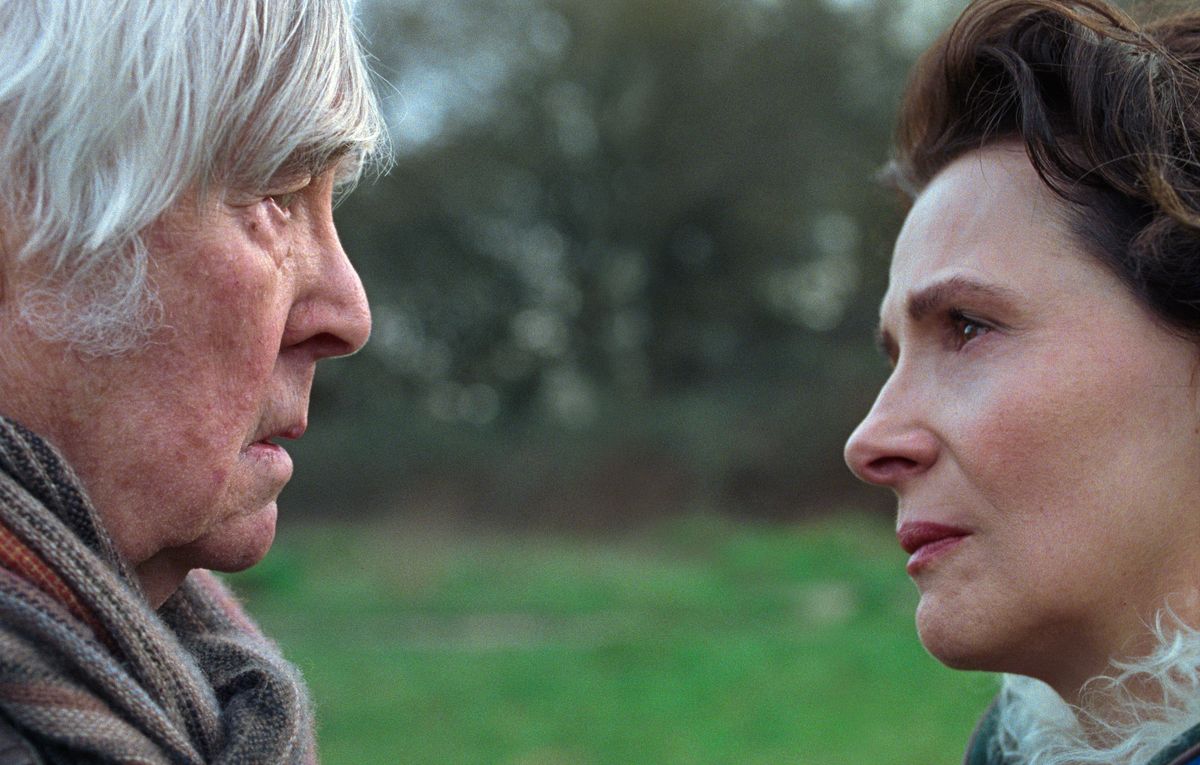
Regarded as one of the most fearless female performers of her generation, Juliette Binoche has been tipped for a best actress nomination for her masterful performance in her new film, Queen at Sea. The star of Chocolat and The English Patient, for which she won an Oscar, Juliette plays Amanda, a woman trying to cope with a traumatic family situation involving her stepfather, Martin (Tom Courtenay) and her mother, Leslie (Anna Calder-Marshall) who has dementia.
Amanda reports her stepfather to the police, after worrying about her mum’s capability to give informed consent to sex, having walked in on an uncompromising situation, when she found Leslie and Martin in bed together. Winning the top prize at the Berlin Film Festival early this year, as well as offering superb performances from a stellar cast, director Lance Hammer has taken the unusual decision to use real officials for certain roles – such as the social worker – to give the scenes more authenticity.
Juliette says: “It’s always wonderful when you have real people because they know what they’re talking about, and so you believe them. It’s as simple as that.” The film, which is in UK cinemas now, raises very difficult moral dilemmas concerning consent and the impact of advanced dementia within a family- especially when it comes to making decisions about care and autonomy.
Determined to bring sincerity to the role and the difficult situation the family was in, Juliette found the professional’s input invaluable. “I was asking a lot of questions about, you know, what in this case, in that case? Asking about what they know, what they’ve been through. It was the perfect combination for a film,” she tells The Arts Hour, on the BBC World Service.
The star of more than 60 films, Juliette, 62, who keeps a main residence in Paris and also has a home in the French countryside, explains: “Amanda, my character in the film, is in shock, and of course Amanda’s reaction is to protect [her mother] and call the police immediately. And so from that, the film [plot], you know, spread. The first instinct is to protect and stop what my stepfather, Tom, is doing.”
But Juliette says that by reporting her stepfather, fearing that her mum may not have the capacity to consent to intimacy, the situation very quickly escalates beyond her control. She says: “It’s a silent bomb in a way. You don’t know what you’re going into as you start, and then it goes on and on, and it becomes this immense mountain. You don’t know how to deal with it.”
As soon officialdom is involved, there is no going back for Amanda. Queen at Sea tackles a very challenging subject, but it is far from the first time Juliette has chosen to play a difficult role. In Camille Claudel 1915 she played the real life French sculptor confined to an asylum; in Three Colors: Blue, she played a woman dealing with the devastating loss of her husband and child and in The English Patient, she played a nurse caring for a severely burned, dying man in a ruined monastery.
But, despite the harrowing storyline of Queen at Sea, Juliette enjoyed making the film, because of the superb actors. She says of Tom Courtenay: “The transformation of his character is wonderful. With Tom, it was very genuinely easy. We talked a lot about the situation, the conversation about how it feels like to be in that situation. There was a lot of care … and giggles, I have to say, because he was wonderful to to be around.”
And while the subject matter was bleak, the sincerity the brilliant performers brought to their roles means there was also a lightness to the experience, according to Juliette. She says: “The thing is, I think in any situation in films, whether it’s darker or lighter, whatever you want to call it, being truthful to a situation brings light.”
Intensely private about her life off-screen, Juliette – who has never married despite saying she has received proposals – is currently thought to be single. Her long-term partners have included scuba diver André Halle, father of her son, Raphaël, 32, and actor Benoît Magimel, dad to her daughter, Hana, 26.
She has previously said about deciding not to marry: “Maybe it’s because my mother divorced and my grandmother divorced, so maybe I’m frightened deep down. But then I also feel there is no real need. Why do I need to get married? To reassure me? No I don’t need reassurance.”
Born into an artistic family, her mother, Monique Stalens, was an actress and director, and her father, Jean-Marie Binoche, was a sculptor and actor. Taking acting lessons as an adolescent, she appeared in various theatre productions, before breaking into French cinema, where she won acclaim for her role in André Téchiné’s 1985 film Rendez-vous.
A globally renowned actress since her international breakthrough role playing Tereza, alongside Daniel Day-Lewis in The Unbearable Lightness of Being, also in 1985, despite more than 40 years at the top of her profession, Juliette says she’s never had a career plan.
“You know, as an actor, you’re going step by step because you don’t know the road,” she says. “You want to survive and try to make your life as interesting as possible.” As a young woman, she says: “I don’t think I had a view.”
With critics noting that it’s hard to find anything negative to say about Juliette’s acting – praising her emotional depth and willingness to embrace complex roles – she still refuses to be pinned down when it comes to predicting her future. She says: “I don’t know what my life is going to be like. I’ve no idea, and I don’t want to know, because life is about not knowing. That’s the fun of it. It’s because the unknown is bigger than what you imagine or you think, because you’re not in control. Life is not about controlling. It’s so interesting. It’s never the same.”
*This interview can be heard in full on The Arts Hour on BBC Sounds.
Disclaimer : This story is auto aggregated by a computer programme and has not been created or edited by DOWNTHENEWS. Publisher: mirror.co.uk




