Recently, one of us joined a throng of New Yorkers at a sauna and cold-plunge bathhouse in Manhattan. Music played, most of the people looked to be in their 20s, and the 36-degree plunge pools felt like a medieval torture device. It was a bar scene, minus the liquor.
Americans will try almost anything to live longer. CNN reported that small changes in diet, exercise and sleep may extend life. The New York Times recommended nine habits for midlife, from lifting weights to running errands with a friend. Harvard Magazine laid out six pillars of lifestyle medicine, and Time offered four science-backed habits. Much of it is sound. But when you look at who actually lives longer, what matters most?
When it comes to what cuts life short, smoking and drugs are in a class of their own, and genes matter less than we assume. Large twin and family-tree studies find they account for a quarter or less of the differences in how long people live. The rest is environment, luck and how we live, including one habit the wellness world almost never mentions.
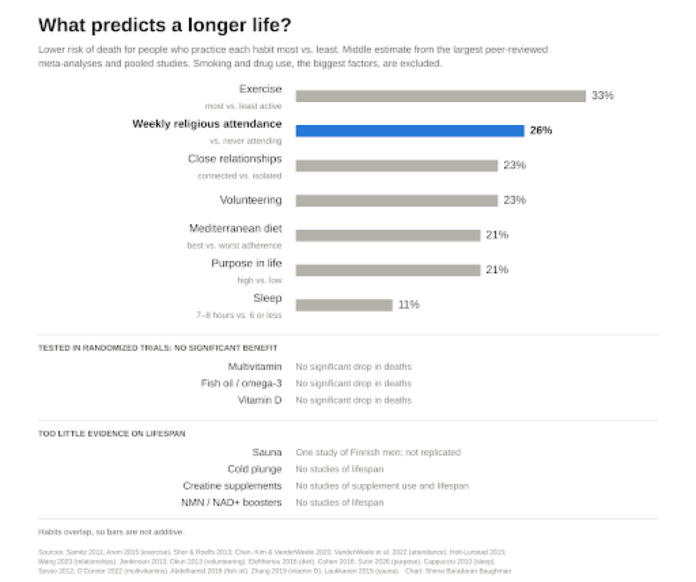
For everything else, we compared each habit the same way, using the largest published meta-analyses of long-term studies: people who practice the habit most versus those who practice it least.
Exercise comes first, linked to roughly a third lower risk of death. Weekly religious attendance comes second, at about 26% lower risk than never attending. Next come close relationships and volunteering at about 23%, then a Mediterranean diet and a strong sense of purpose at about 21%, and good sleep at 11%.
While religious attendance ranks in the top two, none of these wellness articles says a word about it. In the Time piece, a leading longevity scientist says “the most powerful effect is actually from community.” The article never mentions the place where tens of millions of Americans find community every week.
Colleagues at the Wheatley Institute, where we are both fellows, recently reviewed the best research on religion and physical health. In 1,069 studies, for every finding that linked religion to worse health, about seven linked it to better health. And looking at length of life, religion was linked to longer life in 15 studies for every one that found the opposite.
Compare worship with the supplements and cold plunges that fill our social media feeds. Multivitamins and other popular supplements have been tested in randomized trials, but no evidence shows they reduce the risk of death. Even in long-term studies of hundreds of thousands of people, multivitamin users did not live longer. Cold plunges have never been studied for lifespan at all.
A faith community bundles the habits near the top: worship, close relationships, volunteering and purpose.
The benefits of religion grow the more often people attend. In a study of nearly 75,000 nurses followed for 16 years, mortality was 13% lower for occasional attenders, 26% lower for weekly attenders and 33% lower for those who went more than once a week. A national study of older Americans found frequent attenders had 40% lower mortality. Another group — respondents who said religion was “very important” but who did not attend services frequently — did not live longer than average. As one of us has found, belief matters, but the health benefits come to those who show up each week.
However, in a troubling sign for public health, fewer Americans are attending. According to Gallup, fewer than 1 in 3 now attend services weekly or nearly weekly, down from 44% in 1992. Pew’s latest surveys find attendance roughly stable since 2020 after a long decline. We hear a lot about the decline in churchgoing, but almost never that it may be costing us years of life.
Could it be that healthy people are simply the ones able to get to church? Large studies that accounted for people’s prior health still found the link. Would any club do? Sociologists doubt it. As Phil Zuckerman, a sociology professor at Pitzer College, quipped, “A soccer team can’t provide spiritual solace in the face of death.” Social support explained only about a quarter of the link, and weekly attendance beat every other social activity reported. In Europe, joining a religious group was followed by less depression, while joining a political group was followed by more. Community helps, but faith-anchored community helps more.
As with much data about lifestyle, we can’t get the gold standard of scientific rigor: double-blind control group experiments. No one can randomly assign people to go to church. But much of what we know about exercise and diet comes from the same kind of evidence: decades of long-term studies of hundreds of thousands of people. Churchgoers live longer even when compared with people of the same health, income and habits, and the more often people attend, the longer they tend to live. When one of us taught this principle to a group of Yale students, one pupil responded, “Professor, are you implying that if I go to church enough, I might achieve eternal life?” Clever student.
But should you start going to church just to be healthier? The happiness scholar Arthur C. Brooks suggests that people who are unsure start by simply showing up, and author Ross Douthat has argued that even agnostics are better off in church. Sometimes belonging comes before believing. And if we are going to tell people how to live longer, we ought to be accurate about the evidence. It is irrational for more articles to recommend an unproven NAD+ booster than recommend church.
So keep walking. Get your sleep. Eat your vegetables. And this weekend, go to church. It may be the best thing you do for your health all year.
Shima Baradaran Baughman is a professor of law at Brigham Young University Law School. Samuel Wilkinson is an associate professor of psychiatry at Yale and the author of “Purpose: What Evolution and Human Nature Imply About the Meaning of Our Existence.”
More to Read
Disclaimer : This story is auto aggregated by a computer programme and has not been created or edited by DOWNTHENEWS. Publisher: latimes.com